Conflicting Definitions of “Specified” in ID

I see that in the unending TSZ and Jerad Thread Joe has written in response to R0bb

Try to compress the works of Shakespear- CSI. Try to compress any encyclopedia- CSI. Even Stephen C. Meyer says CSI is not amendable to compression.

A protein sequence is not compressable- CSI.

So please reference Dembski and I will find Meyer’s quote

To save Robb the effort.  Using Specification: The Pattern That Signifies Intelligence by William Dembski which is his most recent publication on specification;  turn to page 15 where he discusses the difference between two bit strings (ψR) and (R). (ψR) is the bit stream corresponding to the integers in binary (clearly easily compressible).  (R) to quote Dembksi “cannot, so far as we can tell, be described any more simply than by repeating the sequence”.  He then goes onto explain that (ψR) is an example of a specified string whereas (R) is not.

This conflict between Dembski’s definition of “specified” which he quite explicitly links to low Kolmogorov complexity (see pp 9-12) and others which have the reverse view appears to be a problem which most of the ID community don’t know about and the rest choose to ignore.  I discussed this with Gpuccio a couple of years ago. He at least recognised the conflict and his response was that he didn’t care much what Dembski’s view is – which at least is honest.

Things That IDers Don’t Understand, Part 1 — Intelligent Design is not compatible with the evidence for common descent

Since the time of the Dover trial in 2005, I’ve made a hobby of debating Intelligent Design proponents on the Web, chiefly at the pro-ID website Uncommon Descent. During that time I’ve seen ID proponents make certain mistakes again and again. This is the first of a series of posts in which (as time permits) I’ll point out these common mistakes and the misconceptions that lie behind them.

I encourage IDers to read these posts and, if they disagree, to comment here at TSZ. Unfortunately, dissenters at Uncommon Descent are typically banned or have their comments censored, all for the ‘crime’ of criticizing ID or defending evolution effectively. Most commenters at TSZ, including our blog host Elizabeth Liddle and I, have been banned from UD. Far better to have the discussion here at TSZ where free and open debate is encouraged and comments are not censored.

The first misconception I’ll tackle is a big one: it’s the idea that the evidence for common descent is not a serious threat to ID. As it turns out, ID is not just threatened by the evidence for common descent — it’s literally trillions of times worse than unguided evolution at explaining the evidence. No exaggeration. If you’re skeptical, read on and I’ll explain.

Continue reading

The LCI and Bernoulli’s Principle of Insufficent Reason

(Just found I can post here – I hope it is not a mistake. This is a slightly shortened version of a piece which I have published on my blog. I am sorry it is so long but I struggle to make it any shorter. I am grateful for any comments. I will look at UD for comments as well – but not sure where they would appear.).

I have been rereading Bernoulli’s Principle of Insufficient Reason and Conservation of Information in Computer Search by William Dembski and Robert Marks. It is an important paper for the Intelligent Design movement as Dembski and Marks make liberal use of Bernouilli’s Principle of Insufficient Reason (BPoIR) in their papers on the Law of Conservation of Information (LCI).  For Dembski and Marks BPoIR provides a way of determining the probability of an outcome given no prior knowledge. This is vital to the case for the LCI.

The point of Dembski and Marks paper is to address some fundamental criticisms of BPoIR. For example  J M Keynes (along with with many others) pointed out that the BPoIR does not give a unique result. A well-known example is applying BPoIR to the specific volume of a given substance. If we know nothing about the specific volume then someone could argue using BPoIR that all specific volumes are equally likely. But equally someone could argue using BPoIR all specific densities are equally likely. However, as one is the reciprocal of the other, these two assumptions are incompatible. This is an example based on continuous measurements and Dembski and Marks refer to it in the paper. However, having referred to it, they do not address it. Instead they concentrate on the examples of discrete measurements where they offer a sort of response to Keynes’ objections. What they attempt to prove is a rather limited point about discrete cases such as a pack of cards or protein of a given length. It is hard to write their claim concisely – but I will give it a try.

Imagine you have a search space such as a normal pack of cards and a target such as finding a card which is a spade. Then it is possible to argue by BpoIR that, because all cards are equal, the probability of finding the target with one draw is 0.25. Dembski and Marks attempt to prove that in cases like this that if you decide to do a “some to many” mapping from this search space into another space then you have at best a 50% chance of creating a new search space where BPoIR gives a higher probability of finding a spade. A “some to many” mapping means some different way of viewing the pack of cards so that it is not necessary that all of them are considered and some of them may be considered more often than others. For example, you might take a handful out of the pack at random and then duplicate some of that handful a few times – and then select from what you have created.

There are two problems with this.

1) It does not address Keynes’ objection to BPoIR

2) The proof itself depends on an unjustified use of BPoIR.

But before that a comment on the concept of no prior knowledge.

The Concept of No Prior Knowledge

Dembski and Marks’ case is that BPoIR gives the probability of an outcome when we have no prior knowledge. They stress that this means no prior knowledge of any kind and that it is “easy to take for granted things we have no right to take for granted”.  However, there are deep problems associated with this concept. The act of defining a search space and a target implies prior knowledge. Consider finding a spade in pack of cards. To apply BPoIR at minimum you need to know that a card can be one of four suits, that 25% of the cards have a suit of spades, and that the suit does not affect the chances of that card being selected. The last point is particularly important. BPoIR provides a rationale for claiming that the probability of two or more events are the same. But the events must differ in some respects (even if it is only a difference in when or where they happen) or they would be the same event. To apply BPoIR we have to know (or assume) that these differences are not relevant to the probability of the events happening. We must somehow judge that the suit of the card, the head or tails symbols on the coin, or the choice of DNA base pair is irrelevant to the chances of that card, coin toss or base pair being selected. This is prior knowledge.

In addition the more we try to dispense with assumptions and knowledge about an event then the more difficult it becomes to decide how to apply BPoIR. Another of Keynes’ examples is a bag of 100 black and white balls in an unknown ratio of black to white. Do we assume that all ratios of black to white are equally likely or do we assume that each individual ball is equally likely to be black or white? Either assumption is equally justified by BPoIR but they are incompatible. One results in a uniform probability distribution for the number of white balls from zero to 100; the other results in a binomial distribution which greatly favours roughly equal numbers of black and while balls.

Looking at the problems with the proof in Dembski and Marks’ paper.

The Proof does not Address Keynes’ objection to BPoIR

Even if the proof were valid then it does nothing to show that the assumption of BPoIR is correct. All it would show (if correct) was that if you do not use BPoIR then you have 50% or less chance of improving your chances of finding the target. The fact remains that there are many other assumptions you could make and some of them greatly increase your chances of finding the target. There is nothing in the proof that in anyway justifies assuming BPoIR or giving it any kind of privileged position.

But the problem is even deeper. Keynes’ point was not that there are alternatives to using BPoIR – that’s obvious. His point was that there are different incompatible ways of applying BPoIR. For example, just as with the example of black and white balls above, we might use BPoIR to deduce that all ratios of base pairs in a string of DNA are equally likely. Dembski and Marks do not address this at all. They point out the trap of taking things for granted but fall foul of it themselves.

The Proof Relies on an Unjustified Use of BPoIR

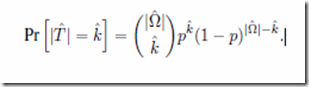
The proof is found in appendix A of the paper and this is the vital line:

image

This is the probability that a new search space created from an old one will include k members which were part of the target in the original search space. The equation holds true if the new search space is created by selecting elements from old search space at random; for example, by picking a random number of cards at random from a pack. It uses BPoIR to justify the assumption that each unique way of picking cards is equally likely. This can be made clearer with an example.

Suppose the original search space comprises just the four DNA bases, one of which is the target. Call them x, y, z and t. Using BPoIR, Dembski and Marks would argue that all of them are equally likely and therefore the probability of finding t with a single search is 0.25. They then consider all the possible ways you might take a subset of that search space. This comprises:

Subsets with

no items

just one item: x,y,z and t

with two items: xy, xz, yz, tx, ty, tz

with three items: xyz, xyt, xzt, yzt

with four items: xyzt

A total of 16 subsets.

Their point is that if you assume each of these subsets is equally likely (so the probability of one of them being selected is 1/16) then 50% of them have a probability of finding t which is greater than or equal to probability in the original search space (i.e. 0.25). To be specific new search spaces where probability of finding t is greater than 0.25 are t, tx, ty, tz, xyt, xzt, yzt and xyzt. That is 8 out of 16 which is 50%.

But what is the justification for assuming each of these subsets are equally likely? Well it requires using BPoIR which the proof is meant to defend. And even if you grant the use of BPoIR Keynes’ concerns apply. There is more than one way to apply BPoIR and not all of them support Dembski and Marks’ proof. Suppose for example the subset was created by the following procedure:

    • Start with one member selected at random as the subset
    • Toss a dice,
      • If it is two or less then stop and use current set as subset
      • If it is a higher than two then add another member selected at random to the subset
    • Continue tossing until dice throw is two or less or all four members in are in subset

This gives a completely different probability distribution.

The probability of:

single item subset (x,y,z, or t) = 0.33/4 = 0.083

double item subset (xy, xz, yz, tx, ty, or tz) = 0.66*0.33/6 = 0.037

triple item subset (xyz, xyt, xzt, or yzt) = 0.66*0.33*0.33/4 = 0.037

four item subset (xyzt) = 0.296

So the combined probability of the subsets where probability of selecting t is ≥ 0.25 (t, tx, ty, tz, xyt, xzt, yzt, xyzt) = 0.083+3*(0.037)+3*(0.037)+0.296 = 0.60 (to 2 dec places) which is bigger than 0.5 as calculated using Dembski and Marks assumptions. In fact using this method, the probability of getting a subset where the probability of selecting t ≥ 0.25 can be made as close to 1 as desired by increasing the probability of adding a member. All of these methods treat all four members of the set equally and are equally justified under BpoIR as Dembski and Marks assumption.

Conclusion

Dembski and Marks paper places great stress on BPoIR being the way to calculate probabilities when there is no prior knowledge. But their proof itself includes prior knowledge. It is doubtful whether it makes sense to eliminate all prior knowledge, but if you attempt to eliminate as much prior knowledge as possible, as Keynes does, then BPoIR proves to be an illusion. It does not give a unique result and some of the results are incompatible with their proof.

Gpuccio’s Theory of Intelligent Design

Gpuccio has made a series of comments at Uncommon Descent and I thought they could form the basis of an opening post. The comments following were copied and pasted from Gpuccio’s comments starting here


To onlooker and to all those who have followed thi discussion:

I will try to express again the procedure to evaluate dFSCI and infer design, referring specifically to Lizzies “experiment”. I will try also to clarify, while I do that, some side aspects that are probably not obvious to all.

Moreover, I will do that a step at a time, in as many posts as nevessary.

So, let’s start with Lizzie’s “experiment”:

Creating CSI with NS
Posted on March 14, 2012 by Elizabeth
Imagine a coin-tossing game. On each turn, players toss a fair coin 500 times. As they do so, they record all runs of heads, so that if they toss H T T H H H T H T T H H H H T T T, they will record: 1, 3, 1, 4, representing the number of heads in each run.

At the end of each round, each player computes the product of their runs-of-heads. The person with the highest product wins.

In addition, there is a House jackpot. Any person whose product exceeds 1060 wins the House jackpot.

There are 2500 possible runs of coin-tosses. However, I’m not sure exactly how many of that vast number of possible series would give a product exceeding 1060. However, if some bright mathematician can work it out for me, we can work out whether a series whose product exceeds 1060 has CSI. My ballpark estimate says it has.

That means, clearly, that if we randomly generate many series of 500 coin-tosses, it is exceedingly unlikely, in the history of the universe, that we will get a product that exceeds 1060.

However, starting with a randomly generated population of, say 100 series, I propose to subject them to random point mutations and natural selection, whereby I will cull the 50 series with the lowest products, and produce “offspring”, with random point mutations from each of the survivors, and repeat this over many generations.

I’ve already reliably got to products exceeding 1058, but it’s

possible that I may have got stuck in a local maximum.

However, before I go further: would an ID proponent like to tell me whether, if I succeed in hitting the jackpot, I have satisfactorily refuted Dembski’s case? And would a mathematician like to check the jackpot?

I’ve done it in MatLab, and will post the script below. Sorry I don’t speak anything more geek-friendly than MatLab (well, a little Java, but MatLab is way easier for this) Continue reading

An Invitation to G Puccio

gpuccio addressed a comment to me at Uncommon Descent. Onlooker, a commenter now unable to post there,

(Added in edit 27/09/2012 – just to clarify, onlooker was banned from threads hosted by “kairosfocus” and can still post at Uncommon Descent in threads not authored by “kairosfocus”)

has expressed an interest in continuing a dialogue with gpuccio and petrushka comments:

By all means let’s have a gpuccio thread.

There are things I’d like to know about his position.

He claims that a non-material designer could insert changes into coding sequences. I’d like to know how that works. How does an entity having no matter or energy interact with matter and energy? Sounds to me like he is saying that A can sometimes equal not A.

He claims that variation is non stochastic and that adaptive adaptations are the result of algorithmic directed mutations. Is that in addition to intervention by non-material designers? How does that work?

What is the evidence that non-stochastic variation exists or that it is even necessary, given the Lenski experiment? Could he cite some evidence from the Lenski experiment that suggests directed mutations? Could he explain why gpuccio sees this and Lenski doesn’t?

It’s been a long time since gpuccio abandoned the discussion at the Mark Frank blog. I’d like to see that continued.

So I copy gpuccio’s comment here and add a few remarks hoping it may stimulate some interesting dialogue. Continue reading

Is ‘Design in Nature’ a Non-Starter?

A row is ready to erupt over two competing notions of ‘design in nature.’ One has been proposed under the auspices of being a natural-physical law. The other continues to clamour for public attention and respectability among natural-physical scientists, engineers and educators, but carries with it obvious religious overtones (Foundation for Thought and Ethics, Wedge Document and Dover trial 2005) and still has not achieved widespread scholarly support after almost 20 years of trying.

One the one hand is the Discovery Institute’s notion of ‘design in nature,’ which is repeated in various forms in the Intelligent Design movement. Here at TSZ many (the majority of?) people are against ID and ID proponents’ views of ‘design in nature.’ The author of this thread is likewise not an ID proponent, not an IDer. On the other hand is Duke University engineering and thermodynamics professor Adrian Bejan’s notion of ‘design in nature’ (Doubleday 2012, co-authored with journalism professor J. Peder Zane), which rejects Intelligent Design theory, but contends that ‘design’ is nevertheless a legitimate natural scientific concept. Apropos another recent thread here at TSZ, Bejan declares that his approach “solves one of the great riddles of science – design without a designer.”

Continue reading

A (repeated) challenge to Upright Biped

Upright Biped,

Before fleeing the discussion in July, you spent months here at TSZ discussing your “Semiotic Theory of ID”. During that time we all struggled with your vague prose, and you were repeatedly asked to clarify your argument and explain its connection to ID. I even summarized your argument no less than three times (!) and asked you to either confirm that my summary was accurate or to amend it accordingly. You failed to do so, and you also repeatedly refused to answer relevant, straightforward questions from other commenters here.

Continue reading

LCI or No LCI, Information Can Appear by Chance

(Preamble: I apologize in advance for cluttering TSZ with these three posts. There are very few people on either side of the debate that actually care about the details of this “conservation of information” stuff, but these posts make good on some claims I made at UD.)

To see that active information can easily be created by chance, even when the LCI holds, we’ll return to the Bertrand’s Box example. Recall that the LCI holds for this example, and all choices are strictly random. Recall further that choosing the GG box gives us 1 bit of active information since it doubles our chance of getting a gold coin. If we conduct 100 trials, we expect to get the GG box about 33 times, which means we expect 33 bits of active information to be generated by nothing but chance.

But before we say QED, we should note a potential objection, namely that we also expect to get SS about 33 times, and each such outcome gives us negative infinity bits of active information. So if we include the SS outcomes in our tally of active information, the total is negative infinity. Be that as it may, the fact remains that in 33 of the trials, 1 bit of information was generated. This fact is not rendered false by the outcomes of other trials, so those 33 trials produced 33 bits of information.

A Free Lunch of Active Info, with a Side of LCI Violations

(Preamble: I apologize in advance for cluttering TSZ with these three posts. There are very few people on either side of the debate that actually care about the details of this “conservation of information” stuff, but these posts make good on some claims I made at UD.)

Given a sample space Ω and a target T ⊆ Ω, Dembski defines the following information measures:

Endogenous information: IS ≡ -log2( P(T) )
Exogenous information: IΩ ≡ -log2( |T|/|Ω| )
Active information: I+ ≡ IΩ – IS = log2( P(T) / |T|/|Ω|)

Active information is supposed to indicate design, but in fact, the amount of active info attributed to a process depends on how we choose to mathematically model that process. We can get as much free active info as we want simply by making certain modeling choices.

Free Active Info via Individuation of Possibilities

Dembski is in the awkward position of having impugned his own information measures before he even invented them. From his book No Free Lunch:

This requires a measure of information that is independent of the procedure used to individuate the possibilities in a reference class. Otherwise the same possibility can be assigned different amounts of information depending on how the other possibilities in the reference class are individuated (thus making the information measure ill-defined).

He used to make this point often. But two of his new information measures, “endogenous information” and “active information”, depend on the procedure used to individuate the possible outcomes, and are therefore ill-defined according to Dembski’s earlier position.

To see how this fact allows arbitrarily high measures of active information, consider how we model the rolling of a six-sided die. We would typically define Ω as the set {1, 2, 3, 4, 5, 6}. If the goal is to roll a number higher than one, then our target T is {2, 3, 4, 5, 6}. The amount of active information I+ is log2(P(T) / (|T|/|Ω|)) = log2((5/6) / (5/6)) = 0 bits.

But we could, instead, define Ω as {1, higher than 1}. In that case, I+ = log2((5/6) / (1/2)) = .7 bits. What we’re modeling hasn’t changed, but we’ve gained active information by making a different modeling choice.

Furthermore, borrowing an example from Dembski, we could distinguish getting a 1 with the die landing on the table from getting a 1 with the die landing on the floor. That is, Ω = { 1 on table, 1 on floor, higher than 1 }. Now I+ = log2((5/6) / (1/3)) = 1.3 bits. And we could keep changing how we individuate outcomes until we get as much active information as we desire.

This may seem like cheating. Maybe if we stipulate that Ω must always be defined the “right” way, then active information will be well-defined, right? But let’s look into another modeling choice that demonstrates that there is no “right” way to define Ω in the EIL framework.

Free Active Info via Inclusion of Possibilities

Again borrowing an example from Dembski, suppose that we know that there’s a buried treasure on the island of Bora Bora, but we have no idea where on the island it is, so all we can do is randomly choose a site to dig. If we want to model this search, it would be natural to define Ω as the set of all possible dig sites on Bora Bora. Our search, then, has zero active information, since it is no more likely to succeed than randomly selecting from Ω (because randomly selecting from Ω is exactly what we’re doing).

But is this the “right” definition of Ω? Dembski asks the question, “how did we know that of all places on earth where the treasure might be hidden, we needed to look on Bora Bora?” Maybe we should define Ω, as Dembski does, to include all of the dry land on earth. In this case, randomly choosing a site on Bora Bora is a high-active-information search, because it is far more likely to succeed than randomly choosing a site from Ω, i.e. the whole earth. Again, we have changed nothing about what is being modeled, but we have gained an enormous amount of active information simply by redefining Ω.

We could also take Dembski’s question further by asking, “how did we know that of all places in the universe, we needed to look on Bora Bora?” Now it seems that we’re being ridiculous. Surely we can take for granted the knowledge that the treasure is on the earth, right? No. Dembski is quite insistent that the zero-active-information baseline must involve no prior information whatsoever:

The “absence of any prior knowledge” required for uniformity conceptually parallels the difficulty of understanding the nothing that physics says existed before the Big Bang. It’s common to picture the universe before the Big Bang is a large black void empty space. No. This is a flawed image. Before the Big Bang there was nothing. A large black void empty space is something. So space must be purged from our visualization. Our next impulse is then, mistakenly, to say, “There was nothing. Then, all of a sudden…” No. That doesn’t work either. All of a sudden presupposes there was time and modern cosmology says that time in our universe was also created at the Big Bang. The concept of nothing must exclude conditions involving time and space. Nothing is conceptually difficult because the idea is so divorced from our experience and familiarity zones.

and further:

The “no prior knowledge” cited in Bernoulli’s PrOIR is all or nothing: we have prior knowledge about the search or we don’t. Active information on the other hand, measures the degree to which prior knowledge can contribute to the solution of a search problem.

To define a search with “no prior knowledge”, we must be careful not to constrain Ω. For example, if Ω consists of permutations, it must contain all permutations:

What search space, for instance, allows for all possible permutations? Most don’t. Yet, insofar as they don’t, it’s because they exhibit structures that constrain the permissible permutations. Such constraints, however, bespeak the addition of active information.

But even if we define Ω to include all permutations of a given ordered set, we’re still constraining Ω, as we’re excluding permutations of other ordered sets. We cannot define Ω without excluding something, so it is impossible to define a search without adding active information.

Active information is always measured relative to a baseline, and there is no baseline that we can call “absolute zero”. We therefore can attribute an arbitrarily large amount of active information to any search simply by choosing a baseline with a sufficiently large Ω.

Returning our six-sided die example, we can take the typical definition of Ω as {1, 2, 3, 4, 5, 6} and add, say, 7 and 8 to the set. Obviously our two additional outcomes each have a probability of zero, but that’s not a problem — probability distributions often include zero-probability elements. Inclusion of these zero-probability outcomes doesn’t change the mean, median, variance, etc. of the distribution, but it does change the amount of active info from 0 to log2((1/6) / (1/8)) = .4 bits (given a target of rolling, say, a one).

Free Violations of the LCI

Given a chain of two searches, the LCI says that the endogenous information of the first search is at least as large as the active information of the second. Since we can model the second search to have arbitrarily large active information, we can always model it such that its active information is larger than the first search’s endogenous information. Thus any chain of searches can be shown to violate the LCI. (We can also model the first search such that its endogenous information is arbitrarily large, so any chain of searches can also be shown to obey the LCI.)

The Law(?) of Conservation of Information

(Preamble: I apologize in advance for cluttering TSZ with these three posts. There are very few people on either side of the debate that actually care about the details of this “conservation of information” stuff, but these posts make good on some claims I made at UD.)

For the past three years Dembski has been promoting his Law of Conservation of Information (LCI), most recently here. The paper he most often promotes is this one, which begins as follows:

Laws of nature are universal in scope, hold with unfailing regularity, and receive support from a wide array of facts and observations. The Law of Conservation of Information (LCI) is such a law.

Dembski hasn’t proven that the LCI is universal, and in fact he claims that it can’t be proven, but he also claims that to date it has always been confirmed. He doesn’t say whether he as actually tried to find counterexamples, but the reality is that they are trivial to come up with. This post demonstrates one very simple counterexample.

Definitions

First we need to clarify Dembski’s terminology. In his LCI math, a search is described by a probability distribution over a sample space Ω. In other words, a search is nothing more than an Ω-valued random variable. Execution of the search consists of a single query, which is simply a realization of the random variable. The search is deemed successful if the realized outcome resides in target T ⊆ Ω. (We must be careful to not read teleology into the terms search, query, and target, despite the terms’ connotations. Obviously, Dembski’s framework must not presuppose teleology if it is to be used to detect design.)

If a search’s parameters depend on the outcome of a preceding search, then the preceding search is a search for a search. It’s this hierarchy of two searches that is the subject of the LCI, which we can state as follows.

Given a search S, we define:

  • q as the probability of S succeeding
  • p2 as the probability that S would succeed if it were a uniform distribution
  • p1 as the probability that a uniformly distributed search-for-a-search would yield a search at least as good as S

The LCI says that p1 ≤ p2/q.

Counterexample

In thinking of a counterexample to the LCI, we should remember that this two-level search hierarchy is nothing more than a chain of two random variables. (Dembski’s search hierarchy is like a Markov chain, except that each transition is from one state space to another, rather than within the same state space.) One of the simplest examples of a chain of random variables is a one-dimensional random walk. Think of a system that periodically changes state, with each state transition represented by a shift to the left or to the right on an state diagram. If we know at a certain point in time that it is in one of, say, three states, namely n-1 or n or n+1, then after the next transition it will be in n-2, n-1, n, n+1, or n+2, as in the following diagram:

Assume that the system is always equally likely to shift left as to shift right, and let the “target” be defined as the center node n. If the state at time t is, say, n-1, then the probability of success q is 1/2. Of the three original states, two (namely n-1 and n+1) yield this probability of success, so p1 is 2/3. Finally, p2 is 1/5 since the target consists of only one of the final five states. The LCI says that p1 ≤ p2/q. Plugging in our numbers for this example, we get 2/3 ≤ (1/5)/(1/2), which is clearly false.

Of course, the LCI does hold under certain conditions. To show that the LCI to biological evolution, Dembski needs to show that his mathematical model of evolution meets those conditions. This model would necessarily include the higher-level search that gave rise to the evolutionary process. As will be shown in the next post, the good news for Dembski is that any process can be modeled such that it obeys the LCI. The bad news is that any process can also be modeled such that it violates the LCI.

Apologies to Kairosfocus and Petrushka

It seems I have given great offence to the commenter, Kairosfocus, at Uncommon Descent with my comment:

I see Kairosfocus is reading comments here.


I can’t tell for sure but is KF owning up to or denying banning mphillips? In case he finds time to read more…

Come on over, KF and, so long as you don’t link to porn and can be succinct enough not to overload the software, you will be very welcome, I’m sure!


I would like first to point out to Kairosfocus that he is mistakenly attributing the comment to Petrushka, a fellow commenter here and elsewhere. I would like to say sorry to Petrushka too for apparently initiating the misdirected criticism she has received.

I am sorry it wasn’t as obvious to Kairosfocus as it was to others that my invitation to post here contained a light-hearted reference to the only (as far as I am aware) IP ban ever meted out at The Skeptical Zone,  received by Joe Gallien in response to his linking a graphically pornographic image here. I hope that clears up any misunderstanding and if Kairosfocus changes his mind about commenting here, I am sure he will find the moderation rules will be adhered to fairly.

KF vs Toronto & Petrushka

Over at UD, KF has started a new thread criticizing Toronto.  He had earlier started a thread criticizing Petrushka.

It would have been nicer if KF had joined here to launch his criticism, instead of taking pot shots from UD where it is my understanding that both Toronto and Petrushka have been banned.

In any case, this is where the two accused can set the record straight by explaining what they actually meant.  Others can join in.  I may add something later.

Let’s keep it polite.  No character attacks.  Let’s stick to clear explanations of positions that KF might have misunderstood.  And let’s remember the rules of The Skeptical Zone and keep it civil.

Open for discussion.

Science and quantification

Barry Arrington has started a new thread over at UD, where he argues that it is perfectly okay if CSI (complex specified information) cannot be quantified.

I responded, in a comment, that he seems to be making the case that CSI is not a scientific concept.  It occurred to me that folk here might want to have a discussion on what is required of a concept, for it to be part of a scientific theory.

It seems to me that, at the very least, the concept has to be defined precisely enough that one can form testable hypotheses.  Moreover, these hypotheses need to be testable by independent researchers, and the tests need to provide some kind of reliability (i.e. reasonable agreement between results obtained by independent researchers).  Perhaps that’s weaker that quantifiable.  However, I think even that weaker requirement is a problem for CSI, as it is currently “defined”.

The topic is open for discussion.

2nd Law of Thermodynamics — an argument Creationists and ID Proponents should NOT use

ID proponents and creationists should not use the 2nd Law of Thermodynamics to support ID. Appropriate for Independence Day in the USA is my declaration of independence and disavowal of 2nd Law arguments in support of ID and creation theory. Any student of statistical mechanics and thermodynamics will likely find Granville Sewell’s argument and similar arguments not consistent with textbook understanding of these subjects, and wrong on many levels. With regrets for my dissent to my colleagues (like my colleague Granville Sewell) and friends in the ID and creationist communities, I offer this essay. I do so because to avoid saying anything would be a disservice to the ID and creationist community of which I am a part.

I’ve said it before, and I’ll say it again, I don’t think Granville Sewell 2nd law arguments are correct. An author of the founding book of ID, Mystery of Life’s Origin, agrees with me:

“Strictly speaking, the earth is an open system, and thus the Second Law of Thermodynamics cannot be used to preclude a naturalistic origin of life.”

Walter Bradley
Thermodynamics and the Origin of Life

Continue reading

New categories and menu item

I’ve added a menu item called “Old but Active” where you can find threads that are still creating discussion but which have dropped off the front page.

I’ve also added two new categories, one for Upright Biped’s Semiotic Argument for ID and one for Granville Sewell’s (or anyone else’s) ideas about the 2nd Law of Thermodynamics.

I hope this will make things easier to find.  The search engine actually works fairly well, though.

James Barham on Mary Jane West-Eberhard and teleology

UD has featured a post by James Barham on the work of Mary Jane  West-Eberhard.  I shall be questioning Barham’s conclusions.

Unlike the subject of my previous column in this series, James A. Shapiro, she does not present her ideas as revolutionary or as a mortal threat to the Darwinian worldview.

In my opinion (as a non-biologist), she is entirely correct about that.

And yet, I shall argue that West-Eberhard—who is a researcher at the Smithsonian Tropical Research Institute in Panama, as well as a professor of biology at the University of Costa Rica—has made a foudational contribution to a new and revolutionary approach to evolutionary theorizing that bids fair (whatever her expressed intentions) to turn mainstream Darwinism on its head.

Perhaps it challenges the strawman version of Darwinism that creationists and ID proponents love to criticize.  But I don’t see it as any challenge at all to Darwinism. Continue reading