Here is a pattern:
It’s a gray-scale image, so it is just one 2D matrix. Here is a text file containing the matrix:
I would like to know whether it has CSI or not. Here is Dembski’s paper, in which he gives the formula:
Here is a pattern:
It’s a gray-scale image, so it is just one 2D matrix. Here is a text file containing the matrix:
I would like to know whether it has CSI or not. Here is Dembski’s paper, in which he gives the formula:
I recently bumped a post by keiths: Things That IDers Don’t Understand, Part 1 — Intelligent Design is not compatible with the evidence for common descent as it had come up in a recent discussion. Vjtorley has responded on UD with a post called Is Darwinism a better explanation of life than Intelligent Design?
I’ve unbumped keiths’ post, as the thread was getting rather long, and in any case, it would be good to respond to vjtorley, who is, of course, very welcome to come over here in purpose. I like Dr Torley, and do hope he will drop by, but in any case, the loudhailer seems to work reasonably well!
Feel free to continue the discussion that had been renewed on keiths’ post in this one (or on the old one if you like, using the link).
It has struck me more than once that a lot of the confusion that accompanies discussions about stuff like consciousness and free will, and intelligent design, and teleology, even the explanatory filter, and the words “chance” and “random” arises from lack of clarity over the difference between decision-making and intention. I think it’s useful to separate them, especially given the tendency for people, especially those making pro-ID arguments, but also those making ghost-in-the-machine consciousness or free will arguments, to regard “random” as meaning “unintentional”. Informed decisions are not random. Not all informed decisions involve intention.
This was my first computer:

It was called Dr Nim. It was a computer game, but completely mechanical – no batteries required. You had to beat Dr Nim, by not being the one left with the last marble, and you took turns with Dr Nim (the plastic board). It was possible to beat Dr Nim, but usually Dr Nim won.
Not a hack this time, but temporary loss of the domain name, for some reason I have yet to fathom.
Hope you all got some fresh air 🙂
Over at UD, Salvador Cordova criticizes a statement by Jerry Coyne that appeared in a USA Today column:
So if we don’t have free will, what can we do? One possibility is to give in to a despairing nihilism and just stop doing anything. But that’s impossible, for our feeling of personal agency is so overwhelming that we have no choice but to pretend that we do choose, and get on with our lives.
There are a lot of problems with Cordova’s post (which we can address in the comments), but I do agree that Coyne’s statement is problematic and warrants criticism. Ironically, Coyne’s misunderstanding is shared by many ID proponents — hence the title of this post.
… I wonder if I could interest you in a little thought experiment, in the form of four simple questions:
1. Is it possible that we could discover an artifact on Mars that would prove the existence of extraterrestrials, without the presence or remains of the extraterrestrials themselves?
2. If yes, exactly what kind of artifact would suffice? Car? House? Writing? Complex device? Take your pick.
3. Explain rationally why the existence of this artifact would convince you of the existence of extraterrestrials.
4. Would that explanation be scientifically sound?
I would assert the following:
a. If you answer “Yes” to Question 4, then to deny ID is valid scientific methodology is nothing short of doublethink. You are saying that a rule that holds on Mars does not hold on Earth. How can that be right?
b. If you can answer Question 3 while answering “No” to Question 4, then you are admitting that methodological naturalism/materialism is not always a reliable source of truth.
c. If you support the idea that methodological naturalism/materialism is equivalent to rational thought, then you are obligated to answer “No” to Question 1.
Well, I can never resist a thought experiment, and this one seems quite enlightening….
Cornelius Hunter has a particularly odd post up, called: More Warfare Thesis Lies, This Time From CNN. He takes issue with a report by Florence Davey-Attlee, on Vatican seeks to rebrand its relationship with science. His complaint is that it promotes what he calls “the false Warfare Thesis, which pits religion against science” and “is too powerful and alluring to allow the truth to get in the way”. He writes:
The key to a good lie is to leverage the truth as much as possible. In this instance, we have two truths juxtaposed to make a lie. You see Bruno did argue for an infinite universe, and he was burned at the stake. But those are two distinct and separate facts. The implication is that the Church burned Bruno at the stake because of his scientific investigations about the universe—a perfect example of the Warfare Thesis.
I consider the following to be a “work in progress,” and will make changes as others here contribute corrections and suggestions.
The so-called “mind-body problem”, as bequeathed to us by Descartes, has invited various solutions over the centuries. In the classical version, the basic positions were dualism, materialism, and idealism — each of which has its sub-varieties.
What is meant by “mind”? Well, there are characteristically mental phenomena have been presented as candidates for what is essential to mindedness: rationality, intentionality, subjectivity, volition, or consciousness. (That these don’t all overlap can be seen by asking, “are there unconscious mental states or processes?”, “what sorts of minds do non-rational animals have?” “are there purely qualitative, non-intentional mental states, e.g. pains?” and so on.)
At UD, Vincent Torley links to an odd little paper by William Lycan, a philosopher at the University of North Carolina, entitled Giving Dualism Its Due.
The abstract reads:
Despite the current resurgence of modest forms of mind-body dualism, traditional Cartesian immaterial-substance dualism has few if any defenders. This paper argues that no convincing case has been against substance dualism, and that standard objections to it can be credibly answered.
Simplistic combinatorial analyses are an honoured tradition in anti-evolutionary circles. Hoyle’s is the archetype of the combinatorial approach, and he gets a whole fallacy named after him for his trouble. The approach will be familiar – a string of length n composed of v different kinds of subunit is one point in a permutation space containing vn points in total. The chance of hitting any given sequence in one step, such as the one you have selected as ‘target’, is the reciprocal of that number. Exponentiation being the powerful tool it is, it takes only a little work with a calculator to assess the permutations available to the biological polymers DNA and protein and come up with some implausibly large numbers and conclude that Life – and, if you are feeling bold, evolution – is impossible.
Dryden, Thomson and White of Edinburgh University’s Chemistry department argue in this 2008 paper that not only is the combinatorial space of the canonical 20 L-acids much smaller than simplistically assumed, but more surprisingly, that it is sufficiently small to have been explored completely during the history of life on earth. Continue reading
[23rd May, 2013 As Kairosfocus continues to reiterate his objections to the views I express in this post, I am taking the opportunity today to clarify my own position:
I will move this post to the sandbox shortly, but as I am banned from UD, and therefore cannot respond to this in the place where it was issued, I am doing so here. Kairosfocus writes:
Aplologies straight away for clogging up such an excellent site with this old chestnut but in the light of GEM (Kairosfocus) having apparently directing a long OP at me over some exchanges in an earlier thread, and as Kairosfocus has closed comments I feel I ought to take an opportunity to respond here. I’ll put everything else below the fold.
I here present a number of theses, each of which deserves an independent argument in support of it, but which I think are both true and defensible:
(1) The resistance to Darwinism as expressed by creationism and by intelligent design largely arises from treating “Darwinism” as a scapegoat for the social ills produced by capitalism. It has become commonplace among creationist and other anti-Darwinists to blame Darwinism for any and all of the following: eugenics, acceptance of homosexuality, sexual promiscuity, genocide, school shootings, abortion, and decline of ecclesiastical authority.
(2) Though the obsession with sexuality and anxiety about the ambiguity of embodiment are standard-fare among the religious far-right, my interest here lies in what it is about contemporary presentations of Darwinism that make it such a tempting target for these anxieties.

When I started this site, I had been struck by the remarkable symmetry between the objections raised by ID proponents to evolution, and the objections raised by ID opponents to ID – both “sides” seemed to think that the other side was motivated by fear of breaking ranks; fear of institutional expulsion; fear of facing up to the consequences of finding themselves mistaken; not understanding the other’s position adequately; blinkered by what they want, ideologically, to be true, etc. Insulting characterisations are hurled freely in both directions. Those symmetries remain, as does the purpose of this site, which is to try to drill past those symmetrical prejudices to reach the mother-lode of genuine difference.
But two asymmetries now stand out to me:
At Evolution News and Views, David Klinghoffer presents a challenge:
Man needs meaning. We crave it, especially when faced with adversity. I challenge any Darwinist readers to write some comments down that would be suitable, not laughable, in the context of speaking to people who have lived through an event like Monday’s bombing. By all means, let me know what you come up with.
Leaving aside Klinghoffer’s conflation of “Darwinism” with atheism, and reading it as a challenge for those of us who do not believe in a supernatural deity or an afterlife (which would include me), and despite lacking the eloquence of the speakers Klinghoffer refers to, let me offer some thoughts, not on Monday’s bombing, specifically, but on violent death in general, which probably touches us all, at some time. Too many lives end far too soon:
We have one life, and it is precious, and the lives of those we love are more precious to us than our own. Even timely death leaves a void in the lives of those left, but the gap left by violent death is ragged, the raw end of hopes and plans and dreams and possibilities. Death is the end of options, and violent death is the smashing of those options; Death itself has no meaning. But our lives and actions have meaning. We mean things, we do things, we act with intention, and our acts ripple onwards, changing the courses of other lives, as our lives are changed in return. And more powerful than the ripples of evil acts are acts of love, kindness, generosity, and imagination. Like the butterfly in Peking that can cause a hurricane in New York, a child’s smile can outlive us all. Good acts are not undone by death, even violent death. We have one life, and it is precious, and no act of violence can destroy its worth.
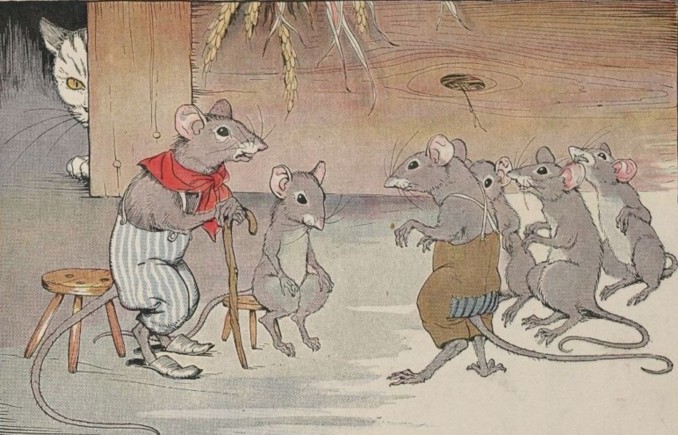
The Mice once called a meeting to decide on a plan to free themselves of their enemy, the Cat. At least they wished to find some way of knowing when she was coming, so they might have time to run away. Indeed, something had to be done, for they lived in such constant fear of her claws that they hardly dared stir from their dens by night or day. Many plans were discussed, but none of them was thought good enough. At last a very young Mouse got up and said: “I have a plan that seems very simple, but I know it will be successful. All we have to do is to hang a bell about the Cat’s neck. When we hear the bell ringing we will know immediately that our enemy is coming.” All the Mice were much surprised that they had not thought of such a plan before. But in the midst of the rejoicing over their good fortune, an old Mouse arose and said: “I will say that the plan of the young Mouse is very good. But let me ask one question: Who will bell the Cat?”
More heat than light seems to me to be generated by the demand for IDists to “define CSI” and the equations that are fired back in response. Nobody is disputing that we have plenty of equations. Here is that bright young mouse, Dembski’s:
χ= –log2[10120 · φS(T)·P(T|H)]
The problem seems to me to lie in Belling the Cat.
Andre poses some interesting questions to Nick Matzke. I thought I’d start a thread that might help him find some answers. I’ll have first go :
Hi Nick
Yes please can we get a textbook on Macro-evolution’s facts!
I’ll make it easy for you;
1.) I want to see a step by step process of the evolution of the lung system.
Google Scholar: evolution of the lung sarcopterygian
Right now, for some bizarre reason (I have no idea how the topic relates to Intelligent Design), Uncommon Descent (“serving the Intelligent Design Community”) has an OP by Barry Arrington presented “without comment”, and consisting entirely of an image of Margaret Sanger, founder of Planned Parenthood, next to a sickening piece of racist text, which is attributed to her.
It turns out (h/t to various members here) that this quotation is widely attributed to Margaret Sanger on the web, usually to the Birth Control Review, April 1933, No such words are found in that journal – indeed, no article by Margaret Sanger appears in that journal that I can find. Another reference gives it as Birth Control Review, October 1926. Well, I can’t find it there either.
In other words, this calumny has been passed around the web, with faux “authoritative” citations, with nobody bothering to check the primary source, which is, in fact, easy to check.
Some folk might be having problems trying to login to the site. I don’t know much about this, but here’s what I do know:
In case you are wondering how I managed to post this – I was actually logged in with two different browsers. My login with “firefox” (my preferred browser) has expired. My login with “rekonq” has not yet expired. I think it has another week to go. So I am posting this from “rekonq”.
DennisJones at UncommonDescent has published an argument that Behe’s irreducible complexity has resisted all attempts at refutation.
…The only logic fallacy would be to draw a conclusion while resisting further examination. Such is not the case with irreducible complexity. The hypothesis has endured 17 years of laboratory research by molecular biologists, and the research continues to this very day.
An irreducibly complex system is one that
(a) the removal of a protein renders the molecular machine inoperable, and
(b) the biochemical structure has no stepwise evolutionary pathway.Here’s how one would set up examination by using gene knockout, reverse engineering, study of homology, and genome sequencing:
I. To CONFIRM Irreducible Complexity:
Show:
1. The molecular machine fails to operate upon the removal of a protein.
AND,
2. The biochemical structure has no evolutionary precursor.
II. To FALSIFY Irreducible Complexity:
Show:
1. The molecular machine still functions upon loss of a protein.
OR,
2. The biochemical structure DOES have an evolutionary pathway
My (limited) understanding is that (1) will nearly always be confirmed.
The problem is confirming (2), the assertion that there is no evolutionary pathway.