
The conversion (or more correctly, reversion) of former agnostic Joe Schmid to Catholicism last month was motivated principally by what Schmid views as overwhelming evidence for the occurrence of miracles which, he argues, vindicate Catholic doctrinal claims. Now, Schmid readily acknowledges that miracle claims won’t impress an avowed naturalist – which is why he created a seven-hour video presenting a cumulative case for theism, thereby establishing at least the possibility of miraculous events occurring. In this post, I won’t be discussing Schmid’s case for theism, which I view as a theological curate’s egg: good in parts (and bad in others). Instead, I’ll be focusing on the miracles Schmid cites to bolster his case for Catholicism. Can they prove his case, and how well do they stack up? Because I was raised in the faith Schmid has returned to, I’ve done a lot of research on the miracles he discusses, and I’ve put together some good links which readers may find helpful.
Joe Schmid makes his case for God’s existence in a 7-hour video, titled, The BEST EVER Cumulative Case for God. See here for a 12-hour critical review of Schmid’s arguments for theism by Nathan Ormond (Digital Gnosis) and James Fodor. My own view is that Ormond and Fodor effectively refute the argument from psycho-physical harmony and the fine-tuning argument, but fail to adequately address the argument from beauty. There are, of course, many other powerful arguments for God’s existence. Schmid, for his part, makes a rather weak response to the atheistic argument from evil, in my opinion: he needs to give a better account of why God allows horrendous evils. That’s all I wish to say on Schmid’s case for theism.
Can miracles be used to argue for the truth of a particular religion, such as Catholicism?
Christian author Glen Scrivener has posted an excellent two-hour Youtube video in response to Joe Schmid, from a Protestant perspective: I Watched 25+ Hours of Joe Schmid—I Have Thoughts.
Derek Lambert of Mythvision has also put up a one-hour video, titled, Joe Schmid’s 20-hour Miracle Case Dies in One Verse, pointing out that the Hebrew Bible itself repeatedly declares that God sometimes sends fake miracles and lying spirits to test the loyalty of his followers. Also, the New Testament declares that there will be false miracles (signs and wonders) that will deceive, if possible, even the elect (Mt 24:24), and that Satan disguises himself as an angel of light (2 Cor 13:14). Hence no miracle can be treated as vindicating a religious doctrine.
How well do Catholic miracle claims stack up?
For the benefit of readers, I’ll mention that an ex-Catholic YouTuber who calls himself Kevin NonTradiCath has created a website debunking many popular Catholic miracles. I should also note that Catholics are not required to believe in any of these miracles, as they relate to private revelations; in approving them, the Church merely declares them worthy of belief. In this post, I’ll examine the following alleged Catholic miracles:
1. Padre Pio
2. The Lourdes miracles and the visions of St. Bernadette
3. Our Lady of Fatima
4. Our Lady of Guadeloupe
5. St. Catherine Laboure and the Miraculous Medal
6. The levitating saint: St. Joseph of Cupertino/Copertino
7. The Miracle of Calanda (in which God grew back an amputee’s leg)
8. Eucharistic miracles: Lanciano, Buenos Aires and Tixtla
9. Incorrupt bodies of Catholic saints
10. The Shroud of Turin
11. Exorcisms: Are demons real?
I haven’t included Our Lady of Zeitoun (Egypt) on this list because it is not a Catholic miracle (the apparitions took place on top of a Coptic church), not everyone saw a lady on top of the church (some simply saw a light), and the apparition did not speak, let alone confirm the truth of any religious claim.
1. Padre Pio
Kevin NonTradiCath has put up a Youtube video titled, St Padre Pio, or, a Case Study in Catholic Cults of Personality, debunking Padre Pio’s alleged miracles (stigmata, healings and bilocation), but clearing him of allegations of impropriety.
2. The Lourdes miracles and the visions of St. Bernadette
Kevin NonTradiCath has created an informative video titled, Our Lady of Lourdes, St. Bernadette Soubirous, Forest Fairies, Medical Malpractice & Pseudoscience, debunking the visions of St. Bernadette and the cures at Lourdes.
3. Our Lady of Fatima
By far the best critical article I have seen on the miracle of Fatima is one by the B.A. psychology graduate Evan Harkness-Murphy, over at her blog The Magpie: “Your Lady of Fatima – A Response to Ethan Muse” (September 13, 2025).
See also James Fodor’s in-depth discussion of the Fatima apparitions, titled, A Skeptical Analysis of the 1917 Marian Apparitions and Miracle of the Sun (very detailed: two hours long).
See also the article, “Fatima Miracle Claims All Wet” by Benjamin Radford in The Skeptical Inquirer, Vol 43 no. 3 (May/June 2019), questioning whether the witnesses to the solar miracle at Fatima were really soaking wet and whether their clothes miraculously dried in the space of a few minutes, as popularly claimed by Fatima devotees.
See, in addition, the article, “Did photos of the 1917 Miracle of the Sun at Fatima prove the sun was at an impossible place in the sky?” at the EukaryoteWrites blog, critiquing recent claims made by the priest Dr. Phillipe Dalleur (who’s cited on Joe Schmid’s video), on the basis of his interpretation of photos of the crowd at Fatima, that the solar miracle was actually caused by a second body in the sky, not the Sun. See here for Dalleur’s original article making the claims.
Kevin NonTradiCath has also made a highly informative video titled, The miracle of the sun at Fatima in 1917 was a natural event, not a miracle. Here is why, reviewing Fr. Stanley Jaki’s book, “God and the Sun at Fatima”, which invokes providentially-timed atmospheric ice crystals to explain the solar phenomena observed at Fatima. Kevin writes: “If you want to skip to to my favorite part, jump to the last chapter of the video, starting at 48:22. That is where I compare all the eyewitness testimony from Fatima to the sun miracle at Medjugorje caught on camera. I think that we can use that footage from Medjugorje in 2023 to try to make sense of the eyewitness testimony from Fatima, over 100 years earlier, in 1917.”
See also the following scientific article from 2003: “Apparitions and Miracles of the Sun” by Dr. Auguste Meessen, Institute of Physics, Catholic University of Louvain, B-1348, Louvain-la-Neuve, Belgium. “Abstract: Apparitions are subjective experiences, but can be accompanied by “miracles of the sun”, observed and described by numerous witnesses. An extensive study of these phenomena reveals a set of characteristic features, suggesting the existence of an underlying mechanism. It is shown that the hypothesis of an extraterrestrial intervention is not sufficient to explain all observed facts, while this is possible in terms of natural, but very peculiar physiological processes. The proof results from personal experiments and reasoning, based on relevant scientific literature. Apparitions are more complex experiences, but the content of the “messages” raises theological problems. Moreover, it is necessary to relate these “mystical experiences” to new insights in psychological processes that involve altered states of consciousness. This subject calls urgently for continued, rigorous and responsible research.”
Please note also that the children’s descriptions of the apparition shifted over time. In the earliest 1917 interviews, the entity was described as a tiny, one-meter-tall girl wearing a short skirt, which heavily conflicted with the traditional, majestic Catholic depictions of the Virgin Mary popularized later.
Regarding the alleged prophecies made by the seers at Fatima, Kevin NonTradiCath has made a video titled, “The more you learn about the Miracle of Fatima, the less impressive it seems”. The video debunks three popular Catholic claims about Our Lady of Fatima: that she predicted the deaths of the visionaries Francisco and Jacinta (false: the earliest record of this alleged prediction is from 1927, more than seven years after their deaths); that she predicted the end of World War I and the beginning of World War II (also false: the earliest record of the prediction about WWII comes from a memoir Lucia wrote in 1941, two years after the outbreak of WWII); and that everybody at Fatima saw the Miracle of the Sun (false: we have records of people who were there and who saw nothing, and the number of recorded testimonies of people who saw the miracle comes to no more than a few dozen, despite the fact that at least 30,000 people are supposed to have been present, and we also have records of educated people who not only saw nothing but who were present at Fatima with several other friends or acquaintances who saw nothing, but who noted that less educated people witnessed the phenomenon).
Kevin Nontradicath has also created a video titled, Retconning Fatima: How Lucia Updated a Prophecy of Fatima about the End of World War I. Kevin NonTradiCath argues that Lucia herself was a fraud because of a failed prophecy she made and later retconned. Lucia said Our Lady told her to wait at the Cova da Iria (the site of the apparitions) because the Portuguese soldiers fighting in World War I would be returning soon, but actually the war didn’t end for another year. Lucia changed the prophecy in her 1941 memoir. Also, Lucia herself never saw the miracle of the sun on October 13th, 1917. Finally, the sign from God that she was referring to seems to have been the end of the war, rather than the solar miracle.
Kevin NonTradiCath has created another video, titled, Jacinta can’t save Lucia’s failed prophecy: A case against the Conditional Prophecy Defense. Note: this “conditional interpretation” is the defense that Joe Schmid leans on, in his online apologia, where he argues that what Our Lady really meant was that that IF people repented, the war would end today.
4. Our Lady of Guadeloupe
Kevin NonTradiCath has made a highly informative video titled, Juan Diego’s Tilma – An Examination of Six Common Claims about the legend of Our Lady of Guadeloupe.
5. The Miraculous Medal of St. Catherine Laboure
Kevin NonTradiCath, in his video, The Miraculous Medal, or, How to Eat Relics to Induce Marian Apparitions, argues that the Miraculous Medal is a pious fraud; curiously, Sister Catherine Laboure completely forgot about her visions of Our Lady for several years. Even more strangely, she declares that it was eating some clothes which had belonged to a Catholic saint that caused her to have visions of Our Lady!
6. The levitating saint: St. Joseph of Cupertino/Copertino
The well-attested miracle of the seventeenth-century flying friar, St. Joseph of Cupertino, is debunked by skeptic Joe Nickell in his article, “Secrets of ‘The Flying Friar’: Did St. Joseph of Copertino Really Levitate?” in The Skeptical Inquirer, Volume 42, No. 4 (July / August 2018). Here’s an AI overview of the article: Joe Nickell’s connection to Cupertino refers to his skeptical investigation of Saint Joseph of Cupertino (1603–1663), the 17th-century Italian Franciscan friar widely known in Catholic tradition as “The Flying Friar” due to numerous accounts of his ecstatic levitations. As a world-renowned professional paranormal investigator and skeptic, Nickell analyzed the historical claims of the friar’s flights — such as soaring to the high altar or carrying a heavy cross through the air — and published his findings in a detailed critique for the Skeptical Inquirer. Nickell’s Core Findings on the “Flying Friar”:
Rather than accepting the levitations as genuine miracles, Nickell attributed the accounts to a mix of natural human abilities, stagecraft, and severe historical distortion:
“Gross Exaggeration” in Biographies: Nickell pointed out that the primary biographical sources documenting these feats were published more than half a century after Joseph’s death. Over decades, oral traditions and legends heavily distorted the original events.
The Nature of the “Flights”: Historical records indicate that Joseph’s “levitations” often began with a loud shriek followed by a leap. Nickell noted that these incidents were better explained as energetic jumps or bounds rather than true floating. Observers, swept up in religious ecstasy and viewing him from below in dimly lit churches, easily misperceived these leaps as supernatural levitation.
Lack of Primary Evidence: The original sworn records used during the early stages of his canonization process are no longer available for independent scientific study, leaving investigators to rely on heavily biased second-hand accounts. Another, fairly balanced article on St. Joseph of Cupertino can be found here, on the Historical Blindness blog.
7. The Miracle of Calanda (in which God is said to have miraculously grown back the leg of an amputee named Miguel Pellicer, from Calanda, Spain, whose leg was surgically amputated in 1637, but allegedly grew back instantly in 1640)
The best take-down of this alleged miracle is Brian Dunning’s Skeptoid podcast, Miracle of Calanda. There’s also an excellent update on the original article, responding to Catholic critics and demonstrating that no doctor at the 1640 miracle trial ever testified that he’d personally amputated Miguel’s leg, casting doubt on claims that it had ever been amputated in the first place.
Here’s an excerpt from an AI-generated summary of the skeptical case against the miracle of Calanda:
Background and Claims The Event: In 1640, a Spanish peasant named Miguel Pellicer claimed his right leg—amputated two and a half years prior after a cart accident—miraculously regrew.
The Investigation: Local church and secular authorities, including a legal tribunal and the Inquisition, investigated the case and declared it a genuine miracle in 1641. Unlike many religious legends that develop centuries later, the documentation for Calanda began within days.
The Notarial Act (April 1, 1640): Just three days after the event, a local royal notary named Miguel Andreu and the parish priest travelled to Calanda. They recorded sworn statements from 10 eyewitnesses (including local officials and family members) who testified they saw Miguel with only one leg right before the event, and two legs right after.
The Canonical Process (June 1640 – April 1641): The Archbishop of Zaragoza, Pedro Apaolaza Ramírez, initiated a formal court to rigorously cross-examine the claims. Over nearly a year, 24 official witnesses gave testimony under oath.
The Hospital Staff Testimony: Crucially, the court called forward the professional secular staff from the General Hospital of Zaragoza where Miguel’s leg was treated. This included Juan de Estanga (the surgeon who ordered the amputation), Diego Millaruelo (the assistant surgeon who cut it off), and the hospital priest who buried the severed leg in the cemetery. The original manuscript — Copia literal y auténtica del proceso — remains preserved in the Zaragoza cathedral archives. It concludes with the Archbishop’s official ruling on April 27, 1641, declaring the limb restoration explicitly “wonderful and miraculous.”
Skeptical View: Critics argue that 17th-century investigations lacked modern scientific rigor, and extraordinary claims from the past rely entirely on anecdotal and biased testimony. While the 1640–1641 legal investigation by the Archbishop of Zaragoza looks incredibly thorough on paper, modern historians and critical researchers have identified several significant cracks, omissions, and systemic biases in the process. When evaluated by modern judicial or investigative standards, the “ironclad” legal record begins to show major vulnerabilities.
(i) The Complete Lack of Cross-Examination In a modern court, a witness’s claims are tested by a skeptical defense attorney who looks for contradictions.
The Crack: The Canonical Process was entirely one-sided. The tribunal was not trying to find a fraud; they were trying to validate a miracle to boost Catholic morale during the Counter-Reformation.
The Reality: Every single one of the 24 witnesses was a devout Catholic, and many stood to gain status, fame, or religious validation from the event. None of the witnesses were cross-examined aggressively, nor were they asked questions that might expose a hoax, such as whether they had ever closely examined Miguel’s “stump” without its bandages.
(ii) The Timeline Discrepancy (The Missing Two Years) The legal documents heavily rely on the testimony of the hospital staff in Zaragoza to prove the leg was actually amputated. However, a major chronological gap exists between the hospital and the miracle.
The Crack: The amputation took place in late 1637. The “miracle” occurred in March 1640.
The Reality: For over two full years between these events, Miguel was not living in the hospital. He was traveling the country as a wandering beggar. The Zaragoza hospital staff had not seen Miguel for years before he suddenly showed up in Calanda claiming his leg grew back. They could only testify to what they did in 1637, not to what Miguel’s leg looked like in the days or weeks leading up to the night of March 29, 1640.
(iii) The Power of “Social and Religious Pressure” Calanda was a small, deeply religious village. Once the rumor of a miracle exploded, it became socially dangerous to deny it.
The Crack: Local officials—including the notary Miguel Andreu, who arrived just three days later—were under immense pressure to confirm the event.
The Reality: If a local villager had suspected Miguel was a fraud who had simply unbound a hidden leg, speaking out would mean accusing their neighbors, the local priests, and eventually the Archbishop of lying. In 17th-century Spain, challenging a declared miracle could easily result in being investigated by the Inquisition for heresy or witchcraft. This created a powerful incentive for total conformity among the witnesses.
(iv) No Physical or Forensics Inspection of the “Regrown” Leg For an event centered entirely on a physical body part, the tribunal’s examination of the leg itself was remarkably superficial.
The Crack: The court relied almost purely on visual testimony (“we saw two legs where there used to be one”) rather than an objective physical or medical evaluation.
The Reality: No independent, outside physicians were brought in to physically manipulate the leg, test its bone structure, or verify if the “amputation scars” were genuine or merely skin blemishes. The court notes that the leg was pale, small, and weak at first — which perfectly matches what a leg looks like after being tightly bound and immobilized against a thigh for two years to fake an injury.
(v) The Disappearance of Key Records While the final summary document (the Proceso) survives, the actual raw investigative notes, daily logs, and initial interviews are missing.
The Crack: Historians pointing out cracks in the case note that we only have the “polished,” final version of the events compiled by the Church authorities.
The Reality: Any early contradictions, hesitant witnesses, or dissenting opinions that occurred during the year-long trial were completely scrubbed from the final official narrative to present a flawless, unanimous front to the public.
8. Eucharistic miracles: Lanciano, Buenos Aires, Tixtla and Sokolka
Cinematographer Cade Bradley interviews Kevin NonTradiCath on the shoddy science behind Eucharistic miracles, in his video, Eucharistic Miracles Are FAKE – The ‘Science’ Is Way Worse Than You’ve Been Told.
Surprisingly, the best critiques of Eucharistic miracles have come from Christians: from Dr. Maxime Georgel (a Protestant who acknowledges the reality of miracles) and from Catholic scientists Stacy Trasancos and Kelly Kearse.
(a) The Eucharistic Miracle of Lanciano, Italy
First, here’s Catholic apologist Ethan Muse’s video arguing for the reality of the Miracle of Lanciano: If You’re Skeptical of Eucharistic Miracles, You Need to See This. (At 22:00, interviewer Matt Fradd puts forward a conspiracy theory suggesting that the actual piece of flesh that’s currently preserved in the Host at Lanciano may not be centuries old, but may date back to only 1970. Muse responds to this conspiracy theory.) There are several high-quality videos and online essays critiquing the miracle of Lanciano. The most in-depth response is the Response to Ethan Muse On the Alleged Eucharistic Miracle of Lanciano by Dr. Maxime Georgel (July 28, 2026), which has been translated to English and reproduced over at Javier Perdomo’s substack. Dr. Georgel makes a point-by-point reply to Muse, arguing that in order to prove a miracle, it has to be shown that the flesh and blood on display at Lanciano is human flesh and blood, that it was once a consecrated host, that its preservation across the centuries is miraculous, and that we can rule out fraud. Dr. Georgel regards each of these claims as questionable.
“The fake Lanciano WHO report” by Catholic chemist Dr. Stacy Trasancos, is a pretty devastating expose of the oft-repeated apologetic assertion that a WHO report backed the claims made in 1971 by a Catholic doctor regarding the alleged presence of flesh in the Host at Lanciano. (Incidentally, you can also read my article, “Catholic Eucharistic miracles debunked by Catholic chemist Dr. Stacy Trasancos” at The Skeptical Zone.)
See also the article, “Exaggerations and Eucharistic Miracles” by Stacy Trasancos, in Crisis magazine. This article discusses the work of Catholic science teacher Kelly Kearse, exposing Eucharistic miracles and showing that bacteria can duplicate many of the results.
Kelly Kearse has recently written a PubMed paper titled, “Scientific analysis of shared AB blood type among relics and eucharistic miracles: A reply to Franco Serafini’s commentary” (Forensic Sci Med Pathol. 2026). See also his Youtube video, “Scientific Analysis of Eucharistic Miracles” (11 July 2025), a 33-minute talk given to the Society of Catholic Scientists at the Catholic University of America, in which Dr. Kearse shows that non-consecrated wafers placed in water for 7 to 10 days display reddish stains, suggests that fungal DNA may account for the reddish stains commonly found on hosts in Eucharistic miracles, and recommends publication in peer-reviewed scientific journals as the best way to rule out alternative, naturalistic explanations of Eucharistic miracles.
Over at his Youtube channel Capturing Catholicism, Cameron Bertuzzi has recently hit back at the skeptics, with a lengthy one-hour Youtube video presented by the French Catholic apologist Matthieu Lavagna, titled, “Demolishing EVERY Objection to Eucharistic Miracles” (July 5, 2026). Please note that Lavagna is not a scientist; he has a degree in philosophy and theology and he’s pursuing studies in mathematics. As Lavagna himself acknowledges, the main oddity in the Catholic evidence for Eucharistic miracles is that there is no DNA of Jesus’ Eucharistic flesh. Lavagna’s lame reply is that maybe God doesn’t want to reveal the details of Christ’s body. Nor does he want people to clone Jesus. Overall, the shrill, defensive tone of Lavagna’s presentation is very off-putting.
(b) Recent Eucharistic Miracles
Kevin NonTradiCath has created a video debunking the Eucharistic miracle at Buenos Aires, Argentina, dating from 1992 to 1996, titled, Eucharistic Miracles at Buenos Aires – An Ex-Catholic Perspective.
Kevin NonTradiCath has also made a video debunking the Eucharistic miracle at Tixtla, Mexico, titled, Eucharistic Miracle Tier List: Tixtla, Mexico – An ex-Catholic’s Opinion.
More recently, Kevin NonTradiCath has put up a video titled, The Eucharistic Miracle at Sokolka Poland, 2008 – An ex-Catholic Perspective.
Kevin NonTradiCath has also made another video titled, Meet the Quack | Snake Oil Salesman who leads Eucharistic Miracle Investigations for the Church, which calls into severe question the judgement of one of the scientists investigating the miracles, Dr. Ricardo Gomez.
9. Incorrupt bodies of Catholic saints
Kevin NonTradiCath has made a video titled, Incorrupt Bodies of Saints – An Ex-Catholic Perspective, showing that many saints’ bodies were artificially preserved, while others were stored in cool environments that would have been conducive to mummification. In a few cases, flooding actually helped prevent decay!
10. The Shroud of Turin
Digital Gnosis (Nathan Ormond) and Luciferian Engineer (James Fodor) have put up a lengthy video titled, Unravelling the Shroud of Turin – Bad Apologetics 30, debunking the Shroud.
11. Exorcism: Are Demons Real? Here’s a CNN article on Yale-trained psychiatrist Dr. Richard Gallagher, who earnestly believes that demons are real: “When exorcists need help, they call him” (August 4, 2017).
A year before the CNN article was published, New England skeptic Dr. Steve Novella had already debunked the claims of psychiatrist Dr. Richard Gallagher, that demons are real, in his article, “A Psychiatrist falls for exorcism” on his Neurologica blog, “The Ness” (July 5, 2016).
Here is Dr. Novella’s response to the above-cited CNN article: “Token Skepticism about Exorcism” (August 7, 2017).
See also this article by skeptic Brian Dunning on one celebrated exorcism: “Exorcism: The case of Annaliese”. Here’s an excerpt from Dunning’s article: “Today doctors can look at cases like Anneliese, and though we cannot make a reliable diagnosis without an examination, it seems clear that she suffered from a variety of conditions including dissociative identity disorder (formerly called multiple personality disorder). It’s usually comorbid with other psychiatric conditions such as schizophrenia, from which Anneliese probably suffered as well; and chronic stress is indeed one potential cause of her epileptic seizures.”
On the psychological harm done by exorcism, and why it constitutes psychological abuse, see this article at the WhatsTheHarm website. Here’s a quote from Brian Dunning’s Skeptoid article, “Exorcism: The case of Annaliese”, which references this website: “Of course, Anneliese was not the only victim of exorcism. The excellent website WhatsTheHarm.net lists over a thousand such cases, most from the recent decade, and most from Western countries. It is not ancient history and it is not limited to developing countries. Hundreds of professional exorcists walk among us, today, seeking critically ill psychiatric patients upon whom they can shout charms and sprinkle water. Many of these cases recount shocking tortures. Drownings, crucifixions, burnings, stabbings, all in the name of exorcism, and most to innocent children or the mentally ill.”
General Criticism
See Kevin NonTradiCath’s video, Miracle or Marketing? Exposing the Lack of Science in Catholic Miracles (Featuring Skeptasmic).
colewd:
[An aside: “thrust worthy” sounds like something you might say about a sexually attractive woman, lol.]
Their textile dating methodology has never been used before, hasn’t been validated, and wouldn’t be expected to work for the Shroud even if it had been validated because of the environmental issue I mentioned above. Why on earth should it cast doubt on the radiocarbon results, which are based on a methodology that’s been used and tested over and over and is known to be accurate? Especially when independent historical data backs up the radiocarbon dates.
And yet you can’t point to anything irrational about my skeptical arguments. This is just one more instance of lazy labeling — you’re calling me irrational without being able to point to anything irrational I’ve said, just as you accuse us of spreading anti-Trump propaganda when you can’t cite anything we’ve said about him that’s inaccurate.
There are two links, and they’re working for me both on my computer and also on my phone.
Honestly, it doesn’t matter to me whether you answer my questions. They’re for your benefit, not mine. I’m just pointing out that it’s irrational to ignore the issues that those questions raise and that if you were truly interested in the truth, you’d consider them carefully. I don’t think you’re looking for the truth; I think you’re looking for reassurance that your religious beliefs are correct. The Shroud would serve that purpose if authentic, as would ID if it were true.
I’ve explained more than once why I think it would be a waste of time. If there is ever evidence that holds up under expert scrutiny and outweighs the very strong evidence that the Shroud is a fake, the word will get out, and at that point i will start paying attention. Otherwise I have no more reason to pay attention to the Shroud than I do to a zillion other supernatural claims.
This is clearly a matter of some urgency to you, which is why you’re trying so hard to defend the claims. As I’ve said, I think that’s because you’re seeking reassurance, not truth. Suit yourself. For me there’s no urgency and no motive to investigate because the evidence is already overwhelming that the Shroud is a forgery. If it turns out that for some wild reason the Shroud is actually genuine, I’ll hear about it and can revise my beliefs accordingly. Until then, there are far better uses of my time.
keiths,
There are several dating tests that contradicted the carbon test. As good as the carbon test is it is subject to error especially when repairs to the cloth and fires depositing carbon can skew the results. The actual data is not homogeneous and that alone shows a problem with the measurements.
The biggest strength of the authenticity argument is the void of a natural explanation of how the microscopic and precise features of the image was formed. Its interesting to me that you have made no attempt to research the details of image as it takes very little time given AI to understand the challenges given your background.
colewd:
You mean the other three methods invented by the guys who published the x-ray paper (both of whom really really really want the Shroud to be authentic), none of which have been validated and none of which would actually be expected to work? If I invent a new unvalidated dating method and announce that the Shroud was created in the 1960s, will you accept my conclusion?
If you had watched the 8-minute video I linked to, you would know that a) no repairs were found in the vicinity of the samples and b) they carefully cleaned the samples in a way that would have removed any contamination, including carbon deposited by fire.
If you had watched the 8-minute video I linked to, you would know that the inhomogeneity was only slightly more than expected and that any dating error would be at most a century or two. That doesn’t get you to the 1st century, which is what you need.
It’s “interesting” to you that I haven’t spent time on something I consider a waste of time, for reasons already given? What is interesting is that you, who unlike me actually do care deeply about the Shroud, can’t be bothered to answer my questions or watch an 8-minute video. You’re ignoring the overwhelming evidence that the Shroud is a fake.
You aren’t looking for truth, you’re looking for reassurance.
That’s a screenshot from the video showing the radiocarbon results. The measurements circled in red are the Shroud results from the three independent labs, and the other clusters are control samples. The x-axis is time. Taking the error bars into account, the worst-case spread is something like 200 years. That doesn’t get you to the time of Jesus’s death, not by a long shot.
Note this part of the caption:
keiths,
Hi Keiths
I understand he made this claim. When was the examination of the sample made to determine no repaired material. What method did they use to examine the sample. Was it the same as Rogers method?
Understand the portion examined was about .03% of the whole shroud. He makes the claim that at most the date could be 200 years off given the lack of homogeneity of the data. .03% of the Shroud looks at the heterogeneous data and makes this call for the entire Shroud?
Agrees Rogers found cotton in his sample but no cotton elsewhere in the rest of this 7 cm long sample?
I agree the carbon test is more mature than the other techniques but all other techniques not agreeing with the carbon test given all other factors should not be dismissed out of hand.
Again, the tie breaker for me is the evidence of advanced technology required to generate the image that was not available given the 1300 AD date.
colewd:
I don’t know, and I’m not motivated to find out. As I keep explaining, the evidence is already overwhelmingly against authenticity, and not just the radiocarbon results. As for the radiocarbon results themselves, textile experts examined the area and found zero evidence of a repair. And zero evidence of an invisible reweave, which proponents have absurdly glommed onto in desperation since there are no visible signs of a patch. I have no reason to doubt the experts, so investigating further would be a waste of my time. There are so many other things (like Rasmussen’s counting argument) that are more interesting.
You’re hoping the experts are wrong because you want the Shroud to be authentic, but merely wanting the Shroud to be authentic is not a reason to doubt the experts.
There is zero reason to expect greater heterogeneity elsewhere within the Shroud. The only thing that should create significant heterogeneity would be a repair patch or reweave, and there is no sign of those in the sampled area. And the heterogeneity would have to be huge in order to date the Shroud to the first century. Then there’s this question: if you think the radiocarbon results are wrong, is it just a coincidence that they date the Shroud to the same time range in which it first appeared in the historical record? That would be a huge coincidence. It’s just not plausible, unless you assume a patch or a reweave, of which there is no evidence.
None of those other techniques were validated, and none of them would even be expected to return accurate results given the vast environmental variation that the Shroud would have experienced over the centuries. What’s beautiful about C14 is that its decay rate is unaffected by those variations.
If an unvalidated, unreliable test returns results at odds with the C14 results, it casts doubt on that test, not on the C14 results. As I asked earlier, if I invent a new unvalidated dating method and announce that the Shroud was created in the 1960s, will you accept my conclusion? Should it reduce your confidence in any other dating method that disagrees? Obviously not.
A tie breaker is only relevant if there’s a tie. There isn’t. The evidence is overwhelming that the Shroud is a fake, and you’re ignoring that evidence. You still haven’t answered my questions:
To which I would add, if there was a repair or a reweave, why can’t textile experts find any evidence of it?
As those questions show, this isn’t a tie that can be nudged one way or the other by a tiebreaker. The score is massively lopsided in favor of the skeptics.
colewd,
Since you’ve latched onto characteristics of the image itself as a way of authenticating the Shroud, here is another characteristic you should consider: the image on the Shroud should be distorted in a particular way if the Shroud was wrapped around a body. It isn’t distorted in that way.
Specifically, the distortion should be lateral. I’ll see if I can find an example image online.
The image on the left shows what the distortion should look like if the Shroud had actually been wrapped around the body of Jesus. It doesn’t look like that, obviously, as the other two images show.
keiths,
And then you follow with bald assertions.
You are assuming the skeptic technical experts are right yet you have no idea on which they base their claim. Why are the skeptic scientists right and those many of which are not Christians wrong? Your argument appears to be simply be an appeal to authority and most likely a biased authority.
You may be right here given some known methods but this requires knowing how the image was made which is the major hole in the skeptics argument.
The date in itself does not eliminate the image as a miracle.
colewd:
Which, amusingly, is a bald assertion. An assertion made with no justification is a bald assertion, and yours qualifies. What are my supposed bald assertions?
Adding ‘bald assertion’ to your homework list:
colewd:
Dude, I’ve been presenting the evidence against authenticity throughout this discussion. I’m not just assuming that the experts are correct. You, on the other hand, blindly assumed that the guys who used the alternate dating methods were right to dispute the C14 results — until I explained to you that they themselves invented those methods, which weren’t validated and wouldn’t be expected to work anyway because they are highly vulnerable to environmental variation.
Think about it: they invented those methods specifically because they wanted the C14 results to be false, not because the C14 results were dubious. (Ditto for the repair theory.) You uncritically accepted their results. And by the way, those guys are not experts in dating while the folks who did the C14 work are.
You’re applying a double standard, and the reason is obvious: you want proponents to be right and you want skeptics to be wrong. It’s emotional, not rational.
I believe the skeptics are right because their arguments make sense while the arguments of the proponents do not.
Adding ‘appeal to authority’ to your homework list above. I’m not saying the Shroud is a fake simply because experts have concluded it’s a fake. I’m considering their evidence and arguments. I understand why the experts think it’s a fake, not just that they do think it’s a fake.
This is a teaching moment: your assertion that the experts are biased is another bald assertion. You haven’t supported it. You’re simply asserting it because you want them to be biased. That would give you an excuse to ignore what they say, and you desperately want to ignore what they say.
It would be an invalid excuse, by the way. If bias were actually disqualifying you’d have to ignore what most of the proponents are saying as well, but you won’t do that because you like what they’re saying.
Further on bias: if you had done your homework, you’d know that one of the textile experts I’ve been mentioning is a Shroud proponent, not a skeptic. She’s actually the person who led the restoration work and she found no patch despite the fact that it would have supported her view.
keiths:
colewd:
It doesn’t require knowing how the image was made. All you need to know is that a burial shroud is wrapped around a body. Think about it. If you wanted to take a photograph of something, would you wrap film around it? The sensor in a camera is flat for a reason. A burial shroud wrapped around a body is not flat.
Huh? You’re talking about a miracle affecting a 14th century shroud that therefore wasn’t Jesus’s?
colewd,
Have you ever thought about what it would take for the repair theory to rescue the Shroud’s authenticity?
1. There would have to be a repair in the first place, and it would have to cover the entire area from which the material was taken.
2. It would have to be a reweave — such a masterful reweave that even the textile experts couldn’t detect it visually.
3.There would have to be a transition zone between the old material and new material in which there was a mix.
4. The samples would had to have come from just the right spot in the transition zone. Otherwise the C14 dates wouldn’t match the time when the Shroud first appears in the historical record.
5. And not just one spot. The three samples came from a strip 8 centimeters long, and two of them were taken from opposite ends. All three would have to have come from just the right spots in the transition zone.
6. With this reasoning, you could literally support any date between the first and 16th centuries (the latter being when the purported repair would have taken place). You’d just have to posit that the samples all happened to have come from places in the transition zone that support your chosen date.
The repair hypothesis is wildy implausible and far less likely to be true than the alternative: there’s no repair, and the reason the Shroud dates to the 14th century is because it was created in the 14th century — by the artist who confessed to creating it.
keiths,
Let’s look at the some documented facts. Let me know what you agree with this list.
-The Shroud has an image of a man on a cloth.
-The image is a photographic negative as it has additional clarity when photographed
-The image is made up of between 30 and 60 million “pixel” units that are discolouration of the yarn.
-The Shroud image is made up of very small units that only on the very surface of the fibers. The penetration is between 200 and 500 nanometers
-The carbon dating test showed a date of the Shroud around 1300 AD
-Other dating methods showed an older date. These methods were not as well established as Carbon dating
-The Carbon results were heterogenous which was not expected. The mean dates increased moving from the bottom corner to the middle of the shroud.
– The raw carbon data was withheld from the public for 30 years
-Cotton fibers have been reported on the shroud. Also gum like material.
-Pollen samples showed evidence of a Middle Eastern chain of custody
– Samples have shown evidence of AB a rare type blood also found on the Sudarium of Oviedo.
–
–
Bill,
First, I’ll note that you didn’t back up your bald assertion about my supposed bald assertions. Next, I’ll note that your list above is extremely selective, that the items on it aren’t persuasive, and that you’re conveniently ignoring or brushing aside all of the inconvenient facts and explanations I’ve confronted you with.
Which of the following is more important to you: a) proving that the Shroud is authentic, or b) finding out whether it’s authentic? The evidence so far points strongly to (a).
If the Shroud isn’t authentic, do you want to believe that it is? Do you want to be bamboozled by something that overwhelmingly appears to be a medieval forgery? Are you looking for reassurance, or are you looking for truth?
If you’re actually seeking the truth, which I doubt, then you’re going about it all wrong. It’s fine to hope that the Shroud turns out to be authentic, but if you let that hope interfere with your examination of the evidence, you’ll end up fooling yourself. If you’re seeking the truth, you cannot ignore the evidence against your desired conclusion.
My previous comment explained why the Shroud isn’t a first century artifact, even when you take the heterogeneity of the C14 data into account. You haven’t addressed the points I raised there. You haven’t explained why the C14 dates point to a 14th century origin, which just happens to coincide with the time that the Shroud first appears in the historical record. You haven’t responded to my explanation of why the alternate dating methods are bogus and untrustworthy. You also haven’t explained why the Shroud image isn’t distorted the way it would be if the Shroud were authentic. You haven’t explained why there are no mentions of the Shroud until the 14th century, when if authentic, it would have been hugely important to Christians, they would have been obsessed with it, there would have been pilgrimages to see it, and church leaders and popes would have commented on it. You haven’t addressed the fact that the possessors were charging people who wanted to see it and therefore had a financial incentive to commission a forgery. You’ve neglected to grapple with the fact that the Church investigated, determined that it was a forgery, and even found the artist, who confessed to the deed.
If you cared about the truth, you would address all of these. If you refuse to address them, what’s the point of continuing the discussion, given that I’ve already spent more time on this than I should have?
keiths,
The Shroud being authentic can mean many things. The current question in my mind and based on the theme of this post is if it is a miracle? My assertion is based on the evidence of the makeup of the image it is most likely a miracle. The debate over the date is secondary as the timing of event is critical only if the claim is that the Shroud is the burial cloth of Jesus.
All this being said I am less confident than you in the carbon dating based on the heterogenous nature of the measurements and the alternative dating methods not agreeing with the carbon results. I also think that the other evidence that I have listed points to the Shroud being Christs burial cloth.
colewd:
What would be the point? Do you think God is trying to fool people into believing that this is Jesus’s shroud? Do you also think that he not only conveniently performed this miracle, he also conveniently caused an artist to lie and confess to creating the image himself? And all of this seems more likely to you than the alternative, namely that the Shroud was created by the guy who confessed to creating it at a time when fake relics were all the rage and money was to be made by charging people for the privilege of seeing it?
I’ve already explained why the alternative methods can’t be trusted:
Suppose someone examined chicken entrails and concluded that the Shroud dates from the first century. Would that further decrease your confidence in the C14 results? Do you see the problem? Until the alternative methods are established as reliable, the dates they produce don’t cast doubt on the C14 results any more than the chicken entrails would.
I’ve also already addressed the heterogeneity and shown why it doesn’t support a first century date. Look at this figure:
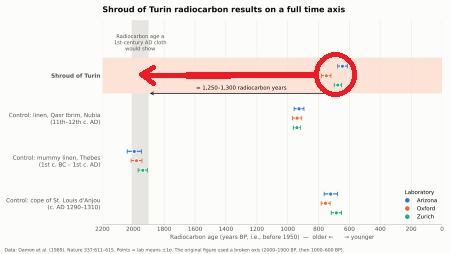
That’s the same data as before, but with the time axis fully expanded and a bunch of annotations added. (Claude did an amazing job. The whole thing took maybe a minute and a half.)
I added the red arrow to show how far off the circled Shroud cluster would have to be in order to support a first century date. It dwarfs the interlab variation. The idea that the error was that large, and of exactly the magnitude needed to place the Shroud in the 1300s (which is when it just so happens to show up in the historical record), just isn’t plausible.
That’s because you’re longing for the Shroud to be authentic and are therefore refusing to address the overwhelming evidence that it isn’t. You refuse to answer my questions and ignore the points I’m making. It’s pure emotion, not rationality.
Not that this is unexpected. You do the same thing when we’re discussing Trump.
keiths,
In this case we have evidence of a miraculous image that by consensus is 700 years old or older. Why God would have done this is beside the point.
You have not made a technical explanation. Like understanding the image you are simply parroting skeptic talking points.
None of this matters until you can explain why the data is heterogeneous. Especially following a pattern of reduced C-14 as you move. toward the middle of the Shroud. The sample is only .03% of the entire Shroud.
While it being authentic is quite interesting I have no interest in believing this if it is not supported by the data. As I told you before I had little interest in the Shroud until I saw contradictory evidence to the Carbon dating method. Later understanding the detail of the technical challenge forming the image confirmed in my mind it is most likely authentic.
colewd:
It’s not beside the point. It’s absolutely relevant because you are trying to interpret the Shroud as evidence for your chosen religion, Christianity. If you weren’t, then you wouldn’t be trying to discredit the C14 data. You’d simply accept that the Shroud was created in the 14th century since both the C14 evidence and the historical evidence independently point toward that date.
Since you do want the Shroud to be evidence for Christianity, then even if you were to give up on a first century date and assert that a Shroud miracle happened at some other time with a body other than Jesus’s, the question is: why would the Christian God perform a miracle that would deceive people like you into thinking that this was the authentic burial shroud of Jesus? Or the flip side: there are people in the world who would convert to Christianity if they believed the Shroud was authentic. Why doesn’t God make the evidence more persuasive for their sake? If the Shroud is authentic and the C14 results are invalid because of an invisible repair, why didn’t God nudge the researchers into taking their samples from an unrepaired part of the Shroud? If he’d done that, then the C14 evidence would have pointed to the first century and the case for authenticity would have been far stronger. Why did he allow the Church to investigate and conclude that the Shroud was a forgery, if it isn’t? Why did he allow an artist to confess to investigators that he had created it, if he hadn’t? Does he want people to go to hell, despite the fact that the Bible says he wants everyone to be saved? None of it makes sense.
What does make sense is simple: The Shroud was a forgery, created by an artist who confessed to doing so. It was created in the 1300s, and that’s why it first shows up in the historical record at that time. It’s also why the radiocarbon dating points to that same time period. That simple story is vastly more plausible than the one you’re pushing. I think you know that, which is why you won’t respond to my questions or address the issues I keep raising.
I’ve explained that the alternate techniques were invented by non-experts for the sole purpose of proving the Shroud’s authenticity, that they haven’t been validated, and that they aren’t used by anyone else. Based on how they’re designed, they also aren’t expected to be accurate due to their sensitivity to environmental variations over the purported 20 centuries of the Shroud’s existence. Why? Because they all directly or indirectly measure chemical degradation in the Shroud material. Chemical degradation is extremely sensitive to environmental conditions, while radioactive decay is not. That’s why radiocarbon dating (and radiometric dating in general) is preferred. It’s the gold standard.
That’s silly. Here’s an analogy: Acme Corporation is concerned about their financial recordkeeping, so they bring in three separate accounting firms to audit the books. Audits aren’t perfect and errors always creep in, so the accounting firms don’t all come up with exactly the same numbers. The spread between their numbers is slightly more than you’d expect given the kinds of errors that normally crop up in the auditing process, but they’re in the right ballpark and they confirm Acme’s own bookkeeping.
Meanwhile, down at Bob’s Tire Repair & Accounting, Bob has taken a great interest in Acme’s financials. He isn’t actually an accountant but he has a vested interest in proving that the Acme Corporation is cooking the books and inflating their revenue numbers. He invents four new accounting methodologies and applies them to Acme’s financial data, which he has managed to obtain. His methodologies haven’t been validated, no one else uses them, and experts who have looked at them point out why they aren’t expected to give accurate answers.
In between repairing flat tires, Bob applies his methodologies to Acme’s financial data and announces that Acme has been vastly overstating their revenue and that it is far less than what Acme and the accounting firms have claimed. The three accounting firms say that revenue last year was $523 million, $525 million, and $528 million, respectively. The $5 million spread is more than usual. Bob, on the other hand, says that revenue was actually $250 million based on his unproven, inaccurate accounting methods.
When accounting experts criticize his methods and point to the huge discrepancy between his numbers and those of the accounting firms, he responds that the $5 million spread of the accounting firm numbers is more than expected. Therefore, he argues, the correct revenue figure is more likely to be closer to $250 million, his figure, than in the vicinity of $525 million, which is what the accounting firms say.
Does Bob’s reasoning make sense to you, or can you see the problem?
Or take a look at the chart in my previous comment. The red circle is around the three C14 Shroud dates. If you were asked to look at that chart and estimate what the actual date was, would your answer be closer to (or inside) the circle, or closer to the arrowhead, and why? The answer is obvious, isn’t it?
A slightly larger than normal spread between the C14 dates doesn’t indicate that the dates are wildly inaccurate. It just means that the precision of the answer is slightly lower than usual. It doesn’t get you a first century date. Not even close.
I don’t know if you watched the Dan McClellan video on the C14 results, but he remarks:
That’s exactly what you’re trying to do. The problem is that the spread isn’t actually an escape route. It just gives you more room inside the cage.
If that were true you’d be answering my questions and responding to the issues I’ve raised, not dodging them.
Contradictory and invalid “evidence” that should carry no weight, just like Bob’s accounting “evidence”.
I have shown you that the image isn’t distorted in the way that it would be if the Shroud were authentic. A shroud wrapped around a body is not the same as the flat sensor in a camera. A flat sensor will producd an undistorted image, but a shroud won’t. That remains true even if you assume that the image was formed miraculously. The image itself, which you keep referring to, is itself evidence that the Shroud is a fake. I still haven’t heard a peep out of you by way of explanation, so I’ll ask again: if the Shroud is authentic, why isn’t the image distorted in the right way?
That the shroud (or at least one of them 😀) was fabricated (no pun intended) around 1350 is no longer in doubt.
The more interesting question remains: who was the fabricator and what was the motive?
The story I like is it was Michaelangelo (and/or his sponsor, teacher, protégé) and the motive was to create a model to help with perspective when working on one of his ceilings.
The Borgias, Pope Innocent VIII, da Vinci, Hitler can be fitted into this scenario. Ask President Zelenskii!
Alan Fox,
The question is how was the Shroud made with feature size and accuracy that makes up the image.
keiths,
What you have shown me is the tenacity to not to give up on an argument no matter how poorly the facts support your position. Its actually quite impressive 🙂
colewd:
You’re not fooling anyone. Give it a shot — if the Shroud was truly wrapped around a body, why isn’t the image distorted in the way that it should be?
keiths,
You’re assuming the image was made while wrapped around a body.
Start with understanding that we cannot explain the small precise individual units the image is made of.
colewd:
What are you suggesting? That it isn’t a burial shroud at all? That it is a burial shroud, but that the image wasn’t formed during the time it was wrapped around the body?
You’ve been all over the place in this thread. At one point you wrote:
At another you wrote:
Which is it? What is your position? Have you even settled on one? Please answer:
1. Do you think it’s a burial shroud?
2. Do you think it’s Jesus’s burial shroud?
3. Do you think the image was formed while it was wrapped around a body, or not?
4. How old do you think it is?
5. Do you think the image was formed miraculously, or via natural means?
No, that story has been told.
By now, it’s clear that the shroud was formed miraculously, the carbon 14 dating was fudged miraculously, the lack of aging for 1300 years was a miracle, the artist confessing to creating it was kidding, the church claiming it’s a fraud was miraculously fooled, the image was imprinted by magical means, and I know this because Jesus told me when I prayed to him for Truth.
Hi Keiths
The most likely scenario based on the data.
-The image was made by God. The God of Abraham.
-We have only ideas at this point what was used to make the image. ie Experimental use of 193nm lasers can make similar image units. The challenge today would be making the image with the measured accuracy with a moving imaging table as we use for semiconductors.
-I think the timing was likely made around the first century but possibly later.
keiths:
colewd:
You didn’t answer numbers 1-3.
Your answer for number 4 doesn’t state a range:
You didn’t answer number 5 directly, but you did say
…which makes it sound like you think it was a miracle. Correct?
How about answering 1-3 and stating an upper bound for 4?
keiths,
I don’t have a strong position on I through 3.
-I think it is a most likely a burial Shroud
-I think it is most likely Jesus
-I don’t think anyone knows how the image was formed.
colewd,
You still haven’t answered number 3: Do you think the image was formed while the Shroud was wrapped around a body? Note that I am not asking you how you think the image was formed — just whether you think the Shroud was wrapped around a body at the time.
On number 4, you still haven’t given a time range.
You also didn’t answer number 5: Was the image formed naturally, or through a miracle? You earlier stated that the image was created by the God of Abraham. That sounds like a miracle claim.
keiths,
I don’t have a strong opinion here but the precision of the image units creating grey scale puts this into doubt. If it was wrapped around the body my sense is the grey scale would be less precise than it is.
There is no credible natural explanation for the image and I think an event that it is an act of God would classify it as a miracle. So yes it is a miracle claim.
Er, yes there is. Have you read any of the evidence, yet?
Alan Fox,
I have looked at the alternative hypothesis. The imaging unit features are too small and precise for the alternative hypothesis. They’re possibly too small and precise for today’s imaging technology. I worked in the semiconductor imaging business. With a current technology of 193nm laser we could print a small amount of the image (with the imaging units on linen but the whole 14 by 4 feet would be a significant challenge.
colewd:
You keep citing your semiconductor experience, but you were in sales IIRC, not engineering, and anyway you’re most likely cribbing the 193 nm number from some apologetic website, not deducing it yourself. The 193 nm number comes from an experiment done all the way back in 2010 which used a laser of that wavelength.
I’ve been avoiding the whole “no human could have done this” rabbit hole because I don’t want to keep wasting time on this, but I decided to at least look into what claims are actually being made, and with AI the search is less painful than it would have been otherwise.
Turns out the “pixel” dimensions are nothing special: the width is just the width of a fiber, and the length is a function of the weave geometry. When a thread is on the surface, it can be colored. Otherwise not. No magic required.
The 200 nm depth figure is just the width of the cell wall. So all it’s saying is that the coloration is limited to the surface of the cell. It’s the anatomy that’s determining the depth, not the technique that produced the image. So the breathless citation of the 200 nm figure is apologetic hype.
This is exactly why I don’t normally go down these rabbit holes. If someone makes a discovery that actually holds up under expert scrutiny, it will make news. No need for me to dig into it until them.
I’ll respond to your other comment later.
colewd:
You still haven’t answered number 4 by giving a date range. If it was Jesus’s burial shroud, then the date is obviously the first century, but you don’t seem willing to commit to that or even to the claim that it is a burial shroud in the first place.
If it isn’t a shroud, then what is it? A piece of linen upon which an image was randomly zapped by God in order to fool people into thinking it was Jesus’s burial shroud? If so, why is God trying to deceive us?
If it is a shroud but not Jesus’s, similar question. What’s the point? Is God trying to fool us?
If it’s Jesus’s shroud but the image wasn’t formed while it was wrapped around Jesus’s body, then what happened? Did God unwrap the shroud and then zap it, so that the body wasn’t involved at all? Again, that would mean that God is trying to fool us into thinking that the image on the Shroud somehow came about by being wrapped around Jesus’s body. Why?
And if it did come about via wrapping, then why isn’t it distorted in the way it should be?
And why does God allow all the other evidence against authenticity to stand? I asked earlier:
Here’s an example of how desperate Shroud proponents can get. There’s a guy, John Jackson, who recognizes the distortion problem I’ve been trying to get colewd to address. He knows that if the image was formed while the Shroud was wrapped around the body, it should be distorted in the way I’ve mentioned. It isn’t.
His solution? He proposes that Jesus’s body became “mechanically transparent” so that the upper portion of the Shroud actually fell through it, with the image forming as it fell.
That’s some crazy shit. But hey, if you’re going to invoke miracles, you might as well go for it.
OK. God said “let there be a shroud” and saw that it was good.
keiths,
The anatomy is not going to determine the depth its dependent of the imaging equipments capability. The depth itself varies between 200 and 500 nm which you know is a very small window but greater than the cell wall.
Keith I do believe the Carbon Date is most likely not representative of the whole Shroud and it is Jesus burial cloth. The argument of the image being a miracle is however not date dependent.
I was incharge of all field operations including servicing the equipment. When it broke I was ultimately responsible for fixing it when fixes went beyond routine. I also as an officer of the company spent significant time in engineering reviews when newer equipment was delayed.
193 nm was the wave length of our latest litho equipment using lasers. You are right this is the same wave length that has been use by Shroud scientists to reproduce the small image.
colewd:
What imaging equipment? Are you suggesting that God used a laser? Or that the 14th-century forger did? Maybe the miracle is that God provided the forger with the laser so he could produce the fake, lol.
Your logic is messed up. What you’re trying (or should be trying) to do is to argue that whatever the unknown process was that created the image, it produced a coloration layer that is too thin to have been within the reach of 14th-century technology. That argument only works if the depth actually was a function of the imaging process. If it was anatomy that determined the depth (see below), then your argument goes out the window.
Are you getting that from an apologetic website? From AI? I looked at the relevant paper (you managed to suck me further into the rabbit hole, lol), in which the abstract says
They’re pointing to anatomy, not to the imaging process. Also, there’s an image in the paper showing exactly what they measured, and it isn’t the color layer, it’s the cell wall:
(Note that the ultra-precise measurement is an amusing 200nm ± 200nm, meaning the uncertainty is as large as the measurement itself. The cell wall thickness is therefore somewhere between 0 and 400 nm. Well, at least we know that it’s greater than zero, lol.)
So they observed a gap in the cell wall and noted that there was no color underneath, meaning that the color layer had been stripped away. They concluded that the color layer was therefore most likely confined to the cell wall. Anatomy determined the depth according to them, not technology.
I know this is a great disappointment to you, but there it is.
keiths,
Keiths the alternative hypothesis uses a bas-relief technique which will not control the depth and will have random units not controlled units. The alternative hypothesis has to take into account what was available in the 14th century or earlier.
Here is the paper that cites this experiment….https://doi.org/10.2352/J.ImagingSci.Technol.2010.54.4.040302
This is from a Shroud paper. This does not show a 14th century process that could have been performed by a human. Again the depth is controlled by the imaging process interacting with the medium. The medium itself cannot control the depth. Along with the depth challenge is the control of the grey scale that generates the clear image when photographed.
Re the 200 nm to 500 nm range, colewd writes:
The paper does indeed cite that range but doesn’t justify it, instead referencing three other papers. I gave Claude the task of looking at those papers to figure out the ultimate source of the numbers. Here’s what he found:
Here’s the context of the quote from Rogers’ FAQ:
Rogers has no idea how thin it is, other than that it’s less than the wavelength of the light used for the photomicrograph. So when you wrote this…
…you were incorrect. He’s saying that it falls within the 200-600 nm range, not that it varies across that range.
In response to my quote, you write:
That’s right. These are Shroud proponents. Shroud proponents, not skeptics, are pointing to the cell wall:
colewd:
It isn’t intended to. This paper is by proponents, not skeptics.
Sure it can. Read this again:
Let’s review. You’ve been claiming that the “pixel” size and depth are humanly impossible without modern technology. But the “pixel” width is just the width of a fiber, and the length is just a function of the weave, and now these Shroud proponents are telling you that the depth is related to the cell wall. None of those three depend on fancy imaging technology.
Your argument doesn’t work.
At best you can fall back and argue that we haven’t yet discovered a technique available in the 14th century that would account for all of the Shroud’s characteristics, but that’s a far cry from saying that those characteristics demand advanced technology — or a miracle — as an explanation.
And you’re not thinking this through. Suppose there is no 14th century method that could account for the Shroud image. Why, then, did someone confess to creating it? I’ve brought this up several times and you won’t address it. Ignoring inconvenient evidence doesn’t make it go away, Bill.
I know this is disappointing. You have your heart set on the Shroud being authentic in the same way that you long for ID to be correct and for Trump to be a good, smart, competent guy who delivers on his promises. The evidence is against you on all three.
Actually, ignoring inconvenient evidence makes it never exist in the first place. No need to ignore what never existed. And it never existed because if it fails to support the needed conclusion, it is not evidence, and can’t be.
You need a better grasp of believer-think.
keiths,
Keiths,
The depth and accuracy of the image is dependent on the matching of the material and the imaging equipment. When we developed the Alta 9000 which used a 193 nm laser vs a 257 nm laser on the prior generation the development of matching the resist was a significant amount R and D.
In trying to duplicate the Shroud image you cannot adjust the material it is fixed. As far as the exact depth of penetration you are correct that it is not precise down to the nanometer given limits of optical measurement tools yet we know it is sub micron which does not change the challenge of making this image.
As far a someone claiming 700 years ago they made the image I think that is easily trumped by the physical evidence.
So let’s see:
The church at the time said it was a fraud.
Explanation: The church couldn’t know what we know today.
The artist admitting creating it
Explanation: The artist must have been lying
There was an active cottage industry producing religious artifacts at that time
Explanation: irrelevant, so we ignore this
The image could not possibly have formed such an image if it was a wrapping
Explanation: It was a miracle
The shroud somehow went unnoticed and unaged for 1300 years
Explanation: let’s ignore this
The materials and weaving technique were current at the time and place the shroud was first noticed, and not current at the time and place Jesus is said to have lived.
Explanation: This can’t be true, so it’s not true.
The only people who believe this shroud stuff are religious believers who NEED it to be real.
Explanation: That doesn’t make their needs incorrect.
To me, this is a classic case of starting with a foregone (but wildly incorrect) conclusion, and accepting only what can be forced to fit, or manipulated to fit, or fabricated to fit, or sworn to fit. And what we see is that it doesn’t matter how preposterous the foregone conclusion is. I’m confident that if Bill’s religion said black is white and night is day, he would find some support for these positions, and he’d be satisfied.
colewd:
Bill, you’re not grasping this. Photolithography equipment was not available in the 1300s. Whoever made the image did not use photolithography equipment. They did not use a laser of any wavelength. The strengths and weaknesses of photolithography equipment did not apply. There was no “matching of the material and the imaging equipment”, because there was no such equipment for the material to be matched to.
The argument you’ve been trying to parrot throughout this thread (and you really should just link to the site or sites where you’re getting this) is that the dimensions and depth of the “pixels” are too fine to have been produced by any method available to a would-be 14th century forger, but that they could be produced by an intense burst of ultraviolet radiation. The people pushing this idea think the burst of radiation was supernatural — a miracle at the time of Jesus’s resurrection.
Their experiments with modern-day equipment are just attempts to bolster the radiation hypothesis. They are not arguing that a 14th-century forger would have had to use radiation and that the constraints of photolithography would therefore apply.
The question is whether the dimensions of the “pixels” are out of reach for the techniques available to the 14th century forger. I’ve already explained that the “pixel” width is just the fiber width and the “pixel” length is determined by the weave, so nothing at all surprising there. The depth is the dimension that matters for our purposes, so the question is: can a non-radiation mechanism produce coloration as shallow as what is seen on the Shroud?
The answer is yes, if the image was produced by a mild chemical reaction that didn’t penetrate the cell wall and remained superficial. The Shroud proponents I quoted above believe that this is exactly what happened. They don’t accept the radiation hypothesis and don’t believe the image formation was a miracle. They think it was a natural chemical process occurring after Jesus’s burial. These are proponents, mind you.
This is where the skeptics come in. If a mild, superficial chemical reaction can produce the requisite coloration, then the medieval forger could have used that as his technique. Photolithography has nothing to do with that question. The only question is whether the coloration could remain shallow enough, and the aforementioned Shroud proponents think it could, based on the fact that the coloration depth is less than the width of the cell wall. They say
Now do you see why the photolithography constraints are irrelevant?
You didn’t answer my question, which is why the guy confessed to creating the Shroud image if, as you believe, he didn’t actually make it. What possible motivation would he have? Compare that to the obvious alternative hypothesis, which is that he confessed to making the Shroud image because he made the Shroud image. Which hypothesis do you think is more likely to be true?
Flint:
I agree, except that I don’t think Bill is satisfied. I suspect he has doubts and that he is here, arguing for the Shroud’s authenticity, in order to reassure himself that it really is authentic and that the apologetic arguments he’s parroting actually hold up under critical scrutiny. Unfortunately, they don’t.
keiths,
Hi Keiths
Modern lasers is the only demo so far that has produced the discolouration and fine features on the Shroud. This is just the first inning of demonstrating feasibility of generating the image today. If we cannot reproduce the image with the image units on the Shroud today how can the forgery hypothesis hold up?
Do you know who the artist is who made this confession?
As far as I can tell the painter has not been identified?
colewd:
Easily, given all of the other evidence that points to it. You, on the other hand, have to find a way to discredit all of the other evidence and show that there is almost certainly no medieval technique that could have produced the image. Good luck with that.
Earlier in the thread I asked:
You’ve simply ignored those questions. Imagine once again that you’re trying to convince a jury that the Shroud is authentic. You’re the defense attorney. The prosecution has raised the same questions I did. Are you going to tell the jury “Just ignore all of that. Trust me when I tell you that no forger in the 14th century could have pulled it off”? And if the prosecution asks “How do you know that?” are you just going to say “Well, I can’t think of any way they could have done it. Therefore they couldn’t have done it”?
Do you not see how flimsy that is? Are you really going to tell the jury “Ignore most of the evidence, and trust me when I tell you that a forger couldn’t have done it”? That is not going to convince the jury, nor should it.
The artist isn’t named in the historical account. How is that relevant?
keiths,
Keiths
The evidence you pointed to is initial feasibility on how the Shroud image could be generated with modern technology that is used in Semiconductor imaging. There is still no evidence, based on a complete model, that the Shroud image with its accuracy and density grey scale could be produced today let alone 700 years ago..
Your case for a forgery is built on an unnamed forger/painter and you think this is worthy evidence?
The Shroud was not considered a painting by the STURP team in 1978 and given the evidence of make up of the pixel units this is a fact.
colewd:
As I just explained, they were testing the hypothesis that the image was created by a miraculous burst of ultraviolet radiation at the time of Jesus’s resurrection. It has nothing to do with the forgery hypothesis because the forger did not use, and could not have used, photolithography equipment.
The limitations of photolithography equipment are irrelevant unless photolithography equipment was used to make the image. It wasn’t.
Here’s an analogy. Imagine that on an alien planet the inhabitants have invented welding, but then the technology is lost because of some global catastrophe. A subsequent civilization has not yet invented welding and uses glue for everything. One of their archaeologists is digging up artifacts and finds two metal pieces that have been welded together.
The archaeologist announces: “These metal pieces could not have been glued together by any known glue. Therefore a miracle must have taken place.” It’s an invalid argument, because the limitations of one technology — gluing — do not apply to a different (and unknown) technology — welding.
Ditto for photolithography and whatever method the forger used. The limitations of photolithography do not apply to the forger because the forger didn’t use photolithography to create the image.
So drop the photolithography stuff and concentrate on this. If you want to show that the Shroud is authentic, you need to find a way to discredit all of the counterevidence and show that there is almost certainly no medieval technique that could have produced the image. Good luck with that.
Of course! Why on earth would the forger’s name matter? We learn about the forger via a letter written to the Pope by the local bishop. The Pope doesn’t care what the guy’s name is — he just cares that the Shroud is a forgery, so the bishop doesn’t bother to mention the forger’s name. How is this a problem? Suppose the bishop had mentioned that the guy’s name was Giuseppe Abbatelli. Would that strengthen the case that the Shroud is a forgery? It’s irrelevant.
Yes, it’s not a painting, but I’m not claiming that it is. I think the most likely explanation is that the forger used chemistry, not pigment, and that the chemical reaction was confined to a small, superficial layer in each fiber, possibly because it was limited by the cell wall. In any case, to convince the jury, you need to show that the image almost certainly could not have been produced by any 14th-century method, known or unknown. Otherwise you’re making the glue-vs-welding mistake. And you need to discredit all of the other evidence that points to a 14th century forgery.
keiths,
What the experiment shows is the challenge of making a sub micron image one that is consistent across 4 by 14 foot strip of linen. The image required very is precise excitation of the linen which in the case of the experiment was using a high frequency laser and optimising its focus, pulse timing etc to match the linen molecular structure in order to generate the image unit we see on the Shroud.
The strategy of generating grey scale was very different than any art of the time of the Shroud. The grey scale was generated by image unit density.
Your glue example is interesting in certain cases but it does not apply where we are trying to explain very difficult technical challenges and what it takes to solve them.
In this case I agree with you because the forger claim is falsified by the examined feature size and accuracy of the image. In other cases not having a name makes the claim too vague to be credible.
The cell wall itself will not limit the penetration of the image unit. The laser needed a precise pulse timing and frequency not to penetrate the cell wall. The linen itself will not control the image unit size and cannot control the accuracy of the placement of the image units.