
The conversion (or more correctly, reversion) of former agnostic Joe Schmid to Catholicism last month was motivated principally by what Schmid views as overwhelming evidence for the occurrence of miracles which, he argues, vindicate Catholic doctrinal claims. Now, Schmid readily acknowledges that miracle claims won’t impress an avowed naturalist – which is why he created a seven-hour video presenting a cumulative case for theism, thereby establishing at least the possibility of miraculous events occurring. In this post, I won’t be discussing Schmid’s case for theism, which I view as a theological curate’s egg: good in parts (and bad in others). Instead, I’ll be focusing on the miracles Schmid cites to bolster his case for Catholicism. Can they prove his case, and how well do they stack up? Because I was raised in the faith Schmid has returned to, I’ve done a lot of research on the miracles he discusses, and I’ve put together some good links which readers may find helpful.
Joe Schmid makes his case for God’s existence in a 7-hour video, titled, The BEST EVER Cumulative Case for God. See here for a 12-hour critical review of Schmid’s arguments for theism by Nathan Ormond (Digital Gnosis) and James Fodor. My own view is that Ormond and Fodor effectively refute the argument from psycho-physical harmony and the fine-tuning argument, but fail to adequately address the argument from beauty. There are, of course, many other powerful arguments for God’s existence. Schmid, for his part, makes a rather weak response to the atheistic argument from evil, in my opinion: he needs to give a better account of why God allows horrendous evils. That’s all I wish to say on Schmid’s case for theism.
Can miracles be used to argue for the truth of a particular religion, such as Catholicism?
Christian author Glen Scrivener has posted an excellent two-hour Youtube video in response to Joe Schmid, from a Protestant perspective: I Watched 25+ Hours of Joe Schmid—I Have Thoughts.
Derek Lambert of Mythvision has also put up a one-hour video, titled, Joe Schmid’s 20-hour Miracle Case Dies in One Verse, pointing out that the Hebrew Bible itself repeatedly declares that God sometimes sends fake miracles and lying spirits to test the loyalty of his followers. Also, the New Testament declares that there will be false miracles (signs and wonders) that will deceive, if possible, even the elect (Mt 24:24), and that Satan disguises himself as an angel of light (2 Cor 13:14). Hence no miracle can be treated as vindicating a religious doctrine.
How well do Catholic miracle claims stack up?
For the benefit of readers, I’ll mention that an ex-Catholic YouTuber who calls himself Kevin NonTradiCath has created a website debunking many popular Catholic miracles. I should also note that Catholics are not required to believe in any of these miracles, as they relate to private revelations; in approving them, the Church merely declares them worthy of belief. In this post, I’ll examine the following alleged Catholic miracles:
1. Padre Pio
2. The Lourdes miracles and the visions of St. Bernadette
3. Our Lady of Fatima
4. Our Lady of Guadeloupe
5. St. Catherine Laboure and the Miraculous Medal
6. The levitating saint: St. Joseph of Cupertino/Copertino
7. The Miracle of Calanda (in which God grew back an amputee’s leg)
8. Eucharistic miracles: Lanciano, Buenos Aires and Tixtla
9. Incorrupt bodies of Catholic saints
10. The Shroud of Turin
11. Exorcisms: Are demons real?
I haven’t included Our Lady of Zeitoun (Egypt) on this list because it is not a Catholic miracle (the apparitions took place on top of a Coptic church), not everyone saw a lady on top of the church (some simply saw a light), and the apparition did not speak, let alone confirm the truth of any religious claim.
1. Padre Pio
Kevin NonTradiCath has put up a Youtube video titled, St Padre Pio, or, a Case Study in Catholic Cults of Personality, debunking Padre Pio’s alleged miracles (stigmata, healings and bilocation), but clearing him of allegations of impropriety.
2. The Lourdes miracles and the visions of St. Bernadette
Kevin NonTradiCath has created an informative video titled, Our Lady of Lourdes, St. Bernadette Soubirous, Forest Fairies, Medical Malpractice & Pseudoscience, debunking the visions of St. Bernadette and the cures at Lourdes.
3. Our Lady of Fatima
By far the best critical article I have seen on the miracle of Fatima is one by the B.A. psychology graduate Evan Harkness-Murphy, over at her blog The Magpie: “Your Lady of Fatima – A Response to Ethan Muse” (September 13, 2025).
See also James Fodor’s in-depth discussion of the Fatima apparitions, titled, A Skeptical Analysis of the 1917 Marian Apparitions and Miracle of the Sun (very detailed: two hours long).
See also the article, “Fatima Miracle Claims All Wet” by Benjamin Radford in The Skeptical Inquirer, Vol 43 no. 3 (May/June 2019), questioning whether the witnesses to the solar miracle at Fatima were really soaking wet and whether their clothes miraculously dried in the space of a few minutes, as popularly claimed by Fatima devotees.
See, in addition, the article, “Did photos of the 1917 Miracle of the Sun at Fatima prove the sun was at an impossible place in the sky?” at the EukaryoteWrites blog, critiquing recent claims made by the priest Dr. Phillipe Dalleur (who’s cited on Joe Schmid’s video), on the basis of his interpretation of photos of the crowd at Fatima, that the solar miracle was actually caused by a second body in the sky, not the Sun. See here for Dalleur’s original article making the claims.
Kevin NonTradiCath has also made a highly informative video titled, The miracle of the sun at Fatima in 1917 was a natural event, not a miracle. Here is why, reviewing Fr. Stanley Jaki’s book, “God and the Sun at Fatima”, which invokes providentially-timed atmospheric ice crystals to explain the solar phenomena observed at Fatima. Kevin writes: “If you want to skip to to my favorite part, jump to the last chapter of the video, starting at 48:22. That is where I compare all the eyewitness testimony from Fatima to the sun miracle at Medjugorje caught on camera. I think that we can use that footage from Medjugorje in 2023 to try to make sense of the eyewitness testimony from Fatima, over 100 years earlier, in 1917.”
See also the following scientific article from 2003: “Apparitions and Miracles of the Sun” by Dr. Auguste Meessen, Institute of Physics, Catholic University of Louvain, B-1348, Louvain-la-Neuve, Belgium. “Abstract: Apparitions are subjective experiences, but can be accompanied by “miracles of the sun”, observed and described by numerous witnesses. An extensive study of these phenomena reveals a set of characteristic features, suggesting the existence of an underlying mechanism. It is shown that the hypothesis of an extraterrestrial intervention is not sufficient to explain all observed facts, while this is possible in terms of natural, but very peculiar physiological processes. The proof results from personal experiments and reasoning, based on relevant scientific literature. Apparitions are more complex experiences, but the content of the “messages” raises theological problems. Moreover, it is necessary to relate these “mystical experiences” to new insights in psychological processes that involve altered states of consciousness. This subject calls urgently for continued, rigorous and responsible research.”
Please note also that the children’s descriptions of the apparition shifted over time. In the earliest 1917 interviews, the entity was described as a tiny, one-meter-tall girl wearing a short skirt, which heavily conflicted with the traditional, majestic Catholic depictions of the Virgin Mary popularized later.
Regarding the alleged prophecies made by the seers at Fatima, Kevin NonTradiCath has made a video titled, “The more you learn about the Miracle of Fatima, the less impressive it seems”. The video debunks three popular Catholic claims about Our Lady of Fatima: that she predicted the deaths of the visionaries Francisco and Jacinta (false: the earliest record of this alleged prediction is from 1927, more than seven years after their deaths); that she predicted the end of World War I and the beginning of World War II (also false: the earliest record of the prediction about WWII comes from a memoir Lucia wrote in 1941, two years after the outbreak of WWII); and that everybody at Fatima saw the Miracle of the Sun (false: we have records of people who were there and who saw nothing, and the number of recorded testimonies of people who saw the miracle comes to no more than a few dozen, despite the fact that at least 30,000 people are supposed to have been present, and we also have records of educated people who not only saw nothing but who were present at Fatima with several other friends or acquaintances who saw nothing, but who noted that less educated people witnessed the phenomenon).
Kevin Nontradicath has also created a video titled, Retconning Fatima: How Lucia Updated a Prophecy of Fatima about the End of World War I. Kevin NonTradiCath argues that Lucia herself was a fraud because of a failed prophecy she made and later retconned. Lucia said Our Lady told her to wait at the Cova da Iria (the site of the apparitions) because the Portuguese soldiers fighting in World War I would be returning soon, but actually the war didn’t end for another year. Lucia changed the prophecy in her 1941 memoir. Also, Lucia herself never saw the miracle of the sun on October 13th, 1917. Finally, the sign from God that she was referring to seems to have been the end of the war, rather than the solar miracle.
Kevin NonTradiCath has created another video, titled, Jacinta can’t save Lucia’s failed prophecy: A case against the Conditional Prophecy Defense. Note: this “conditional interpretation” is the defense that Joe Schmid leans on, in his online apologia, where he argues that what Our Lady really meant was that that IF people repented, the war would end today.
4. Our Lady of Guadeloupe
Kevin NonTradiCath has made a highly informative video titled, Juan Diego’s Tilma – An Examination of Six Common Claims about the legend of Our Lady of Guadeloupe.
5. The Miraculous Medal of St. Catherine Laboure
Kevin NonTradiCath, in his video, The Miraculous Medal, or, How to Eat Relics to Induce Marian Apparitions, argues that the Miraculous Medal is a pious fraud; curiously, Sister Catherine Laboure completely forgot about her visions of Our Lady for several years. Even more strangely, she declares that it was eating some clothes which had belonged to a Catholic saint that caused her to have visions of Our Lady!
6. The levitating saint: St. Joseph of Cupertino/Copertino
The well-attested miracle of the seventeenth-century flying friar, St. Joseph of Cupertino, is debunked by skeptic Joe Nickell in his article, “Secrets of ‘The Flying Friar’: Did St. Joseph of Copertino Really Levitate?” in The Skeptical Inquirer, Volume 42, No. 4 (July / August 2018). Here’s an AI overview of the article: Joe Nickell’s connection to Cupertino refers to his skeptical investigation of Saint Joseph of Cupertino (1603–1663), the 17th-century Italian Franciscan friar widely known in Catholic tradition as “The Flying Friar” due to numerous accounts of his ecstatic levitations. As a world-renowned professional paranormal investigator and skeptic, Nickell analyzed the historical claims of the friar’s flights — such as soaring to the high altar or carrying a heavy cross through the air — and published his findings in a detailed critique for the Skeptical Inquirer. Nickell’s Core Findings on the “Flying Friar”:
Rather than accepting the levitations as genuine miracles, Nickell attributed the accounts to a mix of natural human abilities, stagecraft, and severe historical distortion:
“Gross Exaggeration” in Biographies: Nickell pointed out that the primary biographical sources documenting these feats were published more than half a century after Joseph’s death. Over decades, oral traditions and legends heavily distorted the original events.
The Nature of the “Flights”: Historical records indicate that Joseph’s “levitations” often began with a loud shriek followed by a leap. Nickell noted that these incidents were better explained as energetic jumps or bounds rather than true floating. Observers, swept up in religious ecstasy and viewing him from below in dimly lit churches, easily misperceived these leaps as supernatural levitation.
Lack of Primary Evidence: The original sworn records used during the early stages of his canonization process are no longer available for independent scientific study, leaving investigators to rely on heavily biased second-hand accounts. Another, fairly balanced article on St. Joseph of Cupertino can be found here, on the Historical Blindness blog.
7. The Miracle of Calanda (in which God is said to have miraculously grown back the leg of an amputee named Miguel Pellicer, from Calanda, Spain, whose leg was surgically amputated in 1637, but allegedly grew back instantly in 1640)
The best take-down of this alleged miracle is Brian Dunning’s Skeptoid podcast, Miracle of Calanda. There’s also an excellent update on the original article, responding to Catholic critics and demonstrating that no doctor at the 1640 miracle trial ever testified that he’d personally amputated Miguel’s leg, casting doubt on claims that it had ever been amputated in the first place.
Here’s an excerpt from an AI-generated summary of the skeptical case against the miracle of Calanda:
Background and Claims The Event: In 1640, a Spanish peasant named Miguel Pellicer claimed his right leg—amputated two and a half years prior after a cart accident—miraculously regrew.
The Investigation: Local church and secular authorities, including a legal tribunal and the Inquisition, investigated the case and declared it a genuine miracle in 1641. Unlike many religious legends that develop centuries later, the documentation for Calanda began within days.
The Notarial Act (April 1, 1640): Just three days after the event, a local royal notary named Miguel Andreu and the parish priest travelled to Calanda. They recorded sworn statements from 10 eyewitnesses (including local officials and family members) who testified they saw Miguel with only one leg right before the event, and two legs right after.
The Canonical Process (June 1640 – April 1641): The Archbishop of Zaragoza, Pedro Apaolaza Ramírez, initiated a formal court to rigorously cross-examine the claims. Over nearly a year, 24 official witnesses gave testimony under oath.
The Hospital Staff Testimony: Crucially, the court called forward the professional secular staff from the General Hospital of Zaragoza where Miguel’s leg was treated. This included Juan de Estanga (the surgeon who ordered the amputation), Diego Millaruelo (the assistant surgeon who cut it off), and the hospital priest who buried the severed leg in the cemetery. The original manuscript — Copia literal y auténtica del proceso — remains preserved in the Zaragoza cathedral archives. It concludes with the Archbishop’s official ruling on April 27, 1641, declaring the limb restoration explicitly “wonderful and miraculous.”
Skeptical View: Critics argue that 17th-century investigations lacked modern scientific rigor, and extraordinary claims from the past rely entirely on anecdotal and biased testimony. While the 1640–1641 legal investigation by the Archbishop of Zaragoza looks incredibly thorough on paper, modern historians and critical researchers have identified several significant cracks, omissions, and systemic biases in the process. When evaluated by modern judicial or investigative standards, the “ironclad” legal record begins to show major vulnerabilities.
(i) The Complete Lack of Cross-Examination In a modern court, a witness’s claims are tested by a skeptical defense attorney who looks for contradictions.
The Crack: The Canonical Process was entirely one-sided. The tribunal was not trying to find a fraud; they were trying to validate a miracle to boost Catholic morale during the Counter-Reformation.
The Reality: Every single one of the 24 witnesses was a devout Catholic, and many stood to gain status, fame, or religious validation from the event. None of the witnesses were cross-examined aggressively, nor were they asked questions that might expose a hoax, such as whether they had ever closely examined Miguel’s “stump” without its bandages.
(ii) The Timeline Discrepancy (The Missing Two Years) The legal documents heavily rely on the testimony of the hospital staff in Zaragoza to prove the leg was actually amputated. However, a major chronological gap exists between the hospital and the miracle.
The Crack: The amputation took place in late 1637. The “miracle” occurred in March 1640.
The Reality: For over two full years between these events, Miguel was not living in the hospital. He was traveling the country as a wandering beggar. The Zaragoza hospital staff had not seen Miguel for years before he suddenly showed up in Calanda claiming his leg grew back. They could only testify to what they did in 1637, not to what Miguel’s leg looked like in the days or weeks leading up to the night of March 29, 1640.
(iii) The Power of “Social and Religious Pressure” Calanda was a small, deeply religious village. Once the rumor of a miracle exploded, it became socially dangerous to deny it.
The Crack: Local officials—including the notary Miguel Andreu, who arrived just three days later—were under immense pressure to confirm the event.
The Reality: If a local villager had suspected Miguel was a fraud who had simply unbound a hidden leg, speaking out would mean accusing their neighbors, the local priests, and eventually the Archbishop of lying. In 17th-century Spain, challenging a declared miracle could easily result in being investigated by the Inquisition for heresy or witchcraft. This created a powerful incentive for total conformity among the witnesses.
(iv) No Physical or Forensics Inspection of the “Regrown” Leg For an event centered entirely on a physical body part, the tribunal’s examination of the leg itself was remarkably superficial.
The Crack: The court relied almost purely on visual testimony (“we saw two legs where there used to be one”) rather than an objective physical or medical evaluation.
The Reality: No independent, outside physicians were brought in to physically manipulate the leg, test its bone structure, or verify if the “amputation scars” were genuine or merely skin blemishes. The court notes that the leg was pale, small, and weak at first — which perfectly matches what a leg looks like after being tightly bound and immobilized against a thigh for two years to fake an injury.
(v) The Disappearance of Key Records While the final summary document (the Proceso) survives, the actual raw investigative notes, daily logs, and initial interviews are missing.
The Crack: Historians pointing out cracks in the case note that we only have the “polished,” final version of the events compiled by the Church authorities.
The Reality: Any early contradictions, hesitant witnesses, or dissenting opinions that occurred during the year-long trial were completely scrubbed from the final official narrative to present a flawless, unanimous front to the public.
8. Eucharistic miracles: Lanciano, Buenos Aires, Tixtla and Sokolka
Cinematographer Cade Bradley interviews Kevin NonTradiCath on the shoddy science behind Eucharistic miracles, in his video, Eucharistic Miracles Are FAKE – The ‘Science’ Is Way Worse Than You’ve Been Told.
Surprisingly, the best critiques of Eucharistic miracles have come from Christians: from Dr. Maxime Georgel (a Protestant who acknowledges the reality of miracles) and from Catholic scientists Stacy Trasancos and Kelly Kearse.
(a) The Eucharistic Miracle of Lanciano, Italy
First, here’s Catholic apologist Ethan Muse’s video arguing for the reality of the Miracle of Lanciano: If You’re Skeptical of Eucharistic Miracles, You Need to See This. (At 22:00, interviewer Matt Fradd puts forward a conspiracy theory suggesting that the actual piece of flesh that’s currently preserved in the Host at Lanciano may not be centuries old, but may date back to only 1970. Muse responds to this conspiracy theory.) There are several high-quality videos and online essays critiquing the miracle of Lanciano. The most in-depth response is the Response to Ethan Muse On the Alleged Eucharistic Miracle of Lanciano by Dr. Maxime Georgel (July 28, 2026), which has been translated to English and reproduced over at Javier Perdomo’s substack. Dr. Georgel makes a point-by-point reply to Muse, arguing that in order to prove a miracle, it has to be shown that the flesh and blood on display at Lanciano is human flesh and blood, that it was once a consecrated host, that its preservation across the centuries is miraculous, and that we can rule out fraud. Dr. Georgel regards each of these claims as questionable.
“The fake Lanciano WHO report” by Catholic chemist Dr. Stacy Trasancos, is a pretty devastating expose of the oft-repeated apologetic assertion that a WHO report backed the claims made in 1971 by a Catholic doctor regarding the alleged presence of flesh in the Host at Lanciano. (Incidentally, you can also read my article, “Catholic Eucharistic miracles debunked by Catholic chemist Dr. Stacy Trasancos” at The Skeptical Zone.)
See also the article, “Exaggerations and Eucharistic Miracles” by Stacy Trasancos, in Crisis magazine. This article discusses the work of Catholic science teacher Kelly Kearse, exposing Eucharistic miracles and showing that bacteria can duplicate many of the results.
Kelly Kearse has recently written a PubMed paper titled, “Scientific analysis of shared AB blood type among relics and eucharistic miracles: A reply to Franco Serafini’s commentary” (Forensic Sci Med Pathol. 2026). See also his Youtube video, “Scientific Analysis of Eucharistic Miracles” (11 July 2025), a 33-minute talk given to the Society of Catholic Scientists at the Catholic University of America, in which Dr. Kearse shows that non-consecrated wafers placed in water for 7 to 10 days display reddish stains, suggests that fungal DNA may account for the reddish stains commonly found on hosts in Eucharistic miracles, and recommends publication in peer-reviewed scientific journals as the best way to rule out alternative, naturalistic explanations of Eucharistic miracles.
Over at his Youtube channel Capturing Catholicism, Cameron Bertuzzi has recently hit back at the skeptics, with a lengthy one-hour Youtube video presented by the French Catholic apologist Matthieu Lavagna, titled, “Demolishing EVERY Objection to Eucharistic Miracles” (July 5, 2026). Please note that Lavagna is not a scientist; he has a degree in philosophy and theology and he’s pursuing studies in mathematics. As Lavagna himself acknowledges, the main oddity in the Catholic evidence for Eucharistic miracles is that there is no DNA of Jesus’ Eucharistic flesh. Lavagna’s lame reply is that maybe God doesn’t want to reveal the details of Christ’s body. Nor does he want people to clone Jesus. Overall, the shrill, defensive tone of Lavagna’s presentation is very off-putting.
(b) Recent Eucharistic Miracles
Kevin NonTradiCath has created a video debunking the Eucharistic miracle at Buenos Aires, Argentina, dating from 1992 to 1996, titled, Eucharistic Miracles at Buenos Aires – An Ex-Catholic Perspective.
Kevin NonTradiCath has also made a video debunking the Eucharistic miracle at Tixtla, Mexico, titled, Eucharistic Miracle Tier List: Tixtla, Mexico – An ex-Catholic’s Opinion.
More recently, Kevin NonTradiCath has put up a video titled, The Eucharistic Miracle at Sokolka Poland, 2008 – An ex-Catholic Perspective.
Kevin NonTradiCath has also made another video titled, Meet the Quack | Snake Oil Salesman who leads Eucharistic Miracle Investigations for the Church, which calls into severe question the judgement of one of the scientists investigating the miracles, Dr. Ricardo Gomez.
9. Incorrupt bodies of Catholic saints
Kevin NonTradiCath has made a video titled, Incorrupt Bodies of Saints – An Ex-Catholic Perspective, showing that many saints’ bodies were artificially preserved, while others were stored in cool environments that would have been conducive to mummification. In a few cases, flooding actually helped prevent decay!
10. The Shroud of Turin
Digital Gnosis (Nathan Ormond) and Luciferian Engineer (James Fodor) have put up a lengthy video titled, Unravelling the Shroud of Turin – Bad Apologetics 30, debunking the Shroud.
11. Exorcism: Are Demons Real? Here’s a CNN article on Yale-trained psychiatrist Dr. Richard Gallagher, who earnestly believes that demons are real: “When exorcists need help, they call him” (August 4, 2017).
A year before the CNN article was published, New England skeptic Dr. Steve Novella had already debunked the claims of psychiatrist Dr. Richard Gallagher, that demons are real, in his article, “A Psychiatrist falls for exorcism” on his Neurologica blog, “The Ness” (July 5, 2016).
Here is Dr. Novella’s response to the above-cited CNN article: “Token Skepticism about Exorcism” (August 7, 2017).
See also this article by skeptic Brian Dunning on one celebrated exorcism: “Exorcism: The case of Annaliese”. Here’s an excerpt from Dunning’s article: “Today doctors can look at cases like Anneliese, and though we cannot make a reliable diagnosis without an examination, it seems clear that she suffered from a variety of conditions including dissociative identity disorder (formerly called multiple personality disorder). It’s usually comorbid with other psychiatric conditions such as schizophrenia, from which Anneliese probably suffered as well; and chronic stress is indeed one potential cause of her epileptic seizures.”
On the psychological harm done by exorcism, and why it constitutes psychological abuse, see this article at the WhatsTheHarm website. Here’s a quote from Brian Dunning’s Skeptoid article, “Exorcism: The case of Annaliese”, which references this website: “Of course, Anneliese was not the only victim of exorcism. The excellent website WhatsTheHarm.net lists over a thousand such cases, most from the recent decade, and most from Western countries. It is not ancient history and it is not limited to developing countries. Hundreds of professional exorcists walk among us, today, seeking critically ill psychiatric patients upon whom they can shout charms and sprinkle water. Many of these cases recount shocking tortures. Drownings, crucifixions, burnings, stabbings, all in the name of exorcism, and most to innocent children or the mentally ill.”
General Criticism
See Kevin NonTradiCath’s video, Miracle or Marketing? Exposing the Lack of Science in Catholic Miracles (Featuring Skeptasmic).
I’m skeptical of miracles.
Sorry, but I’m not going to watch a 7 hour video to see what Joe Shmid has to say. That he considers the Shroud of Turin to be a miracle is more than enough to doubt. I have spent some time looking at that, and the Shroud looks to me to be likely a fake.
Hi, Vincent. While you haven’t stated so explicitly, my impression from your OP is that you reject all of the miracles you surveyed. Is that accurate? Are there any accounts of miracles that you do accept as authentic, Catholic or otherwise?
Besides my doubts about their authenticity, another objection I have to miracles as evidence for Christianity is this: assuming miracles are real, what is their purpose?
If the purpose is to bolster faith, are they really the best that the omnipotent creator of the universe could do? Why would God be obsessed with weird things like making someone fly or keeping bodies from decomposing when there are countless things he could do that would be far more impressive and far more likely to win converts and strengthen believers? (Not to mention far more beneficial to humanity.) Why not have a monk pray earnestly and experience a vision of how to build an effective fusion reactor on one day, a cure for cancer on the next, and solutions to all seven Millennium Prize problems in mathematics on the third? Why limit himself to miracles that are so easily doubted? (I make a similar argument regarding the Bible. If God wants to convey his message to the world, why use a book as crappy and untrustworthy as the Bible? If there really is an omniscient, omnipotent God who wants us to know him, he could do far better.)
Or if the purpose of miracles is to help people in certain dire situations, why are they so rare and selective? For instance, why regrow the leg of one particular Spanish peasant when there have been millions of amputees whom God ignored?
It doesn’t make sense. Far more likely that the miracles are bogus, or at the very least that the God who performs them is not the God Christians imagine him to be.
To both Neil and keiths: Yep!
I can’t say whether Schmid will eventually deconvert again, but I do think he’ll come to regret the rather manic way in which he has re-embraced Catholicism. Here’s an example from a discussion he had with Matt Fradd. I recommend watching this part of the video as well as reading the quote, because his intonation and body language give you a better feel for his missionary zeal. You’ll see why I chose the word ‘manic’:
He thinks there is such a thing as “the atheist mind”, that we’re “struggling” and that he can help us “work through it”. Sorry, Joe, but most of us are quite comfortable in our rejection of Christianity (and Hinduism and Islam and Scientology…). I get that it was a struggle for you, but you’re projecting that onto us.
He was clearly longing for reasons to return to the fold and searching for an intellectual justification for doing so, and now he thinks he’s found it.
Hi Neil Rickert, keiths and aleta. Thank you for your comments. I’m pretty skeptical of the miracles I’ve listed, with one exception: healing miracles. However, I don’t think that these cures prove anything: they leave us with a giant question mark.
There’s an atheist doctor named Jacalyn Duffin who’s investigated some of the miraculous cures recorded in the Vatican archives. She acknowledges that they’re medically inexplicable – e.g. spontaneous remission of a brain tumor. She’s even written a book about some of these cures. As far as I’m aware, she’s still an atheist. Genuinely inexplicable does not necessarily mean caused by God, although many might make that inference. Also, as Joe Schmid himself acknowledges in his video, it’s not just Catholics who experience miraculous healing: he discusses the case of a Protestant woman named Barbara Schneider. And I’m sure there are many people of other faiths who have experienced such cures. Regarding the cures at Lourdes, I’m somewhat cautious, as the early medical records of these cures were incomplete and sloppy. However, I’m quite willing to grant that a few of them may be beyond the power of science to explain.
I think it’s nice to live in a universe where good and scientifically inexplicable events occasionally happen. What they prove is another matter: not much.
I think Keiths is right to criticize the Catholic miracles cited by Joe Schmid for being utterly ineffective as proofs of the reality of God. People at one point on the planet seeing the sun zigzagging around in the sky while people elsewhere do not, doesn’t violate any law of nature, so where’s the miracle? Bleeding holes in someone’s hands or wrists sound bizarre rather than miraculous, and even levitation ranks pretty low on a list of miraculous feats. What’s more, it benefits absolutely no-one, so why on earth would an omnibenevolent God want to pull off such a freakish stunt? Eucharistic miracles fare even worse as supernatural signs: after all, if they’re the flesh and blood of the risen Christ, then they should be physically indestructible, but clearly they’re not.
Neil mentioned the Shroud of Turin. I wrote a piece on TSZ a few years ago, in which I discussed some online articles by Catholic science teacher Hugh Farey, debunking popular “proofs” of the Shroud’s authenticity and arguing for a medieval date for the Shroud. Good for him!
Finally, I think Joe Schmid will probably come to regret his youthful naivete. It’ll be interesting to see how he adjusts his views. I just hope he mellows, rather than trying to double down. Cheers.
I haven’t paid much attention to Schmid, but I wonder how his apologetic arguments stack up against his own former skeptical ones. It would be sad if he abandoned good arguments for bad ones.
My only prior exposure to him (which I discussed here) was because of a kerfuffle in which he and Alex O’Connor criticized Matt Dillahunty’s blanket statement that “claims are not evidence”. They can be evidence, so Schmid was right on that, at least.
vjtorley,
Hi VJ
I saw your post and TMZ and at one point agreed that the carbon dating was overwhelming against the Shroud being a miracle. Since that time new dating techniques have put the dating into question.
The major issue that needs to be resolved is the make up of the imaging. This is an area I have some expertise as I was involved in the development and service of the most high resolution semi conductor imaging equipment in the early 2000s. At that point given the measurements of the individual components of the image (assuming this data is real) I don’t see how this image was man made as it would have been very difficult to reproduce it even 20 years ago with millions of dollars of invested capital required.
The video you provided being 9 hours looks like a “Gish gallop” IMO. If it was easy to debunk this should be a lot simpler.
Add ‘Gish Gallop’ to your homework list. A 9-hour video is the opposite of a Gish Gallop, which is a rapidfire and superficial presentation of arguments in a debate where your opponent isn’t allowed time to respond fully. I haven’t watched the video, but if it’s 9 hours long, it sounds like it’s anything but superficial. Plus you can stop a video at any point to ponder it and formulate a response. Not a Gish Gallop.
By that logic, if the Shroud is authentic it should be a lot simpler to prove it. Your logic is bad; it works as well against your position as for it.
I’ll reiterate the point I made earlier. If God wants us to believe in miracles, why doesn’t he make the evidence clear-cut? If he wants us to believe that Jesus was miraculously resurrected, why do so via a burial shroud of dubious provenance when he could easily do so directly and far more convincingly?
keiths,
Hi Keiths
The alternative hypothesis is forgery. If it is a forgery that should be easy to prove and not take 9 hours of cherry picking to explain. The example of radio carbon dating was a strong piece of evidence supporting forgery until it was challenged with other dating methods. Even with carbon dating we were missing the explanation of how the image was formed. This image “pixels” have depth of between 200 and 600 nanometers.
As a guy working around semiconductor manufacturing and the equipment required to make wafers this should get your attention.
colewd:
I’ll add ‘cherry picking’ to your homework list (last updated in February):
To cherry-pick means to focus tendentiously on evidence that supports your desired conclusion while ignoring contrary evidence. You haven’t even watched the video, so you have no basis for dismissing it as cherry-picking.
I’ve noticed that when someone presents evidence that challenges one of your cherished beliefs, you look for excuses not to look at the evidence. For example, you’ve dismissed the WaPo database of over 30,000 Trump falsehoods as “propaganda” despite being unable to point to a single error in it. The thought of actually looking at the database scares you, because we all know that if you did, you’d find correct entry after correct entry, and you’d be forced to confront the fact that your Dear Leader is a sleazy and dishonest person who doesn’t respect you enough to tell you the truth. That scares you. Far less scary to lie to yourself and wave the database away as propaganda.
I think you’re doing something similar here. Instead of actually watching the video and evaluating the arguments therein, you’re looking for excuses not to. You called it a Gish gallop, and now you’re calling it cherry-picking. You’ve provided evidence of neither. You’re just looking for an excuse not to confront the arguments they present.
If they’re wrong, there’s nothing for you to be scared of. If they’re right, though, then the Shroud isn’t want you’re hoping it will be, and that is what scares you. Better to dismiss it the way you dismissed the WaPo database. Squeeze your eyes shut and cover your ears.
If it makes you feel any better, it appears that God (if he exists) couldn’t care less whether we believe the Shroud is authentic. If he did care, he’d provide us with convincing evidence, and there wouldn’t be centuries of debate over it. He can’t be bothered, it seems.
If God doesn’t care, why should we?
keiths,
The video is 8 or 9 hours. If someone is willing to watch it or show where the explanation for the image is I am willing to look at that segment and discuss it.
Keiths, the skeptics problem with arguing against the Shrouds authenticity is explaining the origin of the image. This is an area you should understand given your background in semiconductors and understanding how small a few hundred nanometers is along with the challenge of mechanically printing images that small let alone trying to make this image prior to high resolution imaging.
Revelation has occurred over time. God gave the prophecy to Abraham that his descendant’s would be enslaved in Egypt for 400 years. He did not perform the miracles to help them leave until they were there 400 years and well past Abrahams death. Jesus did not appear until thousands of years after Abraham. The Shroud is interesting as it has been revealed starting two thousand years after Jesus ressurection and over time through scientific discovery starting with the first photo in 1898 revealing the clarity of the image when photographed.
colewd:
I’m not going to watch it, for reasons already given, but the very first comment gives timestamps for all of the major topics they cover, including the image itself.
I’ll pay more attention once one of the “proofs” of authenticity stands up to critical scrutiny. In the meantime, life is too short for me to personally look into this. There are so many better uses of my time. I look on these claims in the same way I look on the perennial claims that yes, this time around someone really has found the remains of Noah’s Ark. Highly unlikely, and if someone actually does find conclusive evidence, it will make headlines. No need for me to look into it before then.
keiths:
colewd:
The Israelites were never enslaved en masse in Egypt, nor did they wander the desert for 40 years after escaping captivity. That story is a myth, but that’s a separate topic.
Which is a big problem for Christianity. Jesus comes sauntering in hundreds of thousands of years after the origin of our species. What was he doing for all that time? Why the holdup?
If the Shroud is authentic, why is God withholding the evidence? Is he afraid that more people might be convinced of Jesus’s resurrection and be saved? Is he worried about overcrowding in heaven?
As if on cue, a ‘research’ team is proving the point I made above:
It’s crap. The boat-shaped rock formation is already known to be of geologic origin, and the claims being made for the ground-penetrating radar are wildly implausible. That doesn’t stop Fox News, of course.
Dan McClellan has a nice takedown here.
Before going to the expense and effort of GPR, someone must have sampled and analysed the surface expression of the structure. What is it made of?
Oh, yeah — I recall you mentioning that you’re a geologist working in oil exploration, right?
Here’s a 1996 paper by a geology professor at Cal State Northridge:
BOGUS “NOAH’S ARK” FROM TURKEY EXPOSED AS A COMMON GEOLOGIC STRUCTURE
That article consistently talks about a ‘natural rock formation’. The author has not been to the site nor has he inspected actual samples of the formation. With those caveats his explanation is that the rock formation is a deposit of erosional products from nearby mountains, laid down horizontally, compacted and lithified and subsequently deformed into a double-plunging syncline that after erosion manifests itself as a boat-like shape.
I went into Google Earth and found the site. There is actually a visitor centre there! Clicking on the visitor centre on the map will bring up some photos of the site.
https://www.google.com/maps/@39.4432384,44.2330118,1105m/data=!3m1!1e3?authuser=0&entry=ttu&g_ep=EgoyMDI2MDkzMC4wIKXMDSoASAFQAw%3D%3D
What is a bit surprising is that the Turkish authorities have actually gone along with a ‘research project’ involving a team of (mostly) archaeologists plus one single geologist. The web site is here: https://www.noahsarkscans.com/#hero
Not a word about the nature of the bedrock, nor about how the ark could have been fossilised.
Looking at the photos on Google Maps, the article has got it right. It is an outcrop of bedrock deformed and eroded into this particular shape. You can actually see a second ring outside the ‘ark’, formed by another layer making up the fold. Double-plunging synclines or anticlines are not uncommon, and the intersection of the deformed strata and the topography can result in shapes like this.
This is obviously just another crazy creationist nonsense story. What we have here is simply a natural rock formation that superficially looks a bit like a boat. Funnily enough, why or how the ark would have been transformed into rock is never mentioned let alone explained! What is less surprising is that there are numerous appeals for donations scattered across that website.
Just another creationist scam to fleece the gullible.
For readers who don’t want to follow the links, here’s what the formation looks like:
The thought struck me that perhaps the creationists think that the shape is an imprint of the ark, produced by it settling on the ground, rather than the ark itself?
This would make marginally more sense than an ark made out of stone (although they never state one way or another what exactly the rock is, apart from ‘Look! the Ark!’), but they still need to first determine nature of the rock and come up with a hypothesis of why it would have been soft enough back then to form, but hard enough now to withstand erosion.
faded_Glory:
They think the Ark was made of wood — the biblical story specifies ‘gopherwood’, though no one is sure exactly what kind of wood that is. The story has the Ark settling high up in “the mountains of Ararat”, which is a problem for Durupinar which is 19 miles from Mt Ararat and much lower. They address that by proposing that the Ark was carried down in a later mudflow.
The outline is supposed to be sediment that piled up against the hull. As far as I know, they think the upper decks eventually decayed and were washed away but that the lower decks are still buried, but in petrified form. They make a big deal out of the fact that soil tests supposedly showed far more organic material within the outline than outside of it, which they interpret as evidence that there was wood there.
Hand-waving is a creationist specialty.
Well, if I was an ancient people living in the area I might be tempted to set up my settlement inside the rock formation. It is a ready-made defensive wall!
Perhaps the Turkish authorities go along with this just to get some genuine archaeological field work done here, and if it gets sponsored by deluded Christian creationists, who cares?
I visited the Ark Encounter a few months ago with a buddy of mine. It’s a full-size replica of the Ark that you can tour. We went for the yuks, and there were plenty of those (for instance, they claim that the continents all drifted to their current locations after the Flood), but we were also impressed by 1) their attention to detail and 2) their willingness to address skeptical arguments. They weren’t just preaching to the choir. They explicitly said they were trying to sway atheists and other skeptics and they didn’t dodge the difficult questions.
An example of their attention to detail: To deal with feeding various small insectivores, such as lizards, they needed a supply of fresh insects. They constructed a moth-breeding box attached to the insectivore cages. The idea was that the moths would pupate and then emerge to travel down a chute into the cages where the hungry lizards were waiting. Implausible, but at least they tackled the problem rather than brushing it aside. There were a lot of examples like that. The rationalizations were ridiculous — the whole enterprise was a circus of rationalizations — but at they tried.
One of my favorite rationalizations: they had trouble fitting giraffes into the design because of their long necks, so they proposed that the giraffes on the Ark were short-necked and only developed their long necks post-Flood:
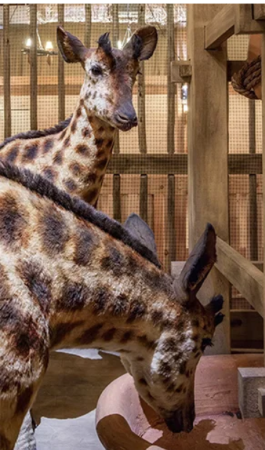
Did they address the question of what all those animals were going to eat once they got off the ark?
I’ve seen land that had just emerged from being drowned by sea water – nothing but a desolate muddy expanse without vegetation. It takes several years for vegetation to recover from such a flooding. I imagine that the carnivores would simply eat the other animals, but once those had run out, then what?
faded_Glory:
Actually, the carnivores couldn’t eat the other animals, because those animals were needed to breed and re-establish their populations. It takes a lot of handwaving to evade this problem. Literalists argue that some of the carnivores were still partly vegetarian at that point, not having made the full transition to carnivory in the brief time after their creation. They propose that the carnivores could eat carcasses left over from the flood. They propose that Noah let the animals out in stages, so that the prey animals had time to disperse before the predators were released. They posit that Noah had stocked the Ark with a bunch of extra food to tide the animals over. It’s rationalization after rationalization, all in service of the goofy idea that the story is literally true.
For the vegetation problem, they posit that while the area near the Ark was barren immediately after the waters receded, there were other land areas where vegetation had had time to grow. They cite the fact that while the ark was still floating, Noah sent out a dove which returned holding an olive leaf in its beak, which was conclusive evidence that dry land was emerging. During the time between the dove’s return and the time they left the Ark, they claim there was ample time for vegetation to grow and become usable as food.
The whole thing makes me want to take YECs by their collective shoulders, give them a shake, and say “You are grown-ass adults. This is the 21st century. The Flood story is a myth. Accept it and move on.”
I attended a lecture by a member of the Acoma tribe, explaining their traditional tribal religious tenets. There were multiple gods, and creation tales, and mythical tension resolutions and lots of names and details. After the lecture, someone asked if they actually believed that stuff, and the answer was “not literally, of course not.” Instead, those tales were regarded as a reflection of tribal history and values. I was struck by the contrast with Christian True Believers, who seem fully capable of sincerely believing six idiotic things before breakfast. The Acoma people are rational. The flood geologists, not so much.
You could do that. Or, you could start trading in miracles and make a boatload.
faded_Glory:
Yeah, I’d be a lot richer if it weren’t for these pesky ethics.
keiths,
Hi Keiths
I find the discussion of history vs symbolism in the bible quite interesting. It stimulated a discussion w Gemini this AM and may shed some light on why God does not just “give us the answers” vs discovery over time.
https://share.gemini.google/v7V0gmhlRHxC
colewd:
I didn’t see anything in that discussion that addressed the question. Were you thinking of this?
I don’t see how any of that applies to the Shroud of Turin.
The question is simple. There are nonbelievers in the world who would become believers if the Shroud were proven to be authentic. That would ensure their salvation. God doesn’t provide the proof, meaning that some of those people will never become believers and will therefore be damned. God supposedly wants everyone to be saved:
If that’s true, why doesn’t God provide the one thing that would ensure the salvation of these individuals?
colewd,
This hearkens back to a question I asked you a couple of years ago:
As I vaguely recall, Dante’s Inferno reserved the outermost circle of hell for good people who had the bad luck to be born too soon or in the wrong place and never had the chance to find Jesus. That circle wasn’t a bad place, no torture, but no bad people allowed.
Flint:
Christians are forced to invent these sorts of unbiblical rationalizations to reconcile their own morality with the immorality of the biblical doctrine, which is unambiguous:
And:
“Whoever does not believe.” No exceptions for people who weren’t exposed to the gospel.
In response to the geographic problem of which my Mongolia/Alabama thought experiment is an example, William Lane Craig has proposed that if God sticks you in a place where you aren’t exposed to the gospel, it’s because he knows that you wouldn’t have believed if you had been exposed to it. It’s ludicrous, and it’s unfalsifiable. Pure rationalization with no evidentiary support.
keiths,
I think He has provided the proof (beyond a reasonable doubt) but the proof takes work to find. With time I think people will realise it. You should understand the challenge of generating images with very small units given you were in the semiconductor business. The image basic units of the Shroud “pixels” are microns in diameter and nanometers in depth.
Barry Swartz, who was a Jew, and was the Shroud imaging expert and agnostic returned to God after 20 years. He was delayed by the redness of the blood but convinced by a blood expert that the redness was expected due to the stress Jesus experienced.
Here is his Ted talk on his experience examining and ultimately lecturing on the Shroud.
colewd:
Why should it take work? If God wants people to believe the Shroud is authentic, he can immediately provide the evidence in a way that will convince everyone. People are living their lives and don’t have the time or inclination to investigate every one of the thousands of claimed miracles. God could save them the work, but he can’t be bothered. People are dying every day and going to hell because God is sleeping on the job.
Conclusion: If he exists at all, the Christian God doesn’t want everyone to be saved, contrary to what the Bible says.
I’ll repeat my question:
colewd:
As I said:
As I understand it, it’s known that there was an active cottage industry of people producing these “authentic” but implausible artifacts around the time and place the Shroud was first seen, and subsequent carbon dating placed its age right around that time. So for me, the case is closed. For those whose need to believe has slammed their minds shut, no evidence will or CAN ever be enough.
Flint:
Yeah, the joke was that if you gathered together all the pieces of wood that had been passed off as being from Jesus’s cross, they would be enough to fill a cargo ship.
As for the Shroud, when it first showed up in France, the Church investigated and found the artist who had created it. Later, a bishop complained to the pope that it was being displayed as if it were authentic, and the pope gave permission for the displays to continue provided that the priests made it absolutely clear to the people that the Shroud was a representation, not the real deal.
I don’t know how Shroud proponents deal with that issue.
keiths,
Or maybe people learn better when they are able to discover for themselves. We can have philosophical discussions on Gods strategies for human development but this does not help establish authenticity and the reality of His existence. We don’t know exactly what happens to people when they die but the Shroud can be scientifically investigated.
A simple AI search by you may resolve this.
In fact, you cannot have a philosophical discussion about God’s strategies without assuming your conclusion that there IS a god and that it has strategies.
We know in exhaustive detail what happens to people (and any living thing) when they die. But some of us won’t accept it.
colewd:
What lessons is God trying to impart by withholding proof of the Shroud’s authenticity? Is it important to him that we all learn about carbon dating and mass spectrometry?
And whatever the supposed lessons, couldn’t they be taught in a way that doesn’t involve sending people to hell?
What about people who don’t have the time or inclination to look into the Shroud? Or who investigate but find the evidence unpersuasive? Should their eternal fate hinge on that?
What about all of the other miracle claims? Are you investigating all of those? Have you looked at all of the purported Hindu miracles? What about the Scientology ‘superpowers’?
The Shroud doesn’t show up in the historical record until the 1300s. Do you think it was floating around for 13 centuries, but no one bothered to mention it? The Church investigated and found it to be a fraud. They even located the artist, who acknowledged creating it. Radiocarbon dating confirms that it was created during that time. That’s a pretty solid case, no?
Even if we assume against the evidence that it’s authentic, your God, if he exists, doesn’t care enough to prove that to us. He’s OK with the fact that the evidence points in the opposite direction, and he’s OK with the fact that people will go to hell because he can’t be bothered to supply proof.
I know that you want to believe that the Shroud is authentic, just as you want to beliieve that Donald Trump is an honest man, but the evidence doesn’t support either of those claims and in fact points the opposite way.
If you want to spend time on the Shroud despite all of the above, that’s your prerogative, but I think I’ve adequately explained why I would consider ir to be a waste of my time to look any further into it than I already have.
keiths,
I know because of my technical background in semiconductor manufacturign of which you share, that the Shroud is authentic beyond a reasonable doubt. Depositing the features on linen of the size and depth of the shroud is most likely beyond today’s imaging technology. I also know that you are struggling because of suffering in the world and you blame God who if all powerful could end it instantly.
The authenticity of the Shroud if you discover it through your own expertise to be most likely real is a huge emotional problem for you. I get this as suffering is the hardest theological issue to work through especially if you have personally experienced it. If we don’t experience it we see it almost every day as somewhere in the world it is reported by the media.
The easy way out which is to deny Gods existence is not going to resolve this conflict The right answer IMO is to work to understand Gods purpose and wrestle with the theological reason for suffering.
colewd:
No, you don’t. You want it to be true beyond a reasonable doubt, so you’re simply ignoring the evidence that it isn’t. Imagine you’re in court, trying to defend the authenticity of the Shroud. The prosecution has presented all the evidence I’ve laid out above and more (including things like the image on the shroud not being distorted in the way that it should be, given that the shroud was wrapped around the body). If you’re going to persuade the jury, you can’t just shrug and say “never mind all that”. If you care about the truth (and that’s a very big “if”), you shouldn’t ignore it either.
If the Shroud is authentic, why didn’t it show up until the 1300s? If people had been preserving it for 13 centuries, don’t you think someone would have mentioned its existence during that time? It would have been as famous then as it is now. Why did the Church conclude it was a fake? Why did an artist confess to creating it? Why have labs independently carbon dated it to the 1300s? Just a coincidence? If God exists, he knows that all of the above evidence points away from the Shroud’s authenticity. If it truly is authentic, why doesn’t he fix the problem by providing overwhelming evidence that it is authentic, especially given that there are people whose eternal fate depends on it? (For that matter, why doesn’t he just show up himself and tell us directly?)
Saying “but semiconductors!” to the jury without addressing all of the above wouldn’t persuade them, and it shouldn’t persuade you either.
I’m not struggling. The problem of evil is a problem for Christians but not for atheists. If God doesn’t exist, then it’s not hard to see why there is suffering in the world. Even if I were a theist, it wouldn’t be a struggle. I would just conclude based on the evidence that God isn’t the Christian God.
The easy way out is to believe things simply because you want them to be true, which is what you’re doing.
The right answer is to look at the evidence and base our beliefs on what it indicates, not on what we want it to indicate. Christians want Christianity to be true, so for them, there’s a real struggle: how can we hang on to our beliefs when the evidence doesn’t support them? How do we reinterpret and distort the evidence so that it props up our faith? That’s understandable, but it’s intellectually dishonest.
Why not just base our beliefs on the evidence and accept reality for what it is?
Somehow this hasn’t ever been as simple as it sounds. I think there is some truth to the claim that scientific theories are not supplanted by new evidence, but because the adherents of prior theories die and are not replaced. And that’s scientists, so imagine the problem with theologists. All too often, evidence cannot satisfy emotional or psychological needs – or childhood indoctrination. And since the needs are hardwired, the evidence must be made to fit or simply ignored.
Flint:
I’m certainly not arguing that it’s always simple. Witness Bill’s reluctance to accept even the most obvious and unpleasant truths about his Dear Leader.
It varies. It’s pretty simple to convince yourself that yes, the Dodgers really did let their bat boy play left field (it was an intersquad game, but still). Much harder to give up your lifelong religion. Somewhere in between is accepting that the Shroud of Turin is almost certainly not authentic.
The evidence is strong, and acknowledging the Shroud’s inauthenticity wouldn’t require Bill to jettison his religious faith, so it’s at least potentially within reach for him.
keiths,
I would bring into court a group of experts that would testify to difficulty in making the image on linen today vs 700 years ago or more. Did you listen to the video I posted from one of the Jewish imaging experts? When the experts for the skeptic testified for the Bas-Relief method of making the image I would have my experts show that this is not capable of creating the small shallow image units. There currently is no solid forgery hypothesis for a competent jury to vote for.
There is other supporting evidence including evidence that deals with the Carbon dating but the image data regarding the size and depth of the individual imaging units is the smoking gun for authenticity.
colewd,
You just proved my point. You brushed aside the evidence I presented above against the Shroud’s authenticity. If you want to persuade the jury, you’re going to have to do better than that. You need to confront the evidence rather than brushing it aside.
Addressing my questions would be a good start:
ETA: And by the way, the objection to the carbon dating — the notion that they were dating a medieval repair patch and not the Shroud proper, which is why they got a date in the 1300s — doesn’t hold up under scrutiny.
keiths,
Hi Keiths
The carbon dating was the original reason I did not take the Shroud seriously initially. My interest returned when a few new tests most notably the WAXS or wide angel x ray scattering which tested the break down of the linen cellular structure brought the medieval date into question. Given the propensity of evidence (blood stains type, pollen type etc) I thought the Shroud authenticity was a real possibility.
It is only recently that I looked at the make up of the image and realised the microscopic size of the image units. Microscopic imaging is an area we both have experience with, you as a mask user, and me as the supplier of Mask pattern generating equipment. Given it would be very difficult and expensive to reproduce this image today I don’t see how this image could be a forgery and is more likely a legitimate miracle.
Since we last debated Christianity I have become more convinced the basic idea (short of the dogma) is objective reality.
colewd:
Your excitement is premature. I remember seeing a Dan McClellan video a while back that addressed the x-ray scattering claims. Turns out the x-ray textile dating methodology they used was brand new, unvalidated, and the Shroud was its first use. Also, I recall him saying that for the methodology to even have a chance of working, the environmental conditions would have to have been maintained in a fairly narrow range for the entire 13 centuries of the Shroud’s existence. That clearly didn’t happen. I know that the Shroud was even on fire at one point. I’ll see if I can track down the video.
So here’s the situation: independent labs using a well-established methodology, radiocarbon dating, have determined that the Shroud was created in the 1300s. Independent historical evidence confirms that time range. Meanwhile, the people who contest that range are using a brand new, unvalidated methodology that you wouldn’t expect to work anyway given that the environmental conditions haven’t been controlled. Who do you think is more likely to be right?
The answer is obvious. The radiocarbon dates are far more trustworthy. You’ve latched onto the x-ray claims not because they’re convincing, but because you want them to be true. It’s intellectually dishonest.
I learned at one that the blood and pollen evidence is very weak, and why, but I don’t remember why and can’t be arsed to go back and find out. As I’ve said, I think it’s a waste of my time to investigate Shroud claims until someone comes up with evidence that survives scrutiny by experts and is robust enough to outweigh all the evidence against the Shroud’s authenticity, which is extremely convincing.
The nice thing about Dan McClellan’s videos is that he’s extremely objective, unbiased and thorough. He does the legwork so that we don’t have to. He’s also a Christian (Mormon, in fact) who would be quite happy if the Shroud turned out to be authentic, so it’s not like he’s on a crusade to debunk Shroud claims. If people like him start to get excited about new evidence, then I’ll sit up and take notice.
The basic idea is dogma. I don’t doubt that you’re more convinced, but I do doubt that it’s for rational reasons.
I notice that you haven’t answered my questions and are ignoring the evidence I’ve provided, concentrating only on the evidence that you (mistakenly) think supports your desired conclusion. For someone who likes to accuse others of cherry-picking, you sure do a lot of it yourself.
Give my questions a whirl. I’m curious to hear your answers.
Here’s the McClellan video on the x-ray methodology (11 minutes):
And here’s one on the radiocarbon dating in general (8 minutes):
I agree they are more thrust worthy but that does not mean another method that does not confirm the result should not add question to the dating method or the sample generating method.
Fair enough. At this point I doubt your skepticism is for rational reasons.
BTW your link is not working. I think if you ask me to answer your questions you should show good faith and look into the imaging as a simple AI search will get you started to understanding the difficulty of generating these microscopic features over
14 feet of linen.