The Ghost in the Machine

Let’s suppose there really is a Ghost in the Machine – a “little man” (“homunculus”) who “looks out” through our eyes, and “listens in” through our ears (interestingly, those are the two senses most usually ascribed to the floating Ghost in NDE accounts).  Or, if you prefer, a Soul.

And let’s further suppose that it is reasonable to posit that the Ghost/Soul is inessential to human day-to day function, merely to conscious experience and/or “free will”; that it is at least possible hypothetically to imagine a soulless simulacrum of a person who behaved exactly as a person would, but was in fact a mere automaton, without conscious experience – without qualia.

Thirdly, let’s suppose that there there are only a handful of these Souls in the world, and the rest of the things that look and behave like human beings are Ghostless automatons – soulless simulacra. But, as in an infernal game of Mafia, none of us know which are the Simulacra, and which are the true Humans – because there is no way of telling from the outside – from an apparent person’s behaviour or social interactions, or cognitive capacities – which is which.

And finally, let’s suppose that souls can migrate at will, from body to body.
Continue reading

“Darwin’s Delusion” Concise Version

LONG WINDED VERSION AT UD:
Darwin’s Delusion vs. Death of the Fittest

CONCISE VERSION AT TSZ
From Kimura and Mayurama’s paper The Mutational Load (eqn 1.4), Nachman and Crowell’s paper Esitmate of the Mutation Rate per Nucleotide in Humans (last paragraph), Eyre-Walker and Keightley’s paper High Genomic Deleterious Mutation rates in Homonids (2nd paragraph) we see that by using the Poisson distribution, it can be deduced that the probability P(0,U) of a child not getting a novel mutation is reasonably approximated as:

where 0 corresponds to the “no mutation” outcome, and U is the mutation rate expressed in mutations per individual per generation.

If the rate of slightly dysfunctional or slightly deleterious mutations is 6 per individual per generation (i.e. U=6), the above result suggests each generation is less “fit” than its parents’ generation since there is a 99.75% probability each offspring is slightly defective. Thus, “death of the fittest” could be a better description of how evolution works in the wild for species with relatively low reproductive rates such as humans.

Naturalism, Normativity, and Nihilism

Hopefully it will not be seen as an abuse of posting privileges if I share some thoughts I’ve been developing over the past few years.   But I’ve been prompted to share them by JLA’s assertion at Uncommon Descent that naturalism entails nihilism — an assertion that seems unquestioned in that forum. I think that that assertion collapses on closer inspection.

The problematic I’m concerned with here is about the relations between naturalism, normativity, and nihilism.  Each of these terms avails itself of a straightforward articulation, but I’ll be explicit: by ‘naturalism’ I mean that all real phenomena have a spatio-temporal location and participate in causal relations with other spatio-temporally locatable particulars.  By ‘normativity’ I mean that thought and action for at least some intelligent beings are governed by norms or rules of what counts as correct or incorrect, valid or invalid, good or bad.  And by ‘nihilism’ I mean that there is nothing of any real, genuine value, meaning, purpose, or fact in the world.

Now, does naturalism entail  nihilism?   It does, I submit, if — and only if — one has an a priori commitment to the further view that normativity is non-natural.  Put otherwise, if normativity is non-natural, but the natural is all that there is, then there isn’t any normativity — not really.   And nihilism follows as a result.

Continue reading

Split-brain patients and the dire implications for the soul

Note: I have changed the title of this post for the benefit of readers who are unfamiliar with the term ‘substance dualism’.

Many of our readers – especially among the regulars at Uncommon Descent – are substance dualists.  That is, they believe that each of us has an immaterial mind or soul that constitutes our true self, and that the body, including the brain, is merely a vehicle “inhabited” and controlled by the mind or soul.

There are many problems with this idea, which is why it is rejected by most neuroscientists and philosophers.  One of the most striking is the problem posed by the strange characteristics of split-brain patients, as described in this video by VS Ramachandran:


Continue reading

If there is no God….

JLAfan2001 writes at UD:

If there is no God and there’s just naturalism, materialism:

• No objective, absolute, inherent meaning in life or the universe
• No objective, absolute, inherent purpose in life or the universe
• No objective, absolute, inherent value in life or the universe
• We are the cobbled together Frankensteins of billions of years of trial and error
• No objective, absolute, inherent morality in life or the universe. No good, no evil, no right, no wrong
• No objective, absolute, inherent truth in life or the universe
• No objective, absolute, inherent knowledge in life or the universe
• No objective, absolute, inherent logic in life or the universe
• We have no free-will, mind, consciousness, rationality or reason. They are illusions and our very personhood, identity and humanity are not real.
• The emotions we express are just chemicals in our brain. The very things we seek in life like happiness, peace, contentment, joy are just chemicals reducing us to nothing more than chemical addicts.
• We are no more important than other animals. A dog is a rat is a pig is a boy.
• There is no after life. Once we die, we fade from existence and all our memories, experiences, knowledge etc goes with it. In time, we are forgotten.
• All the things we do in life are just for survival. Learning, loving, seeking, being positive, eating, relating, having fun are created for the sake of ignoring the real reason we are here and that’s to live as long as we can.
• There is no help coming to save humanity as a species or as individuals. We are all alone and on our own. If you can’t survive, you die.

This is reality if there is no God. I don’t give a rat’s ass what Dawkins, Dennett, Harris, Hitchens or what other atheist wrote a book says. Nihilism is the truth and atheism is a noble lie just the same as theism would be. Survival and reproduction. THAT”S IT. All other things are made up bullshit for survival and reproduction. The atheists of old knew this. The new atheists are trying to say that you can have your cake and eat it too but there really is no cake.

I assumed it was satire; KF assumes not.  Be that as it may, it seems usefully wrong:

Continue reading

Why be concise?

This is an obsession of mine, but I think it matters.  From to time we are all guilty of over-long sentences,  unnecessarily long, unusual, technical or abstract words, or just writing too much. But surely some of the citizens of UD are the worst offenders. I was moved to write this by the most recent post from KF which runs to  3000 words – quite short by his standards but rather longer than the word limit for most university essays. I don’t often have time to wade through posts of this length but for once I tried and I think it can be summarised as:

Materialism means there is no ultimate foundation for ethics and no human free will and this leads to all sorts of evil behaviour.

(I may have missed other important points amongst the deluge)

I am picking on KF because he just posted and he is a serial offender, but many of us do it on both sides of the debate. Does it matter if posts and comments are too long and difficult to read? After all isn’t it the content that matters not the presentation?  I don’t think so.

  • Your critics are unlikely to take the time to read it. So you have subtly cut off discussion and debate.
  • It often covers sloppy thinking. It is so easy to hide fallacies and lack of evidence under a blizzard of abstractions and quotes.

On a more personal level it is egocentric. It is saying that I and my idea are so important you should all be prepared to spend the next 30 minutes wading through my post. My time is too important to be spent extracting the essential points and anyway I want to show how clever I am.

Now I am must stop before I go on too long Smile

On The Origin of Species, read by Richard Dawkins (2007)

There is grandeur in this view of life, with its several powers having been originally breathed into a few forms or into one, and that while this planet has gone cycling on according to the fixed law of gravity, from so simple a beginning, endless forms most beautiful and most wonderful have been, and are being, evolved.

These are the closing words of Darwin’s On the Origin of Species, read abridged in an audio recording by Richard Dawkins from 2007.

How should we read Darwin’s book today?

Should we read it as history? Is On The Origin of Species a Hopeful Monster of a theory lacking a mechanism and made irrelevant by more recent discoveries?

As politics? Is the book no more than a privileged English gentleman naturalist explaining interesting but unsupportable things to his own social class?

As science? Is it no more than a naturalist’s attempt to synthesise what was known or speculated from biology, geology and paleontology, physics and chemistry as it was known at the time?

Continue reading

Final word to KF

In response to KF here: In my view it is no more, or less, slanderous imply a relationship between “Darwinism” and Nazi-ism than it is to imply a relationship between “anti-homosexualism” and Nazi-ism.  To point out that the Nazis conviction that the “unfit” should be “culled” may have owed something to their reading of Darwin, is at least equivalent, I would say, to pointing out that the Nazi’s conviction that homosexuals should be “culled” may have owed something to the view that homosexuality is deviant, immoral and dangerous.  To say the first is not to say that Darwinists are Nazis; to say the second is not to say that anti-homosexualists are Nazi.  To insist that the first is justifiable but the second slander, is, I suggest, to impose a double standard.  Moreover, to suggest, as KF does, that by “enabling” posters here to suggest a comparison between the anti-homosexualism of some religious views and the anti-homosexuality of the Nazis I am somehow comparable to the “good” Germans who “enabled of Nazi-ism is at least as “slanderous” as the comparison he objects to.  However, I can live with that.  The best response, in my view, to slander, is effective rebuttal, not censorship.

I agree with KF that comparisons to Nazis is inflammatory.  That is as far as I will go.

Continue reading

FOR RECORD: An explanatory note to KF of UD

Re this:

The principles on which this site is run are summarised here and here.  The key rule is: “assume other posters are posting in good faith”.

That does not mean that you have to believe that they are posting in good faith, simply that you should make that assumption for the purposes of discussion.

I will not “correct” posts – people are responsible for their own posts, and for any errors they contain.  I will not delete posts, although I may move posts to a different thread, or to the Sandbox or to Guano.  They remain publicly viewable. I will however, delete links to porn or malware, and posting such links or material are the only grounds on which I will ban anyone.  Posters are complete free to disagree with me, with each other, and to be mistaken.

UD is run on different lines.  Fine.  I prefer mine.

Denis Noble again….

Denis Noble has a new review out, in Experimental Physiology called Physiology is rocking the foundations of evolutionary biology.  Unfortunately the article itself is behind a paywall, but here is the abstract:

The ‘Modern Synthesis’ (Neo-Darwinism) is a mid-20th century gene-centric view of evolution, based on random mutations accumulating to produce gradual change through natural selection. Any role of physiological function in influencing genetic inheritance was excluded. The organism became a mere carrier of the real objects of selection, its genes. We now know that genetic change is far from random and often not gradual. Molecular genetics and genome sequencing have deconstructed this unnecessarily restrictive view of evolution in a way that reintroduces physiological function and interactions with the environment as factors influencing the speed and nature of inherited change. Acquired characteristics can be inherited, and in a few but growing number of cases that inheritance has now been shown to be robust for many generations. The 21st century can look forward to a new synthesis that will reintegrate physiology with evolutionary biology.

It’s a nice synthesis of the views he expresses in his book, The Music of Life, which I mentioned a previous post, Reductionism Redux , but he also lays out very clearly the ways in which four assumptions that have underlain much thinking in evolutionary biology since the “modern synthesis” (not so modern now), need to be revisited.

Continue reading

Specification for Dummies

I’m lookin’ at you, IDers 😉

Dembski’s paper: Specification: The Pattern That Specifies Complexity gives a clear definition of CSI.

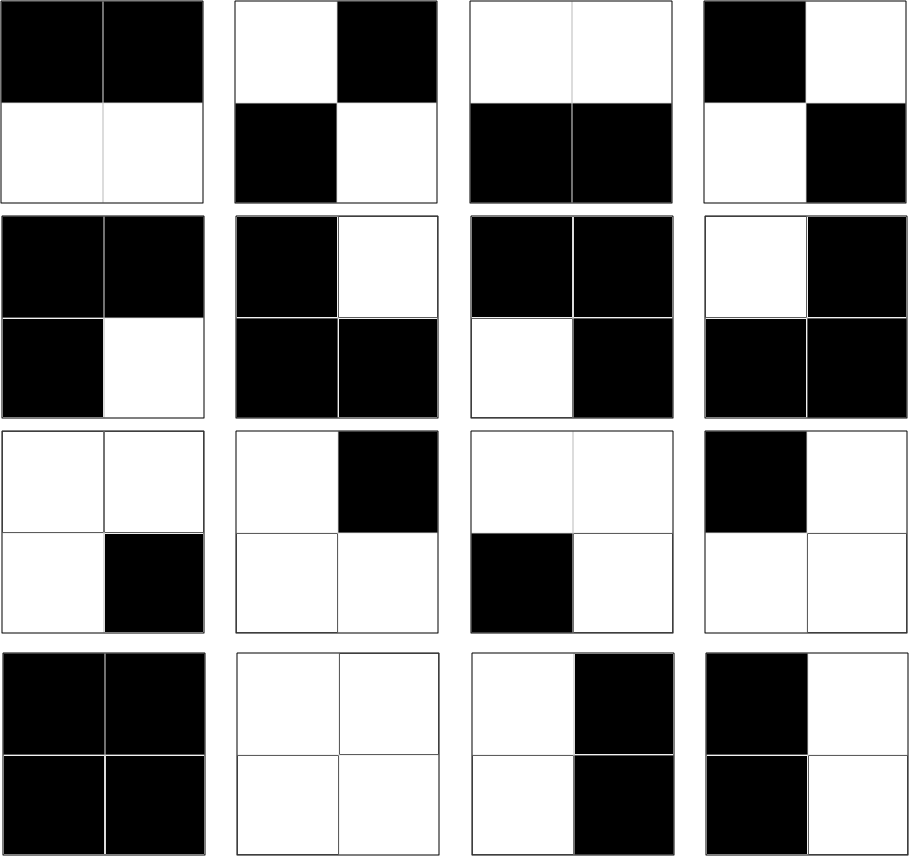
The complexity of pattern (any pattern) is defined in terms of Shannon Complexity.  This is pretty easy to calculate, as it is merely the probability of getting this particular pattern if you were to randomly draw each piece of the pattern from a jumbled bag of pieces, where the bag contains pieces in the same proportion as your pattern, and stick them together any old where.  Let’s say all our patterns are 2×2 arrangements of black or white pixels. Clearly if the pattern consists of just four black or white pixels, two black and two white* , there are only 16 patterns we can make:

Patterns1And we can calculate this by saying: for each pixel we have 2 choices, black or white, so the total number of possible patterns is 2*2*2*2, i.e 24  i.e. 16. That means that if we just made patterns at random we’d have a 1/16 chance of getting any one particular pattern, which in decimals is .0625, or 6.25%.  We could also be fancy and express that as the negative log 2 of .625, which would be 4 bits.  But it all means the same thing.  The neat thing about logs is that you can add them, and get the answer you would have got if you’d multipled the unlogged numbers.  And as the negative log of .5 is 1, each pixel, for which we have a 50% chance of being black or white, is worth “1 bit”, and four pixels will be worth 4 bits.

Continue reading

Protein Space and Hoyle’s Fallacy – a response to vjtorley

‘vjtorley’ has honoured me with my very own OP at Uncommon Descent in response to my piece on Protein Space. I cannot, of course, respond over there (being so darned uncivil and all!), so I will put my response in this here bottle and hope that a favourable wind will drive it to vjt’s shores. It’s a bit long (and I’m sure not any the better for it…but I’m responding to vjt and his several sources … ! ;)).


“Build me a protein – no guidance allowed!”

The title is an apparent demand for a ‘proof of concept’, but it is beyond intelligence too at the moment, despite a working system we can reverse engineer (a luxury not available to Ye Olde Designer). Of course I haven’t solved the problem, which is why I haven’t dusted off a space on my piano for that Nobel Prize. But endless repetition of Hoyle’s Fallacy from multiple sources does not stop it being a fallacious argument.

Dr Torley bookends his post with a bit of misdirection. We get pictures of, respectively, a modern protein and a modern ribozyme. It has never been disputed that modern proteins and ribozymes are complex, and almost certainly not achievable in a single step. But

1) Is modern complexity relevant to abiogenesis?

2) Is modern complexity relevant to evolution?


Here are three more complex objects:

DESCRIPTION HERE

Circuit Board

DESCRIPTION HERE

Panda playing the flute

DESCRIPTION HERE

er … not yet in service!


Continue reading

Prizegiving!

Phinehas and Kairosfocus share second prize for my CSI challenge: yes, it is indeed “Ash on Ice” – it’s a Google Earth image of Skeiðarárjökull Glacier.

But of course the challenge was not to identify the picture, but to calculate its CSI. Vjtorley deserves, I think, first prize, not for calculating it, but for making so clear why we cannot calculate CSI for a pattern unless we can calculate “p(T|H)” for all possible “chance” (where “chance” means “non-design”) hypotheses.

In other words, unless we know, in advance, how likely we are to observe the candidate pattern, given non-chance, we cannot infer Design using CSI. Which is, by the Rules of Right Reason, the same as saying that in order to infer Design using CSI, we must first  calculate how likely our candidate pattern is under all possible non-Design hypotheses.

As Dr Torley rightly says:

Professor Felsenstein is quite correct in claiming that “CSI is not … something you could assess independently of knowing the processes that produced the pattern.”

And also, of course, in observing that Dembski acknowledges this in his paper, , Specification: The Pattern That Signifies Intelligence, as many of us have pointed out.  Which is why we keep saying that it can’t be calculated – you have to be able to quantify p(T|H), where H is the actual non-design hypothesis, not some random-independent-draw hypothesis.

Continue reading

DonaldM, at UD, asks…

…an odd, but revelatory, set of questions:

1. How do you know scientifically (and I emphasize “scientifically” here because I want to make it clear that theological, metaphysical or philosophical opinions – while important for other reasons – have no bearing on the question at hand) that the properties of the Cosmos are such that any apparent design we observe in natural systems can not be actual design, even in principle?

I don’t.

2. How do you know scientifically that Nature (or the Cosmos) is a completely closed system of natural cause and effect? (Recall Dawkins claim that a universe superintended by a Deity would look much different than ours as he says in The God Delusion several times)

I don’t.

3. How do you know scientifically that the properties of biological systems are such that any apparent design we observe in them can not be actual design, even in principle? (The Blind Watchmaker and Dawkins’s claim that “Biology is the study of complicated things that give the appearance [emphasis mine] of having been designed for a purpose.”)

I don’t.

4. How do you know scientifically that no supernatural being, if such actually existed, could ever take any action within nature itself that would produce observable phenomenon or effect any change in the arrangement of matter or energy anywhere in the Cosmos?

I don’t.

Does anyone here?  And does any one make any such claims?  I don’t.

Continue reading

Is Darwinism a better explanation of life than Intelligent Design?

I recently bumped a post by keiths: Things That IDers Don’t Understand, Part 1 — Intelligent Design is not compatible with the evidence for common descent as it had come up in a recent discussion.  Vjtorley has responded on UD with a post called Is Darwinism a better explanation of life than Intelligent Design?

I’ve unbumped keiths’ post, as the thread was getting rather long, and in any case, it would be good to respond to vjtorley, who is, of course, very welcome to come over here in purpose.  I like Dr Torley, and do hope he will drop by, but in any case, the loudhailer seems to work reasonably well!

Feel free to continue the discussion that had been renewed on keiths’ post in this one (or on the old one if you like, using the link).