Proof: Why naturalist science can be no threat to faith in God

I’m going to demonstrate this using Bayes’ Rule. I will represent the hypothesis that (a non-Deist, i.e. an interventionist) God exists as H_G, and the evidence of complex life as L_C.  What we want to know is the posterior probability that H_{G} is true, given L_C, written

    \[P(H_{G}|L_N)}\]

which, in English, is: the probability that God exists, given the evidence before us of complex life.

Continue reading

Chance and 500 coins: a challenge

My problem with the IDists’ 500 coins question (if you saw 500 coins lying heads up, would you reject the hypothesis that they were fair coins, and had been fairly tossed?)  is not that there is anything wrong with concluding that they were not.  Indeed, faced with just 50 coins lying heads up, I’d reject that hypothesis with a great deal of confidence.

It’s the inference from that answer of mine is that if, as a “Darwinist” I am prepared to accept that a pattern can be indicative of something other than “chance” (exemplified by a fairly tossed fair coin) then I must logically also sign on to the idea that an Intelligent Agent (as the alternative to “Chance”) must inferrable from such a pattern.

This, I suggest, is profoundly fallacious.

Continue reading

Barry gets it wrong again….

Here.


The null hypothesis in a drug trial is not that the drug is efficacious. The null hypothesis is that the difference between the groups is due to chance.

No, Barry.  Check any stats text book.  The null hypothesis is certainly not that the drug is efficacious (which is not what Neil said), but more importantly, it is not that “the difference between the groups is due to chance”.

It is that “there is no difference in effects between treatment A and treatment B”.

When in hole, stop digging, Barry!

Continue reading

Yes, Lizzie, Chance is Very Often an Explanation

[Posted by Barry at UD]

Over at The Skeptical Zone Elizabeth Liddle has weighed in on the “coins on the table” issue I raised in this post.

Readers will remember the simple question I asked:

If you came across a table on which was set 500 coins (no tossing involved) and all 500 coins displayed the “heads” side of the coin, how on earth would you test “chance” as a hypothesis to explain this particular configuration of coins on a table?

Dr. Liddle’s answer:

Chance is not an explanation, and therefore cannot be rejected, or supported, as a hypothesis.

Staggering. Gobsmacking. Astounding. Superlatives fail me.

Continue reading

A Statistics Question for Barry Arrington

Re your post here:

  • If you came across a table on which was set 500 coins (no tossing involved) and all 500 coins displayed the “heads” side of the coin, how on earth would you test “chance” as a hypothesis to explain this particular configuration of coins on a table?

Even if the observer was not party to the information that there was “no tossing  involved”?

The reason I ask, is that you seem to have revealed an conceptual error that IMO bedevils much discussion about evolution as an explanation for the complexity of life.

Continue reading

The ‘A’ Word

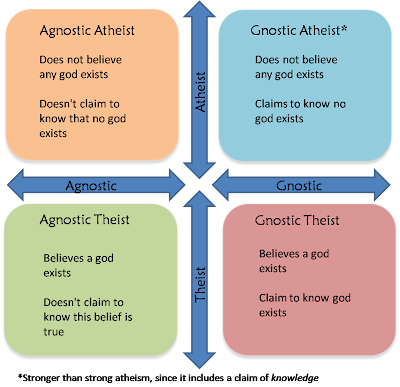
I am an atheist. I do not believe that any gods exist.

Being an atheist does not mean that I claim to have knowledge or proof that no gods exist. I have simply never encountered any objective, empirical evidence for the existence of any entity that fits the definition of “god”. If I were provided with such evidence, I would provisionally accept that at least one such entity exists.

Atheism is not a stronger variant of agnosticism. It is simply a lack of belief. Knowledge and belief are orthogonal concepts:

The word “atheist” has social stigma. Some people characterize their lack of belief as agnosticism to avoid offending their family and friends. That doesn’t change the fact that if you lack belief in a god you are, by definition, an atheist. You might also be an agnostic, but that’s a separate issue.

The only way to eliminate the stigma is to show the people we care about that belief in gods is not required to be a good spouse, parent, child, friend, or neighbor.

I am an atheist. If you don’t believe in a god or gods, you are too.

Thanks to Alan Fox for suggesting this topic.


Why Metaphysics is (Almost) Bullshit

I have finally finished reading Robert Brandom‘s massive tome (650 pp.) Making It Explicit, and it’s given me a lot of new tools with which to think about the nature of concepts and the relation between language, perception, action, and the world.  This is my first attempt to do something with what I’ve learned from Brandom.

It is crucial to Brandom’s account that conceptual content — what our thoughts are about — is constrained in two different ways: normatively and causally.  Normative constraint is, for Brandom, essentially and fundamentally social and linguistic.  For a community of speakers, each speaker holds herself and the others accountable for what they say by keeping track of the compatibility and incompatibility of their commitments and entitlements. (If I assert p, and p implies q, then I am committed to q.  If I assert p, and p implies q, but I am already committed to ~q, then I am not entitled to assert p.  And so on.)  The various ways in which we keep track of our own commitments and entitlements, and our own, is a process that Brandom calls “deontic scorekeeping”: deontic from <I>deonta</I> (Greek, “duty”), what we ought to be committed to.   We keep score of what we ought to say.    Deontic scorekeeping is the only normative constraint on discursive statuses — what it is that we believe or desire.  The statuses — the beliefs and desires — are instituted by the attitudes of commitment, entitlement, acknowledgement, avowal, disavowal, and so on — and are only fully intelligible in those terms.

Continue reading

UD censorship circumvention thread

Rampant censorship at Uncommon Descent has left many of us banned and unable to post comments there.  Others are able to post but are subject to having their comments delayed in the moderation queue, defaced, or deleted altogether at the whims of moderators (such as UD “President” Barry Arrington*) whose egos are large and fragile.

This thread offers a safe place for folks to respond to UD posts and comments without the threat (or the reality) of censorship. It’s also a good place to cross-post and preserve UD comments that you think are likely to be censored.

If the thread becomes popular, we can sticky it or otherwise make it easily accessible from the TSZ home page.

* I kid you not – look at the bottom left corner of the UD home page.

How Was Darwin Wrong? – Darwin’s Errors

O.k. then, here’s your chance, TSZ folks. Have at it.

Darwin made errors, even Darwinian evolutionist Mike Elzinga agrees.

What are/were those errors/mistakes?

Perhaps the odd closet ‘Darwinist’ might even think to change their mind about calling them-self a ‘Darwinist’ as a result of answers provided in this thread…or it could be a rather short thread, with few admissions.

Context: Preprint for a Douglas Allchin paper in American Biology Teacher, 2009 (same Journal that published Theodosius Dobzhansky’s theistic evolution: “Nothing in Biology Makes Sense…” paper, 1973) Celebrating Darwin’s Error’s.

Title Changed: from “How Darwin Was Wrong” to “How Was Darwin Wrong?” – 06-12-2013

The Possibility of Error

Since the discussion about the possibility of error is much-discussed at Uncommon Descent, I thought it might be interesting to see how Josiah Royce develops his argument concerning “the possibility of error” in his The Religious Aspect of Philosophy (1885).  (I’m using The Philosophy of Josiah Royce, which I found recently in a used-book store. I assume that no one here is too concerned about quotations or citations, but those are available on request.)

Royce’s question here is, “how is error possible?” — and by ‘how’ he means, “what are the logical conditions for the possibility of error?”   An error, he points out, is our recognition of the failure of a judgment to agree with its object.  How is possible for us recognize that our judgments have failed to agree with their purported objects?   The puzzle goes as follows: on the one hand, if the object is entirely within our cognitive grasp, our assertion about it would fully correspond to the object — in which case, there would be no error.  On the other hand, if the object were entirely beyond our cognitive grasp, we would be unable to recognize the lack of correspondence between the judgment and the object — in which case the error would be unrecognizable.  So our ability to recognize errors as errors requires that we have “partial knowledge” of the object.  So what is partial knowledge, and how is it possible?

[It will not surprise anyone here who knows how I think to learn that, from my point of view, the above is more-or-less sound, whereas the next bit utterly goes off the rails.]

What is required, Royce thinks, is that both the judgment and the object are contained within some larger, more inclusive thought that can compare them against them against one another and notice the correspondence (or lack thereof) between them.  And since there are infinitely many errors, the inclusive thought must be all-inclusive — it must contain all possible judgments and their objects.  And that in turn must be the Absolute Knowledge and Absolute Mind of God.  (Didn’t see that one coming, eh?)

TL;DR version: there are errors, therefore God.


“The selective incompleteness of the fossil record”

Denyse O’Leary quotes Steve Meyer’s question:

Why, he [Agassiz] asked, does the fossil record always happen to be incomplete at the nodes connecting major branches of Darwin’s tree of life, but rarely—in the parlance of modern paleontology—at the “terminal branches” representing the major already known groups of organisms?…

Was there any easy answer to Agassiz’s argument? If so, beyond his stated willingness to wait for future fossil discoveries, Darwin didn’t offer one.

and responds:

And no one else has either.

Oh, yes, they have, Denyse.  That’s what what punk eek was.  But it also falls readily out of any simulation – you see rapid diversification into a new niche at a node, and thus few exemplars, followed by an increasingly gradual approach to a static optimum, and thus lots of exemplars.  But I present an even more graphic response: when you chop down a tree, and saw it up into logs for your fire, what proportion of your logs include a node?


What defines “good” design in the composition of music and the tuning of musical instruments?

Knowing Lizzie, in addition to being a scientist, is a teacher of music theory and an accomplished musician, I thought I’d frame one aspect of the ID discussion in terms of musical ideas and philosophy.

“Bad design” is one of the most formidable arguments against intelligent design. I’ve responded to this by saying that what constitutes “good design” depends on the goals of the designer. If fuel efficiency is the criteria of good design, then a motorcycle is a better design than an SUV. But some will argue the SUV is a better design for snowy and icy conditions when transporting babies, thus an SUV is a better design. The problem is what constitutes “good design”, and who decides the criteria for good?

We also have the paradoxical situation where good drama needs a bit of “bad” designed into it. If a great novel told a story with no problems, will it be a good drama?

“Once upon a time there were no problems…there were never any problems or difficulties….they lived happily ever after”.

Continue reading

Putting a few things straight….

Apologies for absence (which will continue a little longer, but the end is in sight) – I am just catching up with things here.

First of all, I’d like to confirm for both regulars and occasional readers that the policy of this site is not to delete comments (apart from commercial spam).  They can be moved, but remain visible.  The only content that is redacted is content that is NSFW or malware links.

Similarly, the only grounds for banning (again apart from commercial spammers) are posting NSFW content or malware links.

If you have author rights here, you will find you have the technical ability to temporarily delete comments, but please do not do so.  Thanks to those who restored the deleted comments, and thanks to KN for his graciousness over this matter.

To some of those at UD who have commented on Barry’s thread claiming he was “effectively banned” here:

  • No, he was not, although it may have seemed like it at the time, and I have now given him the permissions to post an OP if he would like.
  • The strapline to this blog is addressed to all who post here, including me.  I have always liked that line from Cromwell, and it is a core principle of this site, however difficult to adhere to.
  • We are not a “bunch of atheists”.  A lot of us are opponents of the Intelligent Design movement, but not all, and of those of us who are, not all of us oppose all aspects of Intelligent Design as a concept.  Also of those who are opponents of Intelligent Design, not all are atheists. And of those who are, at least some of us have come to that position via a long and thoughtful, sometimes painful, road.
  • Finally: anyone from UD is welcome to post here, and while the default registration is “subscriber”, author permissions can be given on request.


Entropy and Disorder from a creationist book endorsed by a Nobel Laureate

Here is an online creationist/ID book.
From http://www.ccel.us/gange.app.html#App

“I was particularly pleased with Dr. Gange’s refusal of the idea of materialism, and the convincing arguments supporting that refusal. In fact, the book will be a welcome response to materialism. Good luck, for a good book!”

Eugene Wigner, Nobel Laureate in Physics

The book had an appendix on thermodynamics.

“We noted earlier that entropy can be correlated-but not identified-with disorder. And we said, moreover, that this correlation is valid in only three cases-ideal gases, isotope mixtures, and crystals near zero degrees Kelvin. The truth of the matter is illustrated by considering the two chemically inert gases, helium, and argon.(7) In our mind’s eye we imagine two balloons, one filled with helium and the other with argon. First, we lower the temperature of both balloons to zero degrees Kelvin. This makes all the gas molecules stop moving in either balloon. Next, we get the molecules moving by heating both balloons to 300 degrees Kelvin (room temperature). Were we to mathematically calculate the increase in entropy, we would find that it was 20 percent higher in the argon balloon than in the helium balloon (154 v. 127 joules per mole per degree Kelvin). But since helium molecules are ten times lighter than argon molecules, they are moving three times faster and thus are more disordered. Here, then, is an example where higher entropy is accompanied by lower disorder, thereby demonstrating that we cannot identify one with the other. In the particular example cited, the greater argon entropy comes from the closer quantum translational energy levels identified with its greater molecular mass as described by the Sackŭr-Tetrode equation.
Continue reading

ID & Explanations

Every camp in the ‘biological origins debate’ has its own explanation(s) as to where the complexity and diversity of life comes from. Some of these explanations would seem to be driven by prior commitments and ideologies (on both sides) and in some cases (notably from the DI and over at UD) they are part of a bigger assault on the opposing viewpoints perceived commitments themselves.

So what makes for a good explanation? Here’s a couple of resources I found interesting:

http://www.culturallogic.com/research-links/

http://philosophicaldisquisitions.blogspot.com/2009/12/explanations-gentle-introduction_28.html

http://philosophicaldisquisitions.blogspot.com/2010/05/what-good-is-explanation-part-1.html

http://philosophicaldisquisitions.blogspot.com/2010/06/what-good-is-explanation-part-2.html

Perhaps we could have a discussion on what makes for a good explanation and look at the various available explanations for biological origins in this framework?

[Multiple edits]

On “Self-Evident Truths”

When one talks about a “self-evident truth,” what exactly is one talking about?

In one sense, it is “self-evidently true” that when one looks at an object — say, this pint glass next to me as I type — I see that it is a pint-glass.  It is “self-evidently true” that I am looking at a pint-glass (putting to aside worries of Cartesian demonic deception), because I do not perform an inference.  My perception of the pint-glass is not the conclusion of an argument, based on premises.  It is a paradigm case of non-inferential knowledge.

But in another sense, this perceptual knowledge is not “self-evident,” if by that we mean knowledge that does not depend on any further presuppositions.  For the contrary is the case: a great deal of background knowledge must be presupposed in order for me to see the pint-glass — for example, I must have the concept of “pint-glass” and know how to apply that concept.  Even the transparent cases of analytic propositions (“a vixen is a fox”, “the sum of the interior angles of a Euclidean triangle is 180 degrees”, “every effect has a cause”) presuppose as their respective background an adequate grasp of the concepts involved.

It is sometimes said that if a proposition is self-evidently true, then nothing can be done which would show it to be to true to someone who denied it.  But this is not quite right.  What is right is that a proposition is self-evidently true, then it cannot be demonstrated from some other premises nor arrived at through generalizations — it is not grounded in either deduction or induction, one might say.

But that does not mean that one cannot resort to all sorts of other arguments or thought-experiments that disclose that the proposition is self-evidently true.  A classic example of this is Descartes’s famous “I think, therefore I am.”   This is not the result of inference or observation, yet Descartes spends a great deal of time setting the stage to prepare the reader for this truth and to see it as self-evident.   For this reason, “I can’t convince of you of this, because it’s self-evidently true” should not be accepted without criticism.

Because of this distinction between non-inferential knowledge and presuppositionless knowledge, accepting the importance of the former does nothing to settle whether or not we ought to be committed to the latter.   The failure to see this is what Sellars called “the Myth of the Given,” which is the original sin of rationalism and empiricism alike.

The Semantic Apocalypse

The other night I came across this fascinating set of lectures about “the semantic apocalypse” — the thought being that, as we come to know more about how the brain really works, the more it will seem as though meaning and intent are a sort of illusion — something that the brain generates in order to organize information — and in no way corresponding to what’s really going on.   Since the brain is adapted to modeling what is going on in the external environment (including the social environment), it doesn’t need to be good at modeling itself.  So the categories we use to describe “mental phenomena”, such as “intentionality”, are just cognitive shortcuts we rely on to compensate for the lack of the brain’s transparency to itself.

I found all three lectures quite fascinating.  I should warn you that the second lecture leans heavily on the work of Ray Brassier and Quentin Meillassoux, so it may seem somewhat off-putting at first.   I’ve only discovered their work recently myself, but I shall endeavor to respond to the best of my abilities to any questions that arise.


Canadians Promoting Intelligent Design Theory – Cameron Wybrow, Denyse O’Leary and Bruce Gordon

This post examines the positions and contributions of 3 Canadian IDists. Two of them easily, if shallowly embrace their IDism in public (as journalist & professor) and one still hasn’t openly reached that point of audacious self-promotion or reflexivity.

Some background: I have watched this evolutionism-creationism-IDT ‘controversy’ (which operates mainly in USAmerica) for more than 10 years. The winners so far are agnostics, atheists and also anti-IDist pro-evolutionary theory Abrahamic theists. The latter are not bothered by the repetitive doubts of agnostics or the anti-theism of atheists because they responsibly accept the horizontality of cutting-edge science while staying faithful to their vertical religious traditions. But the ‘points’ scored by agnostics and atheists against IDists have indeed been considerable, which is evident from the growing numbers of non-theists or non-religious in the USA, a country some call a pre-atheist nation.

As someone living ‘outside’ of the North American ‘culture war,’ let the following put into context the ‘work’ of three Canadian ‘Cdesign proponentsists,’ or what I call in short ‘IDists.’

Continue reading