I, Thou, and Meat Robot

http://www.uncommondescent.com/intelligent-design/the-myth-of-the-continuum-of-creatures-a-reply-to-john-jeremiah-sullivan-part-two/

For a duty towards an animal would have to be directed at someone, and if the lights are out and there’s no-one home, then any talk of duties or obligations is meaningless. To be sure, a magnanimous person, motivated by a disinterested ethic of reverence for all living things, might still wish to alleviate the feelings of pain occurring in animals, even while recognizing that these feelings belonged to no-one. But it would no longer be possible to maintain that animals are morally significant “others.” The most we could say is that insofar as they are organisms, animals have a biological “good of their own.” If we adopted this biocentric view, then we would deplore any wanton harm done to animals, just as we would the felling of a Californian redwood tree. But the notion that animals belong on a psychological or moral continuum with us would be forever shattered. For if animals have no “selves,” then they are not “they,” and their pain doesn’t warrant our pity.

VJ Torley has posted an interesting argument regarding animals’ ability to suffer and the ethical implications of various interpretations of animal consciousness. Although VJ has his own conclusions, his post seem to invite discussion rather than agreement or disagreement. He emphasizes the limits of science rather than simply attacking science. I would suggest he also demonstrates some limits to philosophy.

Mapou helpfully sets up the main line of discussion:

Why beat around the bush? Science cannot even prove that humans are conscious, let alone animals. There is no experiment that can directly detect consciousness. It is a subjective phenomenon. We may know that we are conscious but we can only assume that other humans are equally conscious.

Mapou goes on to say that he considers animals to be meat robots and outside of any consideration of their welfare. I would argue that we draw our lines of demarcation on some basis other than evidence or logic. I personally think this problem of demarcation cannot be solved by reason.

I think we as individuals draw the line between creatures that merit ethical consideration and those that don’t, and I think we do this for purely emotional reasons. Some of us see someone home behind the eyes of non-humans.
 

The Roles of Philosophy in An Age of Science

Lately, the conversations I’ve been having here and with friends on other sites have focused my attention on the question, “what is the role of philosophy in an age of science?”   (I have a long-standing interest in this question, as someone who pursued an undergraduate degree in biology and switched to philosophy for graduate study.)

Here are a couple of options that I think deserve to be taken seriously — though I think there are reasons for thinking that some of them are preferable to others — in coming up with this list I was inspired by Ian Barbour‘s models on science and religion —

(1) total separation: science inquires into a posteriori truths, and philosophy inquires into a priori truths, so nothing that science has to say can affect philosophy, or the other way around.  (Another version of total separation puts the emphasis on the distinction between the descriptive project of science and the normative project of philosophy — “how ought we to live?” is not, at first blush, a scientific question.)

(2) conflict — philosophy makes claims about the human condition, experience, value, meaning (etc.) that are undermined by the causal explanations provided by science.   Under the conflict model, science takes priority over philosophy, or philosophy takes priority over science. For example, phenomenology took the position that a distinctive kind of philosophical inquiry was the foundation of the sciences and made the sciences possible.   (Though phenomenology might be better classified under separation than under conflict — it depends on the particular phenomenologist, perhaps.)

(3) dialogue — the sciences benefit from the reflective analysis practiced in philosophy for refining their basic concepts and assumptions, and philosophy benefits from the new empirical discoveries that science discloses.  So philosophers can contribute the metaphysics of physics or the epistemology of scientific inquiry, for example.

(4) integration — a fully philosophical science and a scientific philosophy.

I would position myself somewhere between (3) and (4) — I think that the philosophy is most successful when it creates new conceptions that give voice to the problems and opportunities disclosed by new scientific discoveries*, e.g. re-conceiving the concepts of selfhood and autonomy in light of neuroscience, or in re-conceiving the concepts of matter and causation in light of quantum physics.

* though not just new scientific discoveries — new kinds of artistic creations and political relations can and should also prompt the philosopher to create new concepts.

Philosophy: Call For Topics

I’ve been trying to think of some new posts on philosophical issues here, and I have a few too many ideas — some (if not most) of which would be of little interest, I conjecture, to most participants here.   So I turn it over to you: what topics, if any, would you like to see raised?

Here’s what I have in mind: people here make suggestions, I look them over and see which ones fall within my limited expertise, and then write up a post on that issue for framing discussion.

If that sounds good to you, then have at it!

Matzke on Meyer: the blind leading the blind

http://pandasthumb.org/archives/2013/10/meyer-on-medved.html

Major criticisms of Darwin’s Doubt by informed critics:

1. Meyer’s book, which is supposed to be about the Cambrian Explosion, gets the Cambrian Explosion fossil record wrong.

2. Meyer says that transitional fossils for the Cambrian groups don’t exist, but fossils with morphology transitional between the crown phyla do exist, oodles of them.

3. Meyer claims that phylogenetic methods are worthless, but doesn’t know that phylogenetic hypotheses are statistical statements and are statistically testable through standard methods – methods which themselves are testable and well-tested.

4. Meyer claims that the evolution of new genetic information is virtually impossible, a claim he is able to sustain mostly because he doesn’t understand the phylogenetic methods (see above) that are necessary for inferring the history of the origin of genes.

5. Meyer’s claim that “massive amounts” of new genetic information was required for the Cambrian Explosion is belied by the fact that gene number, and most of the key developmental patterning genes are shared broadly across the phyla, and even outside of bilaterians, rather than looking like they originated in the midst of the divergence of the phyla.

6. Meyer claims that the “junk DNA” hypothesis has been refuted, and that therefore the 90+ percent of large animal genomes that doesn’t code for genes or gene regulation is actually a massive additional amount of new information, but Meyer doesn’t rebut or even acknowledge the massive, basic, evidential problems with this idea.

6a. Simple calculations show that if most of the DNA in large-genomed organisms like humans was essential, given known mutation rates, we would die from fatal mutations each generation. This was Ohno’s original argument for junk DNA, and it has not been rebutted by ENCODE, the creationists, or anyone else.

6b. Genome sizes in complex animals and plants vary by orders of magnitude within many specific groups (tetrapods, onions, ferns, salamanders, arthropods, whatever), but despite this, within each group they all have about the same number of genes, and approximately the same organs and developmental complexity.

6c. When you actually look at the sequences in the variable fraction of the genome, most of it looks like the product of mutational processes with no selective filtering – transposon remnants, fossil viruses, duplications and other mutational errors, etc. Furthermore, unlike genes and important regulatory regions, which are well-conserved between closely related species, the apparent junk DNA looks like it has no constraint.the same organs and developmental complexity.

Edited to fix 6c.

The Three Acts of the Mind

How does mind move matter? To me, the question appears rather uninteresting. A simple collision is all that’s required to move matter.

How does the mind act at all, and what are the acts of the mind?

1. Simple apprehension
2. Judging
3. Reasoning

Alan Fox asserts that knowledge consists of apprehension.

Elizabeth Liddle claims that she agrees with Alan, but fails to incorporate her belief in the construction of mental models with Alan’s reductionist denial of the incorporation of mental models.

Does knowledge consist only of what can be sensed, as Alan Fox claims?

Or does knowledge consist of only what can be sensed and modeled, as Elizabeth claims?

Can science resolve the question of what can be considered knowledge, as Alan Fox claims?

How does mind move matter

One big problem, as I mentioned here, and elsewhere, with ID as a hypothesis is that it is predicated on the idea that mind is “immaterial” (or at least “non-materialistic”) yet can have an effect on matter.  That’s the basis of Beauregard and O’Leary’s book “The Spiritual Brain”, as well as of a number of theories of consciousness and/or free will.  And, if true, it makes some kind of sense of ID – if by “intelligence” we mean a “mind” (as opposed to, say, an algorithm, and we have many that can produce output from input that is far beyond anything human beings can manage unaided, and can in some sense be said to be “intelligence”), we are also implicitly talking about something that intends an outcome.  Which is why I’ve always thought that ID would make more sense if the I stood for “Intentional” rather than “Intelligence”, but for some reason Dembski thinks that “intention”, together with ethics, aesthetics and the identity of the designer, “are not questions of science”.

I would argue that intention is most definitely a “question of science”, but that’s not my primary point here.

Continue reading

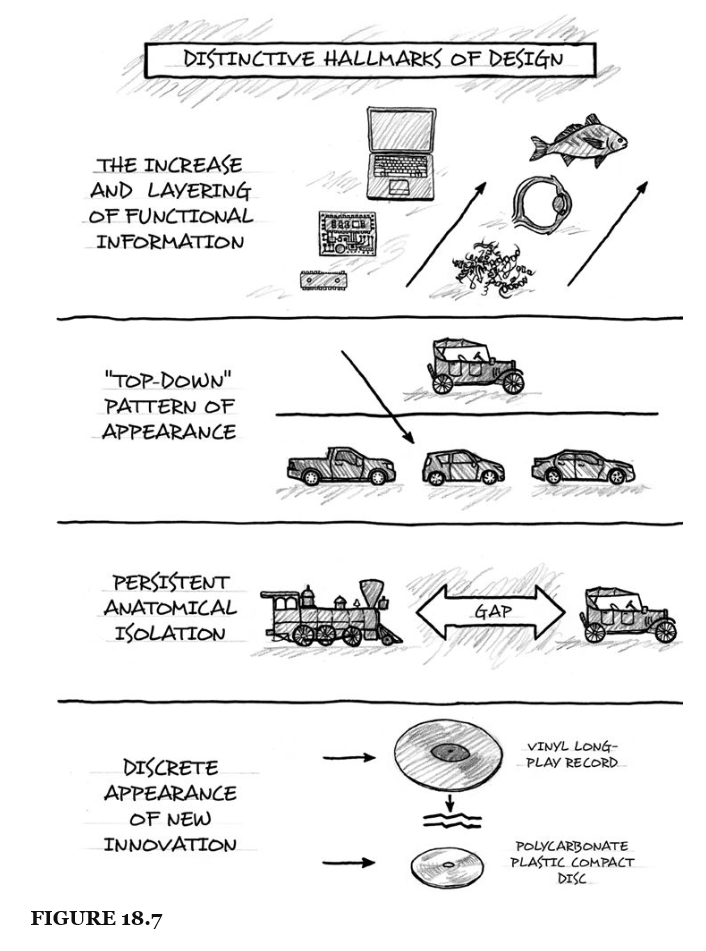
Meyer’s Money Shot

DD18.7There is plenty wrong with Meyer’s book, Darwin’s Doubt.  I have outlined some of the logical inconsistencies and false assumptions myself, and professional palaeontologists have pointed to more far-reaching inadequacies.

But even granting his flawed logic and false premise, there is a major problem with his conclusion.

He puts it succinctly in Chapter 18 thus:


Continue reading

Plantinga’s EAAN: Criticism and Discussion

Alvin Plantinga’s Evolutionary Argument Against Naturalism has attracted a great deal of serious critical discussion (e.g. Naturalism Defeated?) and has had a substantial impact on ‘popular’ appraisals of naturalism.  (For example, William Lane Craig frequently uses it, and it also appears in the dismissal of naturalism in The Experience of God.)  Many philosophers have pointed out various problems with the EAAN, and in my judgment the EAAN is not only flawed but fatally flawed.  Nevertheless, it’s a really interesting argument and it could be worth exploring a bit.  I’ll present the argument here and then we can get into it in comments if you’d like — though I won’t be offended if you’d rather spend your time doing other things!

The EAAN has gone through various iterations, but here’s the latest version, from Where the Conflict Really Lies: Science, Religion, and Naturalism (2011).  Intuitively, we regard our cognitive capacities — sense-perception, introspection, memory, reasoning — as reliable, where “reliable” means “capable of giving us true beliefs most of the time” (subject to the usual caveats).  Call this claim R (for ‘reliable’).   But how probable is R?

Suppose that one accepts evolution (E) but also affirms naturalism, defined here as the belief that there is no God or anything like God (N).  What is the probability of R, given N & E?    One might think it’s quite high.  But Plantinga thinks that, however high the probability of R, nevertheless the probability of R given N&E is low or inscrutable.  Why’s that?

Now, here’s the key move (and in my estimation, the fatal flaw): beliefs are invisible to selection.  Why?  Because selection only works on behavior.  If an unreliable cognitive capacity is causally linked to adaptive behavior, then the unreliable capacity will be selected for (i.e. not selected against).  Even a radically unreliable capacity — that one never or almost never yields true beliefs — can be selected for.  Selection only “cares” about adaptive behaviors, not about true beliefs.  (More precisely, we have no reason to believe that the semantic content is not epiphenomenal.)

So, Plantinga thinks, given N&E, the probability of R is very low. But, if the probability of R is low, given N&E, then that should ‘infect’ the likelihood of all of the beliefs produced by those capacities — including N&E themselves.  So, given N&E, we should it think it extremely unlikely that N&E is true.  And so the initial assumption of N&E defeats itself.  (Here I’m being much too quick with the argument, but we can get into the details in the comments if you’d like.)

Anyway, it’s a really cool little argument, and it’s not immediately clear what’s wrong with it — and I thought it might be worth discussing, given how influential it is.


The Idea of “Pseudo-Science”

When I was poking my nose around philosophy of science in the 1990s, I was told that Larry Laudan’s critique of “the demarcation criterion” had pretty much scuppered the very idea of “pseudo-science.”    Since I don’t work in philosophy of science, but take a keen (and amateurish) interest in the debates about creationism and intelligent design, I found this unfortunate.

Imagine my surprise, then, when I found that some philosophers of science still take the idea of “pseudo-science” seriously and are intent on rescuing it from Laudan’s criticism.  First, I bring to your attention a recent NY Times article, “The Dangers of Pseudo-Science” (part of the usually excellent NY Time series The Stone, which brings philosophy out of the rarefied atmosphere of academia into the very slightly less rarefied atmosphere of the NY Times readership).   The authors, Massimo Pigliucci and Maarten Boudry, are also the editors of Philosophy of Pseudoscience: Reconsidering the Demarcation Problem — which, guessing from the table of contents and reviews, will be an excellent collection.

Something Completely Different

I’ve argued for some time that design is impossible unless the designer is omniscient (because the emergent properties of organic molecules cannot be anticipated).

I have no proof of this, of course, but it seems reasonable to ask design advocates to demonstrate proof of concept. Tell us how design is done without cut and try.

This led me to think a bit about what omniscience means.

ID rage when the multiverse is mentioned — the notion that many universes having differing physical constants might exist simultaneously, making the fine tuning argument moot.

So I thought I might ask if anyone can point out a conceptual difference between an existence in which all possible universes exist, and the mind of an omniscient god, in which all possible universes exist.

I don’t know if this is a serious question, but I thought it might be fun.

Lewontin and “the A Priori”

At Thoughts in a Haystack, Pieret notes that Citizens For Objective Public Education, Inc. (COPE) has brought a lawsuit in Kansas to block the implementation of Next Generation Science Standards. (The whole complaint is here (PDF).)   The complaint alleges that teaching evolutionary theory amounts to state endorsement of atheism, and hence is unconstitutional.

In making their case, COPE quotes this well-known passage from Lewontin’s review of Sagan’s A Demon-Haunted World:

“Our willingness to accept scientific claims that are against common sense is the key to an understanding of the real struggle between science and the supernatural. We take the side of science in spite of the patent absurdity of some of its constructs, in spite of its failure to fulfill many of its extravagant promises of health and life, in spite of the tolerance of the scientific community for unsubstantiated just-so stories, because we have a prior commitment, a commitment to materialism. It is not that the methods and institutions of science somehow compel us to accept a material explanation of the phenomenal world, but, on the contrary, that we are forced by our a priori adherence to material causes to create an apparatus of investigation and a set of concepts that produce material explanations, no matter how counter-intuitive, no matter how mystifying to the uninitiated. Moreover, that materialism is absolute, for we cannot allow a Divine Foot in the door. The eminent Kant scholar Lewis Beck used to say that anyone who could believe in God could believe in anything. To appeal to an omnipotent deity is to allow that at any moment the regularities of nature may be ruptured, that miracles may happen.”


Firstly, this passage is taken out of context; read in context, it is fairly clear that Lewontin is attributing this dogmatism to Sagan, and not endorsing it himself.

Continue reading

Junk DNA

Well, I just got banned again at UD, over my response to this post of Barry’s:

In a prior post I took Dr. Liddle (sorry for the misspelled name) to task for this statement:

“Darwinian hypotheses make testable predictions and ID hypotheses (so far) don’t.”

I responded that this was not true and noted that:

For years Darwinists touted “junk DNA” as not just any evidence but powerful, practically irrefutable evidence for the Darwinian hypothesis. ID proponents disagreed and argued that the evidence would ultimately demonstrate function.

Not only did both hypotheses make testable predictions, the Darwinist prediction turned out to be false and the ID prediction turned out to be confirmed

Continue reading

Moral Behavior Without Principled Intent

Addendum: The original title of this post was “An Evolutionary Antecedent of Morality?”. In the comments Petrushka pointed out the difficulties of this phrase and I have given it a better title.

In the comments of an old post I linked to the story of a Bonobo chimp named Kanzi who is the research subject of a project called The Great Ape Trust. Since then I have been mentally groping for, what was, an amorphous concept I needed to concretize in order to turn that comment into an OP. Petrushka has helpfully formalized that concept with his very own neologism, enabling me to write this.

Continue reading

Reification of the tree metaphor

A brief note to a regular reader.

The Darwinian “tree of life” is not an actual tree. It is a diagram of relationships. Therefore it can survive without having established its “roots”.

It could be granted that the origin of life was artificial, or even supernatural, and the theory of evolution would still be applicable within its domain.

This is not the first time the error in the essay challenge has been pointed out, but it costs us little to hope that a sincere individual, in no way guilty of peddling a religiopolitical agenda, would acknowledge the mistake.

The Programmer and N.E.C.R.O.

A computer programmer noticed that he was not able to type very much in a single day.  But he mused that if there were a large number of software bots working on his code, then they might be able to proceed via totally blind trial and error.  So he decided to try an experiment.

In the initial version of his experiment, he established the following process.

1. The software was reproduced by an imperfect method of replication, such that it was possible for random copying errors to sometimes occur.  This was used to create new generations of the software with variations.

2. The new instances of the software were subjected to a rigorous test suite to determine which copies of the software performed the best.  The worst performers were weeded out, and the process was repeated by replicating the best performers.

The initial results were dismal.  The programmer noticed that changes to a working module tended to quickly impair function, since the software lost the existing function long before it gained any new function.  So, the programmer added another aspect to his system — duplication.

3. Rather than have the code’s only copy of a function be jeopardized by the random changes, he made copies of the content from functional modules and added these duplicated copies to other parts of the code.  In order to not immediately impair function due to the inserted new code, the programmer decided to try placing the duplicates within comments in the software.  (Perhaps later, the transformed duplicates with changes might be applied to serve new purposes.)

Since the software was not depending on the duplicates for its current functioning, this made the duplicates completely free to mutate due to the random copying errors without causing the program to fail the selection process.  Changes to the duplicated code could not harm the functionality of the software and thereby cause that version to be eliminated.  Thus, in this revised approach with duplicates, the mutations to the duplicated code were neutral with regard to the selection process.

The programmer dubbed this version of his system N.E.C.R.O. (Neutral Errors in Copying, Randomly Occurring).  He realized that even with these changes, his system would not yet fulfill his hopes.  Nevertheless, he looked upon it as another step of exploration.  In that respect it was worthwhile and more revealing than he had anticipated, leading the programmer to several observations as he reflected on the nature of its behavior.

Under these conditions of freedom to change without being selected out for loss or impairment of current function, what should we expect to happen to the duplicated code sequences over time and over many generations of copying?

And why?

[p.s. Sincere thanks to real computer programmer OMagain for providing the original seed of the idea for this tale, which serves as a context for the questions about Neutral Errors in Copying, Randomly Occurring.]


When Prior Belief Trumps Scholarship (Review of Darwin’s Doubt)

http://www.sciencemag.org/content/341/6152/1344.1.full

Just in case We haven beaten this book to death, let’s have another round.

His case against current scientific explanations of the relatively rapid appearance of the animal phyla rests on the claim that the origin of new animal body plans requires vast amounts of novel genetic information coupled with the unsubstantiated assertion that this new genetic information must include many new protein folds. In fact, our present understanding of morphogenesis indicates that new phyla were not made by new genes but largely emerged through the rewiring of the gene regulatory networks (GRNs) of already existing genes.


As Meyer points out, he is not a biologist; so perhaps he could be excused for basing his scientific arguments on an outdated understanding of morphogenesis. But my disappointment runs deeper than that. It stems from Meyer’s systematic failure of scholarship. For instance, while I was flattered to find him quote one of my own review papers—although the quote is actually a chimera drawn from two very different parts of my review—he fails to even mention the review’s (and many other papers’) central point: that new genes did not drive the Cambrian explosion. His scholarship, where it matters most, is highly selective.


Charles R. Marshall

The word “chimera” is interesting. The rules of this site forbid characterizing what Meyer did


On the Idea of “Scientism”

Defenders of evolutionary theory are sometimes accused of “scientism”, and this much-used (and much-abused) term has also arisen in the republic of letters due to Steven Pinker’s recent “Science is Not the Enemy of the Humanities” in The New Republic, which drew interesting responses from Leon Wieseltier, Ross Douthat, and Dan Dennett.    Here I want to examine a bit more carefully the idea of “scientism” by way of a criticism of Wieseltier’s “Perhaps Culture is Now the Counterculture”: A Defense of the Humanities”.  There he complains that

Our glittering age of technologism is also a glittering age of scientism. Scientism is not the same thing as science. Science is a blessing, but scientism is a curse. Science, I mean what practicing scientists actually do, is acutely and admirably aware of its limits, and humbly admits to the provisional character of its conclusions; but scientism is dogmatic, and peddles  certainties. It is always at the ready with the solution to every problem, because it believes that the solution to every problem is a scientific one, and so it gives scientific answers to non-scientific questions. But even the question of the place of science in human existence is not a scientific question. It is a philosophical, which is to say, a humanistic question.

Wieseltier isn’t a philosopher but a professional pundit who sprinkles his prose with philosophemes to appeal to the class-prejudices of his intended audience. So it would take some work just to locate his rant on a more well-traveled map.

Continue reading