
Eric Harris Übermensch

Barry Arrington (the current owner of the blog, Uncommon Descent – the former “playground” of William Dembski, advocate of “Intelligent Design”) is a lawyer who seems to regard his finest hour when he acted for some victims families in the wake of the Columbine massacre.

Regular readers of Uncommon Descent (come on, admit it – it’s not just me) may have noted Barry’s singular style of posting “gotcha” questions and using the answers and his ability to control what appears on his blog to bolster his claim of “crickets”. (No complaint from me – ID is a lost cause as a philosophical view so whatever Barry does cannot make any difference in the real world – whether he allows discussion or limits it, the hollowness of ID shines through). The latest post, Eric Harris Was Just Paying Attention, seems to blend Barry’s contribution to Columbine with his predilection for the gotcha. Continue reading


Quine, Alston and Hall On What There Is

As we have been discussing ontology as it refers to hidden variables and multiple worlds, I thought there might be some interest in this excerpt from my Hall book, The Roots of Representationism.  It focuses on a shift in Quine’s position subsequent to “On What There Is,” but I think it touches on some of the broader questions of ontology and how one ought to investigate it as well. Continue reading

ID / UD and the War on Materialism

http://ncse.com/files/pub/creationism/The_Wedge_Strategy.pdf

Governing Goals

To defeat scientific materialism and its destructive moral, cultural and political legacies.
To replace materialistic explanations with the theistic understanding that nature and human beings are created by God.

http://www.uncommondescent.com/about-2/

Uncommon Descent holds that…
Materialistic ideology has subverted the study of biological and cosmological origins so that the actual content of these sciences has become corrupted. The problem, therefore, is not merely that science is being used illegitimately to promote a materialistic worldview, but that this worldview is actively undermining scientific inquiry, leading to incorrect and unsupported conclusions about biological and cosmological origins. At the same time, intelligent design (ID) offers a promising scientific alternative to materialistic theories of biological and cosmological evolution — an alternative that is finding increasing theoretical and empirical support. Hence, ID needs to be vigorously developed as a scientific, intellectual, and cultural project.

At its (theistic) core, ID and creationism is angry with materialism / philosophical naturalism. Denyse, as “News”, is quick to assault any mainstream science she can find through her powers of misunderstanding. KF advocates (but can’t defend or explain) immaterial process that enable minds and contemplation. And yet, like our own WJM, they are all functional materialists.

Continue reading

Corrupt Catholic SCOTUS officially makes women second-class citizens

The Hobby Lobby case.

It’s finally happened.  The conservative Catholic gang have found a case where they could drop their pretense of legal objectivity in favor of (male) bosses’ supposed “religious rights” to interfere with female employees’ personal healthcare.

Note that there is no pretense whatsoever that this decision is fair and equal with respect to its effect on both men and women.  On the contrary, the 5-judge majority make it clear that only women are allowed to be victims of their employers’ religious prejudice under this decision.  The Court wrote that it intends this decision to apply only to forms of contraception specifically for females (which would have been covered by the employees’ insurance under the ACA) and NOT to apply to any other employer “religious” objections such as those against transfusions or vaccines, which might affect both male and female equally.  Hobby Lobby’s paid health insurance will still cover vasectomies. And erectile-disfunction prescriptions.

Continue reading

The tight grip of the teleological mindset

In a new post at UD, Denyse O’Leary quotes an article from The Scientist (which she misattributes to Science):

Populations of Escherichia coli grown in the lab quickly evolve tolerance when exposed to repeated treatments with the antibiotic ampicillin, according to a study published today (June 25) in Nature. Specifically, the bacteria evolved to stay in a dormant “lag” phase for just longer than three-, five-, or eight-hour-long treatment courses, before waking up and growing overnight until the next round of treatment began.

Continue reading

Pesky EleP(T|H)ant

Over at Uncommon Descent KirosFocus repeats the same old bignum arguments as always. He seems to enjoy the ‘needle in a haystack’ metaphor, but I’d like to counter by asking how does he know he’s not searching for a needle in a needle stack?

There is then of course much smugness and back-pating, along with “Notice some chirping crickets?”

Well, let’s see what happens in an environment where crickets aren’t moderated or banned…

Genes in Conflict

On the Counterintuitive evolutionary truths thread, I expressed amazement at the sheer number of distinct kinds of intragenomic conflict that have been discovered by science.  In response, Allan Miller recommended the 2006 book Genes in Conflict, by Austin Burt and Robert Trivers. Burt’s name is unfamiliar to me, but Trivers is famous for proposing the theory of reciprocal altruism.

I ordered the book (23 on the Kindle and28 for the paperback), and so did Gralgrathor, so I thought it would be nice to have a discussion thread for the book as we read it. Anyone is welcome to join in, of course, whether or not you are reading the book.
ID’s grand quest

Scordova has posted something that caught my attention at UD.

William Dembski:

It’s up to ID proponents to demonstrate a few incontrovertible instances where design is uniquely fruitful for biology. Scientists without an inordinate attachment to Darwinian evolution (and there are many, though this fact is not widely advertised) will be only too happy to shift their allegiance if they think that intelligent design is where the interesting problems in biology lie.

Continue reading

Hypoxia – 4 of spades

At UD this claim was made:

Neither rocks nor human brains dream. Only the mind/soul dreams. The human body is a diving suit, specifically designed to be operational by conscious/subconscious intent – meaning, an individualized consciousness (mind/soul) can use it to functionally operate in the physical world. A rock has no such capacity for service.

I have to wonder how what this video depicts can be squared with that.

Hypoxia – 4 of spades

During hypobaric chamber, or altitude chamber training, #14 displayed symptoms of hypoxia, after exceeding his time of useful consciousness (TUC).

Continue reading

Stuck between a rock and an immaterial place

Kairosfocus has a new OP at UD entitled Putting the mind back on the table for discussion. His argument begins thus:

Starting with the principle that rocks have no dreams:

Reciprocating Bill points out that since KF denies physicalism, he has no principled basis for denying the consciousness of rocks:

If the physical states exhibited by brains, but absent in rocks, don’t account for human dreams (contemplation, etc.) then you’ve no basis for claiming rocks are devoid of dreams – at least not on the basis of the physical states present in brains and absent in rocks. Given that, on what basis do you claim that rocks don’t dream?

Needless to say, KF is squirming to avoid the question.

I’ve got popcorn in the microwave.  Pull up a chair.

Pinker: The Sense of Style

http://whyevolutionistrue.wordpress.com/2014/06/09/pinker-discusses-his-new-book-on-edge/

Steven Pinker is about to release a new book on writing. I’m holding my breath.

When you write you should pretend that you, the writer, see something in the world that’s interesting, that you are directing the attention of your reader to that thing in the world, and that you are doing so by means of conversation.

That may sound obvious. But it’s amazing how many of the bad habits of academese and legalese and so on come from flouting that model. Bad writers don’t point to something in the world but are self-conscious about not seeming naïve about the pitfalls of their own enterprise. Their goal is not to show something to the reader but to prove that they are not a bad lawyer or a bad scientist or a bad academic. And so bad writing is cluttered with apologies and hedges and somewhats and reviews of the past activity of people in the same line of work as the writer, as opposed to concentrating on something in the world that the writer is trying to get someone else to see with their own eyes.

If I were running a forum, I would ask posters to follow Pinker’s rules for writing.

A thread for William J Murray to unpack the alternatives to “materialism/physicalism/naturalism”

William has taken exception to the current state of science and its ‘overreach’.

He claims, “IMO, all that is left of materialism/physicalism/naturalism is really nothing more than a hidden (even subconscious) anti-theistic agenda.”

This is a thread for William to guide us in a detailed exploration of the alternatives, their mechanisms, how we might test them and how we might benefit from them.

on how to reconcile evolution, creation and intelligent design

<video snipped on request>


From the video description:

<redacted> TEDx presentation speaks to the debate over innovation of ideas specifically regarding evolution, creation and intelligent design. He asks whether or not science can have the courage to work together with philosophy and religion or worldview to discover where humanity is headed and presents the idea of human extension as a way to promote human dignity, cooperation, altruism and flourishing instead of Darwinian dehumanisation, conflict and struggle.

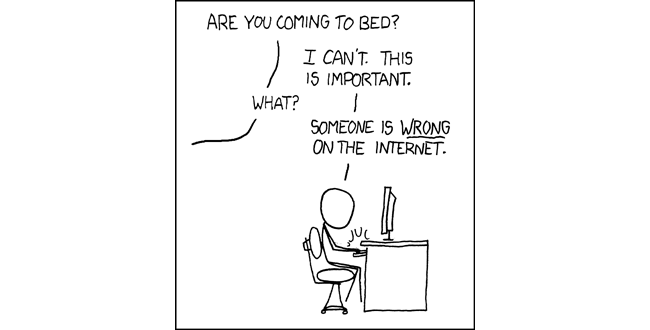
I Don’t care If You Are Wrong

Just some random, unorganized thoughts regarding the recent hostilities.

1. I don’t care if you are wrong.
2. Your disagreeing with me does not diminish my life.
3. I have no need to beat you into submission.
4. If I disagree with you, I would like to know why you believe what you believe.
5. I would like for you to understand my position, and I appreciate any effort you make to understand me.
6. To these ends I will ask questions designed to probe our differences.
7. If you don’t or can’t respond to my satisfaction, I will try to accept the impasse and move on.
8. These are more what you’d call “guidelines” than actual rules.