Is language a search?

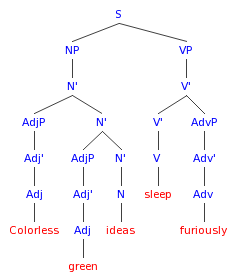
syntax_tree_for_colorless_green_ideas_sleep_furiosly

Given sentences can be expressed in a hierarchy / taxonomy that can have moveable, functional elements, are they amenable to exploitation / investigation by GAs? (We already know Markov Chains work – http://theskepticalzone.com/wp/idbots/ )

If All ideas can be expressed in language then could digitally evolved sentences be genuinely creative? It’s like genetic programming for people language 😀

H/T Mung.

A One Line GA

Please post your software implementation of a GA that can be expressed in a single line of executable code.

Here’s mine:

#

A minimalist GA – Inspired by Allan Miller at TSZ

#
pop = Array.new(10) {“I AM APE-ISCH”}.map! {|ape| ape.dup}

The original population is copied and eliminated.

Further Thoughts on the Evolution of Consciousness

Continuing a discussion I and one or two others were having in the thread vincent-torleys-disappearing-book-review it is of little surprise that those responding to what I said, along with many of the posters here, regard consciousness as a product of matter. I believe that it is the other way round. As with Owen Barfield and John Davy, I came to this conclusion many, many years ago, and for me like them, Rudolf Steiner was a big influence in solidifying this view. Here is an extract from an article about Owen Barfield from Richard A. Hocks

Barfield’s precoccupation with the history of consciousness is different from even the most saturated analyses of the past, such as Erich Auerbach’s Mimesis. Barfield maintains that, in any thoughtful consideration of evolution, it is both more reasonable and more illuminating to hold that mind, or consciousness, precedes matter rather than the reverse–though not individualized mind or self-consciousness. Not only does the origin of language point toward this supposition but also the content of the great myths, indeed even the very archetypes that a thinker like Jung explores so deeply yet without ever considering that that they might inhabit the world “outside” the human head–or a vast collection of human heads. In other words, evolution for Barfield begins with mind as anterior to matter, as a given “field” out of which, as it were, matter compresses. Barfield’s thesis herein does not merely challenge the Darwinian argument; in a sense it turns that argument on its head: for not only does mind precede and bring matter into being, and a form of intentionality replace chance-ridden natural selection, but the very same physical evidence used in support of the received position is never directly challenged or discredited, but interpreted differently…

Here are some words from John Davy (pseudonym, John Waterman) who gives an overview of Steiner’s thoughts on the evolution of physical life better than I ever could:

John Davy:

The evolution of man, Steiner said, has consisted in the gradual incarnation of a spiritual being into a material body. It has been a true “descent” of man from a spiritual world into a world of matter. The evolution of the animal kingdom did not precede, but rather ;accompanied; the process of human incarnation. Man is thus not the end result of the evolution of the animals, but is rather in a certain sense their cause. In the succession of types which appears in the fossil record-the fishes, reptiles, mammals, and finally fossil remains of man himself-the stages of this process of incarnation are reflected. Continue reading

The Tide Turns in Landlocked Ohio

Back in May of this year, Zack Kopplin reported that an Ohio school district was teaching creationism using a video from Harun Yahya. Yahya is the pseudonym of Adnan Oktar, an Islamic televangelist and creationist.

Hemant Mehta, The Friendly Atheist, notes the that new CEO of the Youngstown school district is putting a stop to that. Starting immediately, science classes in the district will conform to state standards. Creationism, including the intelligent design variant, are definitely not part of those standards.

It looks like a good start to the school year in Ohio.

Some Questions on Genetic Algorithms

vjtorley:

I was very struck by Glenn Williamson’s [vjt meant GlenDavidson] remark that creativity is not the same thing as complexity. Very deep. Glenn seems to think that people are good at the former, but the blind processes can outdo them in the latter. That’s an interesting view, but I’d want to see evidence that blind processes are actually capable of producing systems with a high degree of functional complexity, of the kind Axe described in his book. Even a computer simulation would be something.

What with all the experts in writing GA’s here at TSZ I was hoping VJT would have elicited more of a response.

Continue reading

Vincent Torley’s Disappearing Book Review

I guess many folks here are familiar with Dr (of philosophy) Vincent Torley as a contributor of many posts at Uncommon Descent now operated by one Barry Arrington.

Vincent strikes me as a genuinely nice guy whose views are very different from mine on many issues. Possibly one of his most remarked-upon idiosyncracies is his tendency to publish exceedingly long posts at Uncommon Descent but (leaving Joseph of Cupertino in the air for a moment) lately Vincent has become a little more reflective on the merits of “Intelligent Design” as some sort of alternative or rival to mainstream biology. Continue reading

Some evidence ALUs and SINES aren’t junk and garbologists are wrong

Larry Moran, Dan Graur and other garbologists (promoters of the junkDNA perspective), have argued SINES and ALU elements are non-functional junk. That claim may have been a quasi-defensible position a decade ago, but real science marches forward. Dan Graur can only whine and complain about the hundreds of millions of dollars spent at the NIH and elsewhere that now strengthens his unwitting claim in 2013, “If ENCODE is right, Evolution is wrong.”

Larry said in Junk in Your Genome: SINES
Continue reading

Evidence of greater interest in the Flying Spaghetti Monster than in ID

When the Click Whore of Babylon appeals to her own authority, the chances are high that her rhetoric is designed to conceal an intolerable truth:

My sense, based on some years of coverage at Uncommon Descent, is that Pastafarianism has changed its focus. […] They could not stay in the game with ID indefinitely because they would need to be something other than just a big practical joke that went on way too long.

My response to her pulling stuff out of her ass is of course not to pull stuff out of my ass, but instead to look for evidence. What came immediately to mind was to plug the terms “Flying Spaghetti Monster” and “intelligent design” into Google Trends.

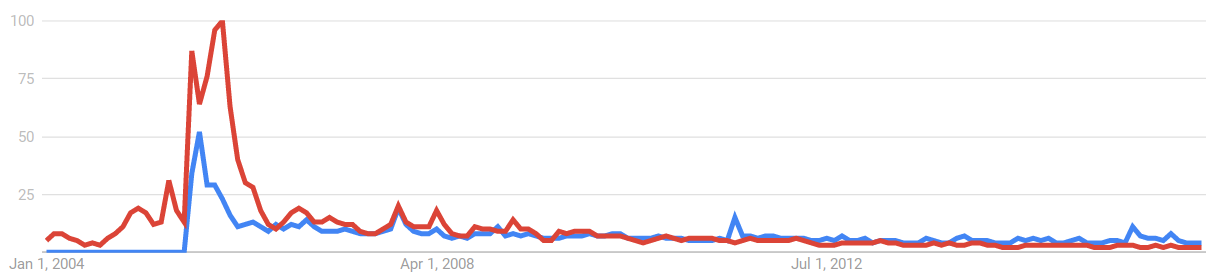
Interest in FSM and ID Since 2004

According to Google Trends, interest in "Flying Spaghetti Monster" has been

According to Google Trends, interest in “intelligent design” (red) has declined steadily since the Dover trial. Interest in “Flying Spaghetti Monster” (blue) has plateaued.

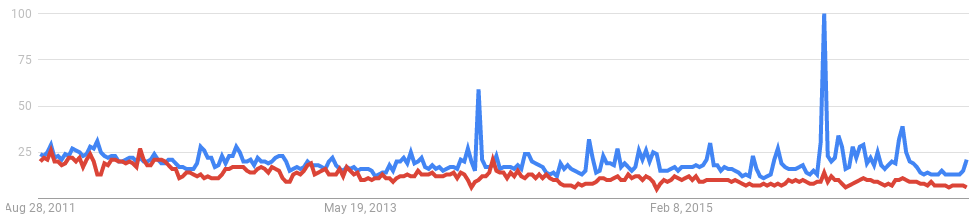
Interest in FSM and ID over the Past Five Years

According to Google Trends, there has been more interest in the Flying Spaghetti Monster than in "intelligent design" crypto-creationism over the past five years.

According to Google Trends, there has been more interest in “Flying Spaghetti Monster” (blue) than in “intelligent design” (red) over the past five years. The average levels of interest in the FSM and ID are, respectively, 20 and 12.

The parody of religion evidently has greater staying power than the parody of science.

Evolution’s Search Problem

Tom English: (If Mung does not know that authors at Evolution News and Views often disagree with one another, but never point out their disagreements, then I’ve given him way too much credit. For instance, Dembski told us that “evolutionary search” really does search for targets. But Meyer and Axe have both gone out of their ways to explain that “evolutionary search” actually does not search.)

Did Tom ever reveal his sources?

Continue reading

How Much For The Baptists?

Matt Wilbourn, one of the founders of the Muskogee Atheist Community donated $100 to the Murrow Indian Children’s Home. His donation was returned because the MICH gets most of its funding from the American Baptist Churches Association and “accepting a donation from atheists would go against everything they believe in.”

Matt upped the ante to $250. Still refused. He and his wife then started a GoFundMe page to see if they could raise $1000 for the charity. At the time of this post the total amount pledged is $12,670 and climbing.

I encourage everyone to donate until we find out how much money it takes to convince a Baptist to do the right thing.

Cartesian skepticism and the Sentinel Islander thought experiment

Cartesian skepticism has been a hot topic lately at TSZ. I’ve been defending a version of it that I’ve summarized as follows:

Any knowledge claim based on the veridicality of our senses is illegitimate, because we can’t know that our senses are veridical.

This means that even things that seem obvious — that there is a computer monitor in front of me as I write this, for instance — aren’t certain. Besides not being certain, we can’t even claim to know them, and that remains true even when we use a standard of knowledge that allows for some uncertainty. (There’s more — a lot more — on this in earlier threads.)

In explaining to Kantian Naturalist why I am a Cartesian skeptic, I introduced the analogy of the Sentinel Islander:

Continue reading

Another take on the Conspira-Sea Cruise

Remember the Conspire-Sea Cruise, attended and reported on by TSZ commenter ‘Colin’, aka ‘Learned Hand’?

Popular Mechanics sent a reporter, Bronwen Dickey, on the same cruise, and here is her dispatch:

Conspira-Sea

I Went on a Weeklong Cruise For Conspiracy Theorists. It Ended Poorly.

What do you get when you stick some of the conspiracy world’s biggest celebrities and their die-hard fans on a cruise ship in the middle of the Pacific Ocean for a week? Some fascinating insight into our strange times. And one near fistfight.

Genetic load and junk.

Mung, to petrushka, elsewhere:

Everyone does not understand “genetic load” and those that do claim to understand are probably wrong. Why don’t you start an OP on genetic load and the genetic load argument? That would be interesting. Betting you won’t.

This is such an OP. I believe the genetic load argument*** was initially proposed by Susumu Ohno in 1972, whose paper also introduced the then-scare-quoted term “junk”. It’s brief, accessible, and worth a read for anyone who wishes to offer an opinion/understand (not necessarily in that order).

The short version: sequence-related function must be subject to deleterious mutations. Long genomes (such as those of most eukaryotes) contain too many bases for the entire genome to be considered functional in that way, given known mutation rates. The bulk of such genomes must either have functions that are not related to sequence, or no function at all.

Interestingly, the paper is hosted on the site of an anti-junk-er, Andras Pellionisz, a self-promoting double-PhD’d … er … maverick. Also of interest is that, contrary to some ID narratives, the idea was initially resisted by ‘Darwinists’, if that term is understood not as people who simply accept evolution, but as people who place most emphasis on Natural Selection. Perfectionism is not the sole preserve of Creationists.

More recent work has characterised the nonfunctional fraction, and this lends considerable empirical support to Ohno’s contentions.

[eta: link to comment]
***[eta: in relation to genome size, not the first time anyone, ever, discussed genetic load!]

Mung, a theistic evolutionist who disagrees with some of his kind

Mung: What I Believe

I am neither YEC nor OEC, so don’t really know of a label I can give you.

I accept that the universe is old, that the earth is old. No problem with dating as provided by the latest science.

I am a theist and a Christian. I am not a deist. I am not a naturalist. I reject the idea of “nature acting alone.”

I believe the universe is created and sustained by God I believe the same of all living beings. I accept common descent or descent with modification as the best explanation for the history of life on earth, but reject the idea that this happens without God (by a random undirected process).

I’ve not identified myself as a theistic evolutionist because I find myself in disagreement with theistic evolutionist authors.

So the best description I can offer is “intelligent design” proponent.
Continue reading

The Great Filter

Hoping this will be more fun / less confrontational, but certainly ID and non-ID perspectives will differ. In a nutshell ‘The Great Filter’ is an event that stops life inevitably filling the universe. Others have written much better accounts, so here is your background reading:

The Drake Equation

The Fermi Paradox

The Great Filter

One-stop synopsis if you don’t want the top 3

What do the folks here think? Is there a great filter(s) are we past it / them? My vote is there is at least one ahead of us and we probably won’t make it. Candidates include:

Environmental catastrophe, war using highly potent (N/B/C) weapons, religious zealotry taking us backwards..

I also think other possibilities are flawed assumptions in the Fermi Paradox (maybe marginal / diminishing utility in expansion beyond a certain point, or perhaps transcendence out of this physical realm for sufficiently advanced species. Certainly a million SciFi tropes (Let’s see if we can make a list? Childhood’s End, Mass Effect…) have come from this. What do you folks think?