Randomness and evolution – An Interactive toy

Lizzie Allan Miller said:

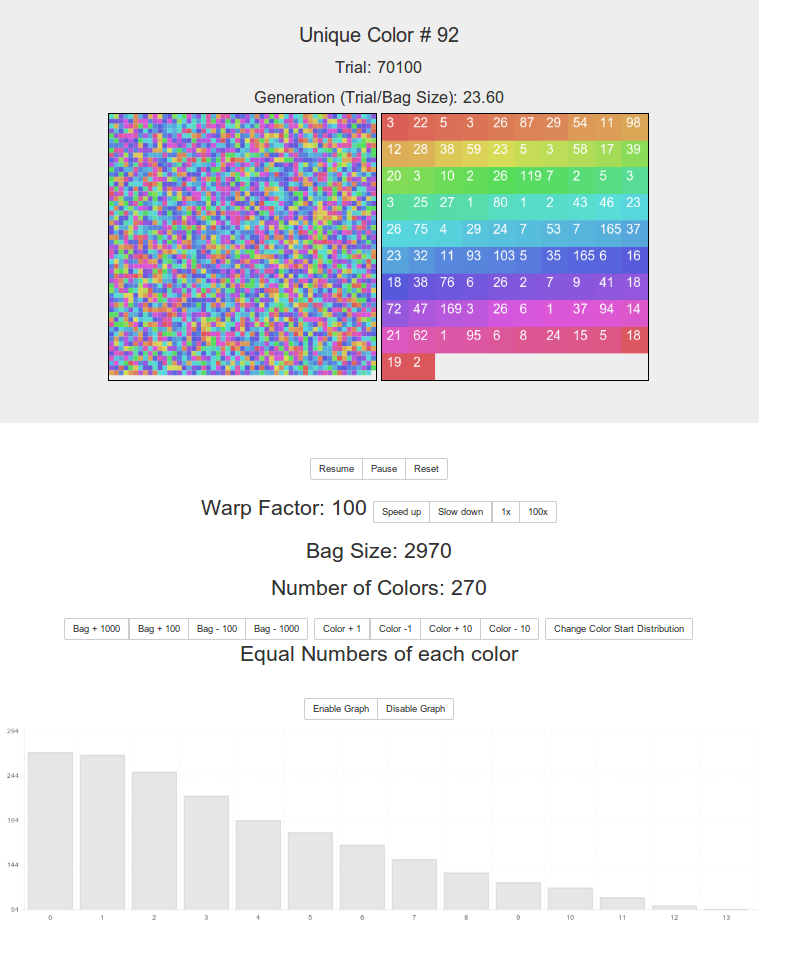
Here’s a simple experiment one can actually try. Take a bag of M&M’s, and without peeking reach in and grab one. Eat it. Then grab another and return it to the bag with another one, from a separate bag, of the same colour. Give it a shake. I guarantee (and if you tell me how big your bag is I’ll have a bet on how long it’ll take) that your bag will end up containing only one colour. Every time. I can’t tell you which colour it will be, but fixation will happen.

I’ve written an interactive browser based version you can explore this idea with.

http://mandmcounter.appspot.com/emeniem.html

color


Continue reading

Darwin backwards?

What is it with ID proponents and gambling?  Or rather, what is it that makes people who play p0ker and roulette think that that gives them a relevant background for statistical hypothesis testing and an understanding of stochastic processes such as evolution?  Today, “niwrad”, has a post at UD, with one of the most extraordinary garblings of evolutionary theory I think I have yet seen.  He has decided that p0ker is an appropriate model this time (makes a change from coin tossing, I guess).

Continue reading

Randomness and evolution

Here’s a simple experiment one can actually try. Take a bag of M&M’s, and without peeking reach in and grab one. Eat it. Then grab another and return it to the bag with another one, from a separate bag, of the same colour. Give it a shake. I guarantee (and if you tell me how big your bag is I’ll have a bet on how long it’ll take) that your bag will end up containing only one colour. Every time. I can’t tell you which colour it will be, but fixation will happen.
Continue reading

Lizzie asked me a question, so I will respond

Sal Cordova responded to my OP at UD, and I have given his post in full below.

Dr. Liddle recently used my name specifically in a question here:

Chance and 500 coins: a challenge

Barry? Sal? William?

I would always like to stay on good terms with Dr. Liddle. She has shown great hospitality. The reason I don’t visit her website is the acrimony many of the participants have toward me. My absence there has nothing to do with her treatment of me, and in fact, one reason I was ever there in the first place was she was one of the few critics of ID that actually focused on what I said versus assailing me personally.

So, apologies in advance Dr. Liddle if I don’t respond to every question you field. It has nothing to do with you but lots to do with hatred obviously direct toward me by some of the people at your website.

I’ve enjoyed discussion about music and musical instruments.

Continue reading

Proof: Why naturalist science can be no threat to faith in God

I’m going to demonstrate this using Bayes’ Rule. I will represent the hypothesis that (a non-Deist, i.e. an interventionist) God exists as H_G, and the evidence of complex life as L_C.  What we want to know is the posterior probability that H_{G} is true, given L_C, written

    \[P(H_{G}|L_N)}\]

which, in English, is: the probability that God exists, given the evidence before us of complex life.

Continue reading

Chance and 500 coins: a challenge

My problem with the IDists’ 500 coins question (if you saw 500 coins lying heads up, would you reject the hypothesis that they were fair coins, and had been fairly tossed?)  is not that there is anything wrong with concluding that they were not.  Indeed, faced with just 50 coins lying heads up, I’d reject that hypothesis with a great deal of confidence.

It’s the inference from that answer of mine is that if, as a “Darwinist” I am prepared to accept that a pattern can be indicative of something other than “chance” (exemplified by a fairly tossed fair coin) then I must logically also sign on to the idea that an Intelligent Agent (as the alternative to “Chance”) must inferrable from such a pattern.

This, I suggest, is profoundly fallacious.

Continue reading

Barry gets it wrong again….

Here.


The null hypothesis in a drug trial is not that the drug is efficacious. The null hypothesis is that the difference between the groups is due to chance.

No, Barry.  Check any stats text book.  The null hypothesis is certainly not that the drug is efficacious (which is not what Neil said), but more importantly, it is not that “the difference between the groups is due to chance”.

It is that “there is no difference in effects between treatment A and treatment B”.

When in hole, stop digging, Barry!

Continue reading

Yes, Lizzie, Chance is Very Often an Explanation

[Posted by Barry at UD]

Over at The Skeptical Zone Elizabeth Liddle has weighed in on the “coins on the table” issue I raised in this post.

Readers will remember the simple question I asked:

If you came across a table on which was set 500 coins (no tossing involved) and all 500 coins displayed the “heads” side of the coin, how on earth would you test “chance” as a hypothesis to explain this particular configuration of coins on a table?

Dr. Liddle’s answer:

Chance is not an explanation, and therefore cannot be rejected, or supported, as a hypothesis.

Staggering. Gobsmacking. Astounding. Superlatives fail me.

Continue reading

Getting from Fisher to Bayes

(slightly edited version of a comment I made at UD)

Barry Arrington has  a rather extraordinary thread at UD right now, ar

Jerad’s DDS Causes Him to Succumb to “Miller’s Mendacity” and Other Errors

It arose from a Sal’s post, here at TSZ, Siding with Mathgrrl on a point,and offering an alternative to CSI v2.0

Below is what I posted in the UD thread.

Continue reading

Siding with Mathgrrl on a point,and offering an alternative to CSI v2.0

[cross posted from UD Siding with Mathgrrl on a point, and offering an alternative to CSI v2.0, special thanks to Dr. Liddle for her generous invitation to cross post]

There are two versions of the metric for Bill Dembski’s CSI. One version can be traced to his book No Free Lunch published in 2002. Let us call that “CSI v1.0”.

Then in 2005 Bill published Specification the Pattern that Signifies Intelligence where he includes the identifier “v1.22”, but perhaps it would be better to call the concepts in that paper CSI v2.0 since, like windows 8, it has some radical differences from its predecessor and will come up with different results. Some end users of the concept of CSI prefer CSI v1.0 over v2.0.
Continue reading

Specification for Dummies

I’m lookin’ at you, IDers 😉

Dembski’s paper: Specification: The Pattern That Specifies Complexity gives a clear definition of CSI.

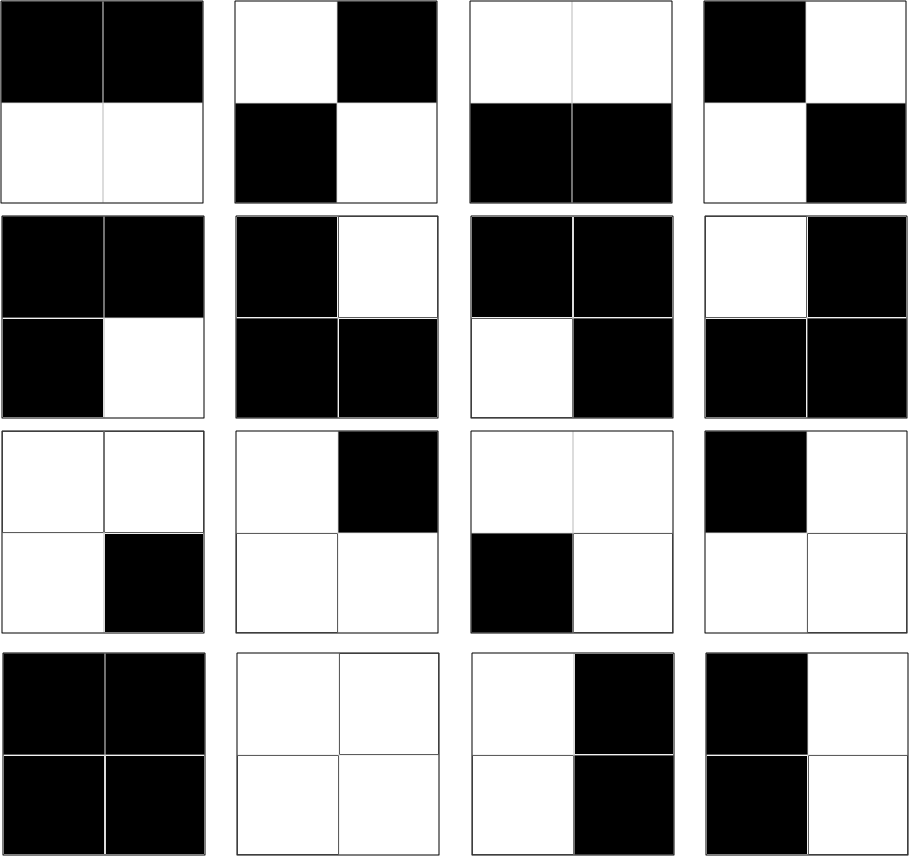
The complexity of pattern (any pattern) is defined in terms of Shannon Complexity.  This is pretty easy to calculate, as it is merely the probability of getting this particular pattern if you were to randomly draw each piece of the pattern from a jumbled bag of pieces, where the bag contains pieces in the same proportion as your pattern, and stick them together any old where.  Let’s say all our patterns are 2×2 arrangements of black or white pixels. Clearly if the pattern consists of just four black or white pixels, two black and two white* , there are only 16 patterns we can make:

Patterns1And we can calculate this by saying: for each pixel we have 2 choices, black or white, so the total number of possible patterns is 2*2*2*2, i.e 24  i.e. 16. That means that if we just made patterns at random we’d have a 1/16 chance of getting any one particular pattern, which in decimals is .0625, or 6.25%.  We could also be fancy and express that as the negative log 2 of .625, which would be 4 bits.  But it all means the same thing.  The neat thing about logs is that you can add them, and get the answer you would have got if you’d multipled the unlogged numbers.  And as the negative log of .5 is 1, each pixel, for which we have a 50% chance of being black or white, is worth “1 bit”, and four pixels will be worth 4 bits.

Continue reading

Protein Space and Hoyle’s Fallacy – a response to vjtorley

‘vjtorley’ has honoured me with my very own OP at Uncommon Descent in response to my piece on Protein Space. I cannot, of course, respond over there (being so darned uncivil and all!), so I will put my response in this here bottle and hope that a favourable wind will drive it to vjt’s shores. It’s a bit long (and I’m sure not any the better for it…but I’m responding to vjt and his several sources … ! ;)).


“Build me a protein – no guidance allowed!”

The title is an apparent demand for a ‘proof of concept’, but it is beyond intelligence too at the moment, despite a working system we can reverse engineer (a luxury not available to Ye Olde Designer). Of course I haven’t solved the problem, which is why I haven’t dusted off a space on my piano for that Nobel Prize. But endless repetition of Hoyle’s Fallacy from multiple sources does not stop it being a fallacious argument.

Dr Torley bookends his post with a bit of misdirection. We get pictures of, respectively, a modern protein and a modern ribozyme. It has never been disputed that modern proteins and ribozymes are complex, and almost certainly not achievable in a single step. But

1) Is modern complexity relevant to abiogenesis?

2) Is modern complexity relevant to evolution?


Here are three more complex objects:

DESCRIPTION HERE

Circuit Board

DESCRIPTION HERE

Panda playing the flute

DESCRIPTION HERE

er … not yet in service!


Continue reading

Prizegiving!

Phinehas and Kairosfocus share second prize for my CSI challenge: yes, it is indeed “Ash on Ice” – it’s a Google Earth image of Skeiðarárjökull Glacier.

But of course the challenge was not to identify the picture, but to calculate its CSI. Vjtorley deserves, I think, first prize, not for calculating it, but for making so clear why we cannot calculate CSI for a pattern unless we can calculate “p(T|H)” for all possible “chance” (where “chance” means “non-design”) hypotheses.

In other words, unless we know, in advance, how likely we are to observe the candidate pattern, given non-chance, we cannot infer Design using CSI. Which is, by the Rules of Right Reason, the same as saying that in order to infer Design using CSI, we must first  calculate how likely our candidate pattern is under all possible non-Design hypotheses.

As Dr Torley rightly says:

Professor Felsenstein is quite correct in claiming that “CSI is not … something you could assess independently of knowing the processes that produced the pattern.”

And also, of course, in observing that Dembski acknowledges this in his paper, , Specification: The Pattern That Signifies Intelligence, as many of us have pointed out.  Which is why we keep saying that it can’t be calculated – you have to be able to quantify p(T|H), where H is the actual non-design hypothesis, not some random-independent-draw hypothesis.

Continue reading

Journal club – Protein Space. Big, isn’t it?

Simplistic combinatorial analyses are an honoured tradition in anti-evolutionary circles. Hoyle’s is the archetype of the combinatorial approach, and he gets a whole fallacy named after him for his trouble. The approach will be familiar – a string of length n composed of v different kinds of subunit is one point in a permutation space containing vn points in total. The chance of hitting any given sequence in one step, such as the one you have selected as ‘target’, is the reciprocal of that number. Exponentiation being the powerful tool it is, it takes only a little work with a calculator to assess the permutations available to the biological polymers DNA and protein and come up with some implausibly large numbers and conclude that Life – and, if you are feeling bold, evolution – is impossible.

Dryden, Thomson and White of Edinburgh University’s Chemistry department argue in this 2008 paper that not only is the combinatorial space of the canonical 20 L-acids much smaller than simplistically assumed, but more surprisingly, that it is sufficiently small to have been explored completely during the history of life on earth. Continue reading

Some Help for IDists: Benford’s Law

Guys, as your scientific output is lacking at the moment, allow me to point you towards Benford’s law: http://en.wikipedia.org/wiki/Benford’s_law

Benford’s law, also called the first-digit law, refers to the frequency distribution of digits in many (but not all) real-life sources of data. In this distribution, the number 1 occurs as the first digit about 30% of the time, while larger numbers occur in that position less frequently: 9 as the first digit less than 5% of the time. This distribution of first digits is the same as the widths of gridlines on a logarithmic scale. Benford’s law also concerns the expected distribution for digits beyond the first, which approach a uniform distribution.


TSZ team: Can we build this into a statistically testable (Null hypothesis?) ID Hypothesis?

This one piqued my interest:

“Frequency of first significant digit of physical constants plotted against Benford’s law” – Wikipedia

Is evolution of proteins impossible?

At Uncommon Descent, “niwrad” has posted a link to a Sequences Probability Calculator. This webserver allows you to set a number of trials (“chemical reactions”) per second, the number of letters per position (20 for amino acids) and a sequence length, and then it calculates how long it will take for you to get exactly that sequence. Each trial assumes that you draw a sequence at random, and success is only when you exactly match the target sequence. This of course takes nearly forever.

So in effect the process is one of random mutation without natural selection present, or random mutation with natural selection that shows no increase in fitness when a sequence partially matches the target. This leads to many thoughts about evolution, such as:

  • Do different species show different sequences for a given protein? Typically they do, so the above scheme implies that they can’t have evolved from common ancestors that had a different protein sequence. They each must have been the result of a separate special creation event.
  • If an experimenter takes a gene from one species and puts it into another, so that the protein sequence is now that of the source species, does it still function? If not, why are people so concerned about making transgenic organisms (they’d all be dead anyway)?
  • If we make a protein sequence by combining part of a sequence from one species and the rest of that protein sequence from another, will that show function in either of the parent species? (Typically yes, it will).

Does a consideration of the experimental evidence show that the SPC fails to take account of the function of nearby sequences?

The author of the Sequences Probability Calculator views evolution as basically impossible. The SPC assumes that any change in a protein makes it unable to function. Each species sits on a high fitness peak with no shoulders. In fact, experimental studies of protein function are usually frustrating, because it is hard to find noticeable difference of function, at least ones big enough to measure in the laboratory.