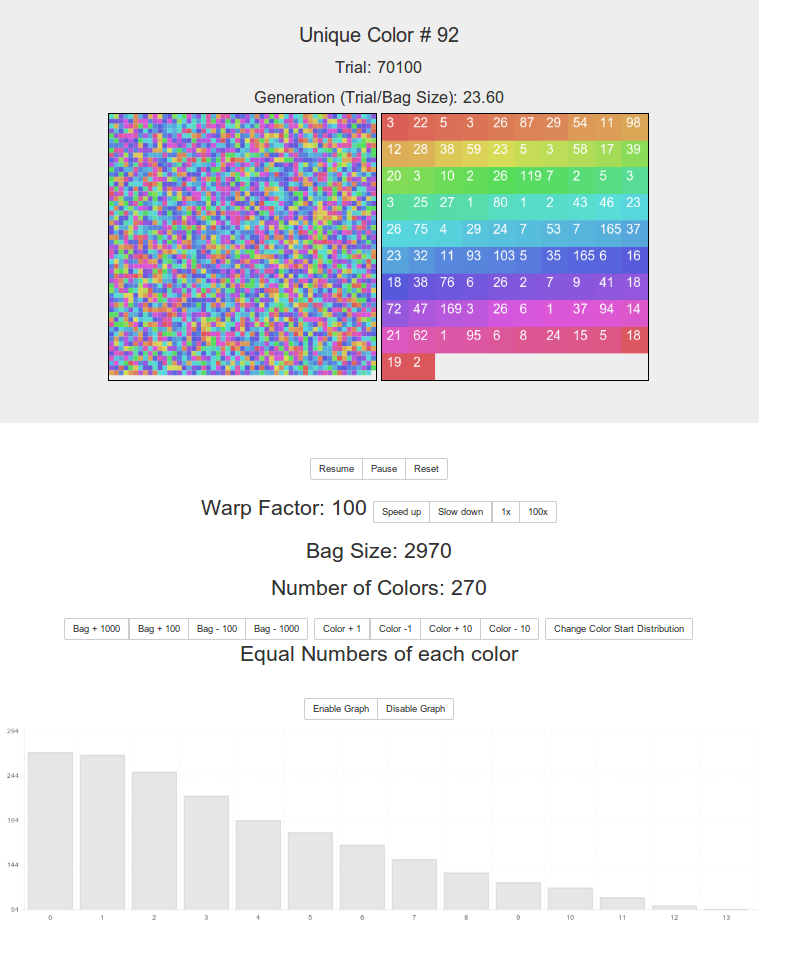
A neat zombie post from Barry Arrington (thanks, Barry! I do appreciate, and this is without snark, the succinctness and articulacy of your posts – they encapsulate your ideas extremely cogently, and thus make it much easier for me to see just how and why I disagree with you!)
ID proponents: is Chance a Cause?
- If yes, in what sense?
- If no, do you think that evolutionists claim that it is?
- If yes, why do you think this?
- If no, what the heck are we arguing about?
Getting some stuff off my chest….
I don’t think that science has disproven, nor even suggests, that it is unlikely that an Intelligent Designer was responsible for the world, and intended it to come into existence.
I don’t think that science has, nor even can, prove that divine and/or miraculous intervention is impossible.
I don’t think that the fact that we can make good predictive models of the world (and we can) in any way demonstrates that how the world has observedly panned out was not entirely foreseen and intended by some deity.
Random Mutations: vjtorley
vjtorley, at UD, writes a post entitled It’s time for scientists to come clean with the public about evolution and the origin of life that includes this:
Edward Frenkel, a professor of mathematics at the University of California, Berkeley, recently reviewed a book titled, Probably Approximately Correct: Nature’s Algorithms for Learning and Prospering in a Complex World (Basic Books, 2013) by computer scientist Leslie Valiant, in a report for the New York Times (Evolution, Speeded by Computation, September 30, 2013). The following excerpt conveys the gist of Dr. Valiant’s conclusions:
The evolution of species, as Darwin taught us, relies on natural selection. But Dr. Valiant argues that if all the mutations that drive evolution were simply random and equally distributed, it would proceed at an impossibly slow and inefficient pace.
Darwin’s theory “has the gaping gap that it can make no quantitative predictions as far as the number of generations needed for the evolution of a behavior of a certain complexity,” he writes. “We need to explain how evolution is possible at all, how we got from no life, or from very simple life, to life as complex as we find it on earth today. This is the BIG question.”
Dr. Valiant proposes that natural selection is supplemented by ecorithms, which enable organisms to learn and adapt more efficiently. Not all mutations are realized with equal probability; those that are more beneficial are more likely to occur. In other words, evolution is accelerated by computation.
The criticisms being made here of the Darwinian theory of evolution are pretty devastating: not only is it far too slow to generate life in all its diversity, but it’s also utterly incapable of making quantitative predictions about the time required for a structure of known complexity to evolve, by natural selection. And there’s no reason to believe that the “nearly neutral theory of evolution” espoused by biologists such as Professor Larry Moran would fare any better, in this regard.
Dr Torley is a scholar and a gentleman and someone for whom I have a great deal of personal respect. In fact I owe him more than one debt of personal kindness. But that does not mean that I think his ideas are correct, and I submit he is profoundly wrong here in an extremely useful way. Unusually, the passage he cites is very specific about the kind of randomness that cannot be the kind of randomness that would produce Darwinian evolution: equally distributed.
Chance

Is the trajectory here “due to chance”?
What Is [wrong with] the Science Behind Intelligent Design?
The FAQ at the Discovery Institute CSC site links to an ID “summary” , entitled What Is the Science Behind Intelligent Design?, dated May 1, 2009. So five years out of date, but worth deconstructing all the same, as it basically gives away the farm.
Here goes:
Intelligent design (ID) is a scientific theory that employs the methods commonly used by other historical sciences to conclude that certain features of the universe and of living things are best explained by an intelligent cause, not an undirected process such as natural selection.
Well, no, not to my knowledge it doesn’t. It employs very odd methods indeed, and even fewer that are actually empirical. But we’ll unpack that as we go.
Intelligent Design predicts…
Critics of intelligent design (myself included) often claim that intelligent design is a poor explanation. One of the many reasons is that it does not make any novel predictions of its own. In response IDists have proposed several “ID predictions”, for example:
http://post-darwinist.blogspot.com/2008/01/nine-predictions-if-intelligent-design.html
Which is an interesting list because it lists things that “won’t happen” – strange because they cannot be falsified unless one has infinite time, they can’t even be used as falsifiers because of the very soft nature of the claims they make.
I think the inability of ID to proffer mechanisms limits its ability to make predictions, so it must settle with being unhappy with the current state of evolutionary theory (and “materialism”) instead. Anything remotely positive seems to be predicated on “what a designer would do” – and here ID finds itself at odds with … itself:
“Q Intelligent design says nothing about the intelligent designer’s motivations?
A The only statement it makes about that is that the designer had the motivation to make the structure that is designed.”
http://www.talkorigins.org/faqs/dover/day11pm2.html
So ID has to make predictions without any motivations or mechanisms.
Let’s look at a couple of IDs more widely touted predictions:
Speculative Naturalism
The standard design-theorist argument hinges on the assumption that there are three logically distinct kinds of explanation: chance, necessity, and design. (I say “explanation” rather than “cause” in order to avoid certain kinds of ambiguities we’ve seen worked out here in the past two weeks).
This basic idea — that there are these three logically distinct kinds of explanation — was first worked on by Plato, and from Plato it was transmitted to the Stoics (one can see the Stoics use this argument in their criticism of the Epicureans) and then it gets re-activated in the 18th-centuries following, such as in the Christian Stoicism of the Scottish and English Enlightenment, of which William Paley is a late representative. Henceforth I’ll call this distinction “the Platonic Trichotomy”
There are at least two different ways of criticizing the Platonic Trichotomy. One approach, much-favored by ultra-Darwinists, is to argue that unplanned heritable variation (“chance”) and natural selection (“necessity,” if natural selection is a “law” in the first place) together can produce the appearance of design. (Jacques Monod is a proponent of this view, and perhaps Dawkins is today.) The other approach, which I prefer, is to reject the entire Trichotomy.
To reject the Trichotomy is not to reject the idea that speciation is largely explained in terms of the feedback between variation and selection, but rather to reject the idea that this process is best conceptualized in terms of “chance” and “necessity.”
So what’s the alternative? What we would need here is a new concept of nature that is not beholden to any of the positions made possible with respect to the conceptual straitjacket imposed by the Trichotomy.
Lizzie asked me a question, so I will respond
Sal Cordova responded to my OP at UD, and I have given his post in full below.
Dr. Liddle recently used my name specifically in a question here:
Chance and 500 coins: a challenge
Barry? Sal? William?
I would always like to stay on good terms with Dr. Liddle. She has shown great hospitality. The reason I don’t visit her website is the acrimony many of the participants have toward me. My absence there has nothing to do with her treatment of me, and in fact, one reason I was ever there in the first place was she was one of the few critics of ID that actually focused on what I said versus assailing me personally.
So, apologies in advance Dr. Liddle if I don’t respond to every question you field. It has nothing to do with you but lots to do with hatred obviously direct toward me by some of the people at your website.
I’ve enjoyed discussion about music and musical instruments.
Proof: Why naturalist science can be no threat to faith in God
I’m going to demonstrate this using Bayes’ Rule. I will represent the hypothesis that (a non-Deist, i.e. an interventionist) God exists as
, and the evidence of complex life as
. What we want to know is the posterior probability that
is true, given
, written
![]()
which, in English, is: the probability that God exists, given the evidence before us of complex life.
Chance and 500 coins: a challenge
My problem with the IDists’ 500 coins question (if you saw 500 coins lying heads up, would you reject the hypothesis that they were fair coins, and had been fairly tossed?) is not that there is anything wrong with concluding that they were not. Indeed, faced with just 50 coins lying heads up, I’d reject that hypothesis with a great deal of confidence.
It’s the inference from that answer of mine is that if, as a “Darwinist” I am prepared to accept that a pattern can be indicative of something other than “chance” (exemplified by a fairly tossed fair coin) then I must logically also sign on to the idea that an Intelligent Agent (as the alternative to “Chance”) must inferrable from such a pattern.
This, I suggest, is profoundly fallacious.
Chance yet again (from UD comments)
For what it’s worth…
Dr Liddle has described her conception of chance as all outcomes being equiprobable, and has most assuredly used “chance” as an explanation of that outcome. [citation needed]
Barry gets it wrong again….
Here.
The null hypothesis in a drug trial is not that the drug is efficacious. The null hypothesis is that the difference between the groups is due to chance.
No, Barry. Check any stats text book. The null hypothesis is certainly not that the drug is efficacious (which is not what Neil said), but more importantly, it is not that “the difference between the groups is due to chance”.
It is that “there is no difference in effects between treatment A and treatment B”.
When in hole, stop digging, Barry!
Yes, Lizzie, Chance is Very Often an Explanation
Over at The Skeptical Zone Elizabeth Liddle has weighed in on the “coins on the table” issue I raised in this post.
Readers will remember the simple question I asked:
If you came across a table on which was set 500 coins (no tossing involved) and all 500 coins displayed the “heads” side of the coin, how on earth would you test “chance” as a hypothesis to explain this particular configuration of coins on a table?
Dr. Liddle’s answer:
Chance is not an explanation, and therefore cannot be rejected, or supported, as a hypothesis.
Staggering. Gobsmacking. Astounding. Superlatives fail me.
A Statistics Question for Barry Arrington
Re your post here:

- If you came across a table on which was set 500 coins (no tossing involved) and all 500 coins displayed the “heads” side of the coin, how on earth would you test “chance” as a hypothesis to explain this particular configuration of coins on a table?
Even if the observer was not party to the information that there was “no tossing involved”?
The reason I ask, is that you seem to have revealed an conceptual error that IMO bedevils much discussion about evolution as an explanation for the complexity of life.
The ‘A’ Word
I am an atheist. I do not believe that any gods exist.
Being an atheist does not mean that I claim to have knowledge or proof that no gods exist. I have simply never encountered any objective, empirical evidence for the existence of any entity that fits the definition of “god”. If I were provided with such evidence, I would provisionally accept that at least one such entity exists.
Atheism is not a stronger variant of agnosticism. It is simply a lack of belief. Knowledge and belief are orthogonal concepts:

The word “atheist” has social stigma. Some people characterize their lack of belief as agnosticism to avoid offending their family and friends. That doesn’t change the fact that if you lack belief in a god you are, by definition, an atheist. You might also be an agnostic, but that’s a separate issue.
The only way to eliminate the stigma is to show the people we care about that belief in gods is not required to be a good spouse, parent, child, friend, or neighbor.
I am an atheist. If you don’t believe in a god or gods, you are too.
Thanks to Alan Fox for suggesting this topic.
Why Metaphysics is (Almost) Bullshit
I have finally finished reading Robert Brandom‘s massive tome (650 pp.) Making It Explicit, and it’s given me a lot of new tools with which to think about the nature of concepts and the relation between language, perception, action, and the world. This is my first attempt to do something with what I’ve learned from Brandom.
It is crucial to Brandom’s account that conceptual content — what our thoughts are about — is constrained in two different ways: normatively and causally. Normative constraint is, for Brandom, essentially and fundamentally social and linguistic. For a community of speakers, each speaker holds herself and the others accountable for what they say by keeping track of the compatibility and incompatibility of their commitments and entitlements. (If I assert p, and p implies q, then I am committed to q. If I assert p, and p implies q, but I am already committed to ~q, then I am not entitled to assert p. And so on.) The various ways in which we keep track of our own commitments and entitlements, and our own, is a process that Brandom calls “deontic scorekeeping”: deontic from <I>deonta</I> (Greek, “duty”), what we ought to be committed to. We keep score of what we ought to say. Deontic scorekeeping is the only normative constraint on discursive statuses — what it is that we believe or desire. The statuses — the beliefs and desires — are instituted by the attitudes of commitment, entitlement, acknowledgement, avowal, disavowal, and so on — and are only fully intelligible in those terms.
UD censorship circumvention thread
Rampant censorship at Uncommon Descent has left many of us banned and unable to post comments there. Others are able to post but are subject to having their comments delayed in the moderation queue, defaced, or deleted altogether at the whims of moderators (such as UD “President” Barry Arrington*) whose egos are large and fragile.
This thread offers a safe place for folks to respond to UD posts and comments without the threat (or the reality) of censorship. It’s also a good place to cross-post and preserve UD comments that you think are likely to be censored.
If the thread becomes popular, we can sticky it or otherwise make it easily accessible from the TSZ home page.
* I kid you not – look at the bottom left corner of the UD home page.
Barry Arrington: his part in my downfall
Just my thoughts on the recent series of posts at Uncommon Descent on Darwin, Eldredge and the fossil record. Click on the link if you want to know more! Continue reading
How Was Darwin Wrong? – Darwin’s Errors
O.k. then, here’s your chance, TSZ folks. Have at it.
Darwin made errors, even Darwinian evolutionist Mike Elzinga agrees.
What are/were those errors/mistakes?
Perhaps the odd closet ‘Darwinist’ might even think to change their mind about calling them-self a ‘Darwinist’ as a result of answers provided in this thread…or it could be a rather short thread, with few admissions.
Context: Preprint for a Douglas Allchin paper in American Biology Teacher, 2009 (same Journal that published Theodosius Dobzhansky’s theistic evolution: “Nothing in Biology Makes Sense…” paper, 1973) Celebrating Darwin’s Error’s.
Title Changed: from “How Darwin Was Wrong” to “How Was Darwin Wrong?” – 06-12-2013