Circularity of using CSI to conclude Design?

At Uncommon Descent, William Dembski’s and Robert Marks’s coauthor Winston Ewert has made a post conceding that using Complex Specified Information to conclude that evolution of an adaptation is improbable is in fact circular. This was argued at UD by “Keith S.” (our own “keiths”) in recent weeks. It was long asserted by various people here, and was argued in posts here by Elizabeth Liddle in her “Belling the Cat” and “EleP(T|H)ant in the room” series of posts (here, here, and here). I had posted at Panda’s Thumb on the same issue.

Here is a bit of what Ewert posted at UD:

CSI and Specified complexity do not help in any way to establish that the evolution of the bacterial flagellum is improbable. Rather, the only way to establish that the bacterial flagellum exhibits CSI is to first show that it was improbable. Any attempt to use CSI to establish the improbability of evolution is deeply fallacious.

I have put up this post so that keiths and others can discuss what Ewert conceded. I urge people to read his post carefully. There are still aspects of it that I am not sure I understand. What for example is the practical distinction between showing that evolution is very improbable and showing that it is impossible? Ewert seems to think that CSI has a role to play there.

Having this concession from Ewert may surprise Denyse O’Leary (“News” at UD) and UD’s head honcho Barry Arrington. Both of them have declared that a big problem for evolution is the observation of CSI. Here is Barry in 2011 (here):

All it would take is even one instance of CSI or IC being observed to arise through chance or mechanical necessity or a combination of the two. Such an observation would blow the ID project out of the water.

Ewert is conceding that one does not first find CSI and then conclude from this that evolution is improbable. Barry and Denyse O’Leary said the opposite — that having observed CSI, one could conclude that evolution was improbable.

The discussion of Ewert’s post at UD is interesting, but maybe we can have some useful discussion here too.

Angry at God?

Angry baby
A commenter at Uncommon Descent wrote

Keith, I am not convinced that you are an atheist. I believe that you are angry at God and suffer from cognitive dissonance. And to say that the evidence supports your materialist belief system is completely absurd!

I’ve seen versions of this “angry at God” accusation levelled at non-believers quite often and I wonder why those that use it think it makes sense. Continue reading

Observations from my visit to Uncommon Descent

Executive Summary:

Barry Arrington doesn’t understand ID. KF talks about math and design detection but never does it. ID exists as an amorphous miasmic anti-evolutionary argument. It is the North Korea of the internet

Barry Arrington doesn’t understand ID.
in now epic thread Barry told us what would convince him ID was wrong:

The science bomb that will destroy my belief in ID: A single example of natural forces observed to have create Orgel’s CSI.

Now as IDists can’t actually measure CSI (they don’t appear to understand it at UD) this was troublesome, but a close examination of Dembski’s CSI contains the term P(T|H), which is described by him as

Moreover, H, here, is the relevant chance hypothesis that takes into account Darwinian and other material mechanisms.

So Barry wanted a demonstration of CSI being made by natural forces, whilst Dembski defines CSI as only to be ‘counted’ in the absence of them. Barry doesn’t understand CSI. I asked him if he thought that “CSI=FSC=FSCO/I”. He never responded.

KF talks about math and design detection but never does it

KF’s behavior is perhaps the most odious of the moderators there. Rather than have an actual discussion, he creates multiple one-off posts with closed comments, which means that associated critique is never attached to the post itself. This effectively allows him to perpetually reboot once destroyed arguments as if they are new and unassailable. This just shows us the strong connection between creationism and ID – creationists are still rolling out “2LoT” and “If we came from Monkeys” today.

All of KF’s posts are basically reformations of Hoyle’s tornado in a junkyard arguments: Complex things cannot spontaneously generate. Of course this has *nothing* to do with life and does not consider P(T|H). KF has yet to do any credible math pertaining to an evolutionary narrative. Sadly telling.

ID exists as an amorphous miasmic anti-evolutionary argument

The general trend at UD is for the IDists to tell us what they think evolution can’t do rather than what ID can do. It is gapism in its purest form. The target moves from PCD to abiogenesis to the first cell and they want a complete history of the evolution of life with pictures and an index of all the mutations as they happened. Given the ‘Jesus this’ and ‘God that’ that happens at UD, I wonder if they have the same high bar for other ‘historical’ events.

It is the North Korea of the internet

They silently ban, delete accounts, place in moderation, mark up others posts and post themselves with comments disabled. This degree of message control is a symptom of their arguments being completely noncompetitive when there is a free and fair exchange of ideas.

Uncommon Descent: Back to Banning?

Couldn’t resist the tribute to Denyse?

The new open policy at Uncommon Descent appears to have stalled somewhat. In trying to post a comment this morning I find it disappears. I tried on a couple of threads to no avail. Going on past behaviour, I suspect Barry Arrington has found having an open venue even less appealing than a blog dying from lack of traffic. Of course I could be wrong and will be ready to eat my hat if it turns out to be a glitch. Continue reading

Andre: “PCD stops unguided evolution in its tracks”

UD commenter Andre has a bad case of PCD OCD.

PCD stands for “programmed cell death”. Andre is convinced that it is the death knell not only of cells, but of modern evolutionary theory. He has been spamming the “bomb” thread at UD in an unsuccessful attempt to persuade us of this. (112 mentions of PCD in that thread, but no intelligible argument from Andre.)

Rich suggested that we set up a thread for him here, which I think is a great idea.

Here you go, Andre.  Tell us why PCD is an unguided evolution killer, and be prepared to learn why it is not.

Compressed Sensing / Sampling

I’m still trying to push ID forward as science. I previously suggest Bendford’s Law might be a fruitful avenue for ID research, but there were no takers I know of. Recently I came across Compressed Sensing, and I think this might also be a concept IDist want to explore. Here is the Wikipedia page:

http://en.wikipedia.org/wiki/Compressed_sensing

See also:

http://authors.library.caltech.edu/10092/1/CANieeespm08.pdf

It seems to be able to recreate structured datasets with surprisingly high fidelity from very low samples. Could it be used to find a hallmark of design?
So, Barry@UD – time to stop the apologetics wagon and do some science. Unfortunately you’ve banned the brightest minds at UD but a couple of the regulars might want to have a crack at this?

Michael Graziano: Are We Really Conscious?

He raises the question in the New York Times Sunday Review:

I believe a major change in our perspective on consciousness may be necessary, a shift from a credulous and egocentric viewpoint to a skeptical and slightly disconcerting one: namely, that we don’t actually have inner feelings in the way most of us think we do…

How does the brain go beyond processing information to become subjectively aware of information? The answer is: It doesn’t. The brain has arrived at a conclusion that is not correct. When we introspect and seem to find that ghostly thing — awareness, consciousness, the way green looks or pain feels — our cognitive machinery is accessing internal models and those models are providing information that is wrong…

Continue reading

Expunge the Mung

The assertion has been put forth that I said I would never post here at TSZ again.

Alan Fox:

Welcome back, mung. Didn’t you say that you would never darken our door again? By your moral compass, don’t you have to call yourself a liar, now?

I’ve been searching for the post in which I made a statement that I would never post here again. I do recall being excessively miffed about something that petrushka wrote about me that I thought was egregiously false. Something about animals being meat puppets. But I haven’t yet been able to locate my response to that post.

What post is Alan is referring to?

Are Biological Laws More Like Evolving Habits Than Fixed Rules?

Rupert Sheldrake obviously thinks so.  (I have no idea myself, but would be interested in comments on his piece by those who do.)

********************************************************************************************************

A New Science of Life

The idea of natural laws is embarrassingly anthropomorphic; it’s time for a rethink.
Rupert Sheldrake | Scientist, author, A New Science of Life, The Science Delusion
 

8fa76MmUvwIkKgQffNQZ714P3pwveNBo6dHYVGMqvk

The hypothesis of morphic resonance proposes that memory is inherent in nature. The laws of nature are more like habits. Each species has a collective memory on which all individuals draw and to which they contribute.

Continue reading

Some questions about music in the head

1.How many of you have a song or some other piece of music “playing” in your head, right now?

2. During roughly what percentage of your waking time do you have “mental music” playing (that is, when you’re not listening to an external source of music)?

3. How much voluntary control do you have over the music playing in your head?  If a song you don’t like starts to “play”, are you able to replace it with something you like better, or do you get stuck with “earworms” – songs that you can’t get rid of despite trying?

Continue reading

Critique of Dembski’s not-so-new argument, at PT

We interrupt all this philosophy for a brief announcement: I have written a critique of the arguments William Dembski used in his talk on 14 August at the Computations in Science Seminar at the University of Chicago, which can watch on this Youtube video. These were based primarily on the Conservation of Information (CoI) argument of William Dembski and Robert Marks, and these were in turn based on their earlier Search For a Search (SFS) argument. Neither those arguments nor my response are new, but I hope that the new post will explain the issues clearly.

The critique will be found here, at Panda’s Thumb.

I suspect that most of the discussion will occur at PT but I will try to respond here as well.

On the Moral Objection to Catholicism

Alan Fox:

Both Feser and Torley are both staunch Catholics, a religion that I find pretty objectionable (above all for it’s interference in private life and thought, the readiness of its leaders to tell others how to behave, oppression of women and minorities…).

Q1: Are these objections not all moral?

Q2: Are there other unlisted objections, and are they not also moral objections?

Q3: Is there any religion Alan Fox does not find objectionable?

Q4: Is there an objective basis for Alan’s objections?

Definitive Demise of “Intelligent Design”?

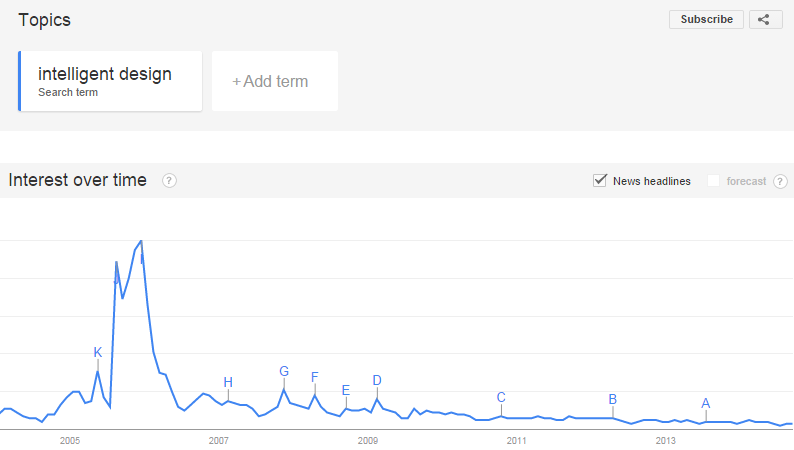
I don’t know if anyone is still following the Uncommon Descent blog, currently owned by lawyer Barry Arrington. It is supposed to be a blog dedicated to “Intelligent Design” – the idea that evolutionary theories are unable to account for the diversity of life on Earth. However, interest in ID has been on the wane since its peak around December 2005 (the run-up to the decision on whether ID is genuinely scientific).

Capture


Hat-tip – Rich Hughes

Continue reading

Obscurantism

The subject of obscure writing came up on another thread, and with Steven Pinker’s new book on writing coming out next week, now is a good time for a thread on the topic.

Obscure writing has its place (Finnegan’s Wake and The Sound and the Fury, for example), but it is usually annoying and often completely unnecessary. Here’s a funny clip in which John Searle laments the prevalence of obscurantism among continental philosophers:

John Searle – Foucault and Bourdieu on continental obscurantism

When is obscure prose appropriate or useful? When is it annoying or harmful? Who are the worst offenders? Feel free to share examples of annoyingly obscure prose.