Falsified scientific data, the book Whitewash
25

 (Sorry, Patrick, for stealing your meme.)
Let me begin with a little history. Continue reading
But I say to you who are hearing, Love your enemies, do good to those hating you, bless those cursing you, and pray for those accusing you falsely; and to him smiting thee upon the cheek, give also the other, and from him taking away from thee the mantle, also the coat thou mayest not keep back. And to every one who is asking of thee, be giving; and from him who is taking away thy goods, be not asking again; and as ye wish that men may do to you, do ye also to them in like manner; and — if ye love those loving you, what grace have ye? for also the sinful love those loving them; and if ye do good to those doing good to you, what grace have ye? for also the sinful do the same; and if ye lend to those of whom ye hope to receive back, what grace have ye? for also the sinful lend to sinners — that they may receive again as much. But love your enemies, and do good, and lend, hoping for nothing again, and your reward will be great, and ye shall be sons of the Highest, because He is kind unto the ungracious and evil; be ye therefore merciful, as also your Father is merciful. And judge not, and ye may not be judged; condemn not, and ye may not be condemned; release, and ye shall be released. Give, and it shall be given to you; good measure, pressed, and shaken, and running over, they shall give into your bosom; for with that measure with which ye measure, it shall be measured to you again.
– Some weird dude named Jesus. No wonder they killed Him.
Because no Christian organization has spoken out against Matt McLaughlin’s hate-filled initiative proposal “The Sodomite Suppression Act”.
It’s better known as the Kill the Gays Act. It begins with:
“The People of California wisely command, in the fear of God, that any person who willingly touches another person of the same gender for purposes of sexual gratification be put to death by bullets to the head or by any other convenient method.”
Look, anyone with the $200 filing fee and access to a typewriter or computer can submit an initiative proposal, so it’s not surprising that some dangerously deranged people start the process.
What’s surprising is that no christian leader, no christian-oriented news source, no official church spokesperson that I’ve heard, has repudiated McLaughlin’s despicable proposal.
Nor can they claim that they haven’t responded to it merely because it’s too minor to make the news. Kill the Gays has made all the major papers in the state. It is significant enough that it might trigger the CA state legislature to overhaul (finally!) the corruptible voter-initiative system. Also, it’s already involved in a court case with the state AG tying to pre-empt placing this clearly-unconstitutional initiative on the state ballot.
So, Christians, why are you silent? What would your beloved Jesus say if he witnessed you silently accepting MM’s murderous desire?
Petrushka writes:
There’s a rumor that all of aurelio smith’s posts at UD have disappeared. Big win for Winston Ewert.
I looked, and sure enough, Smith’s comments are all gone — even from his guest thread.
UD has sunk to a new low.
Is there such a thing as a fair die?
[Many thanks to Elizabeth Liddle, the admins and mods for hosting these discussions.]
Skepticism is a virtue, and gullibility is not. It seems to me many religious organizations throughout history prefer followers who follow blindly. Many churches fostered a culture of gullibility and were often led by sociopaths who preyed upon the gullible. Such experiences left a bad taste in my mouth to this day, and hence I’ve grown to have a high regard and admiration for the skeptical community. For those reasons I’m on more cordial terms with skeptics than most Christians are.
Continue reading
Sal Cordova mentioned Pascal’s Wager on the Randi thread, and I was surprised to find that there has never been a thread on that topic here at TSZ. Hence this OP.
Pascal was a brilliant guy, but his famous Wager is an irrational mess. (Religion can have that effect on otherwise bright people.) In the comments, let’s explain the Wager’s shortcomings to Sal.
To start things off, here is Wikipedia’s statement of the argument, using Pascal’s words:
http://web.randi.org/the-million-dollar-challenge.html
1.1 How long has this Challenge been open?
The Challenge was first introduced in 1964 when James Randi offered
1,000 to anyone who could demonstrate paranormal powers in a controlled test. The prize has since grown to One Million Dollars.
Continue reading
The WEDGIES are at it again, this time talking about NDEs (last time it was dreams producing CSI)
Heres’s the link:
and the old one
Both posted by Barry Arrington on NKendall’s behalf.
This thread is for commentary for those of us who can’t participate there.
If evolution is not a search, why is the term “evolutionary search” not an oxymoron?
Over at Uncommon Descent Elizabeth posted the following:
“…any “search” algorithm worthy of the name of “evolutionary search” comes with its own moderately smooth fitness landscape built in.”
So evolution is a search if it comes pre-built with its own moderately smooth fitness landscape built in?
Piotr, our esteemed associate, is a linguist. I admire the discipline of linguistics on many levels and some of my professional work has been in formal languages (computer languages, DNA languages). Noam Chomsky was noted for his contributions to computers, languages and psychology. Chomsky’s work was my first and only formal introduction to linguistics.
Continue reading
A long time commenter at UncommonDescent gives his opinion on ID’s position with regard to common descent:
The design inference is compatible with common descent and with universal common descent; a certain Michael Behe is a case in point on this. Common descent all the way up to universal common descent, is compatible with intelligently directed configuration of first life and of major forms thereafter including our own.
Yet in all my time learning about ID it’s never been clear to me, if that’s the case why are there not specific predictions from ID about what we will find in the fossil record?

Just thought I’d start a thread about my reappearance to save derailing this one!
Thanks to all who have been keeping the place busy in my absence! Things are still sticky for me, but I can smell a thaw!
Good guest post at Uncommon Descent by Aurelio Smith,
For those who prefer to comment here, this is your thread!

For me, the argument by Ewert Dembski and Marks reminds me of poor old Zeno and his paradox. They’ve over-thought the problem and come to a conclusion that appears mathematically valid, but actually makes no sense. Trying to figure out just the manner in which it makes no sense isn’t that easy, though I don’t think we need to invent the equivalent of differential calculus to solve it in this case. I think it’s a simple case of picking the wrong model. Evolution is not a search for anything, and information is not the same as [im]probability, whether you take log2 of it or not. Which means that you don’t need to add Active Information to an Evolutionary Search in order to find a Target, because there’s no Target, no search, and the Active Information is simply the increased probability of solving a problem if you have some sort of feedback for each attempt, and partial solutions are moderately similar to better ones.
Enjoy!
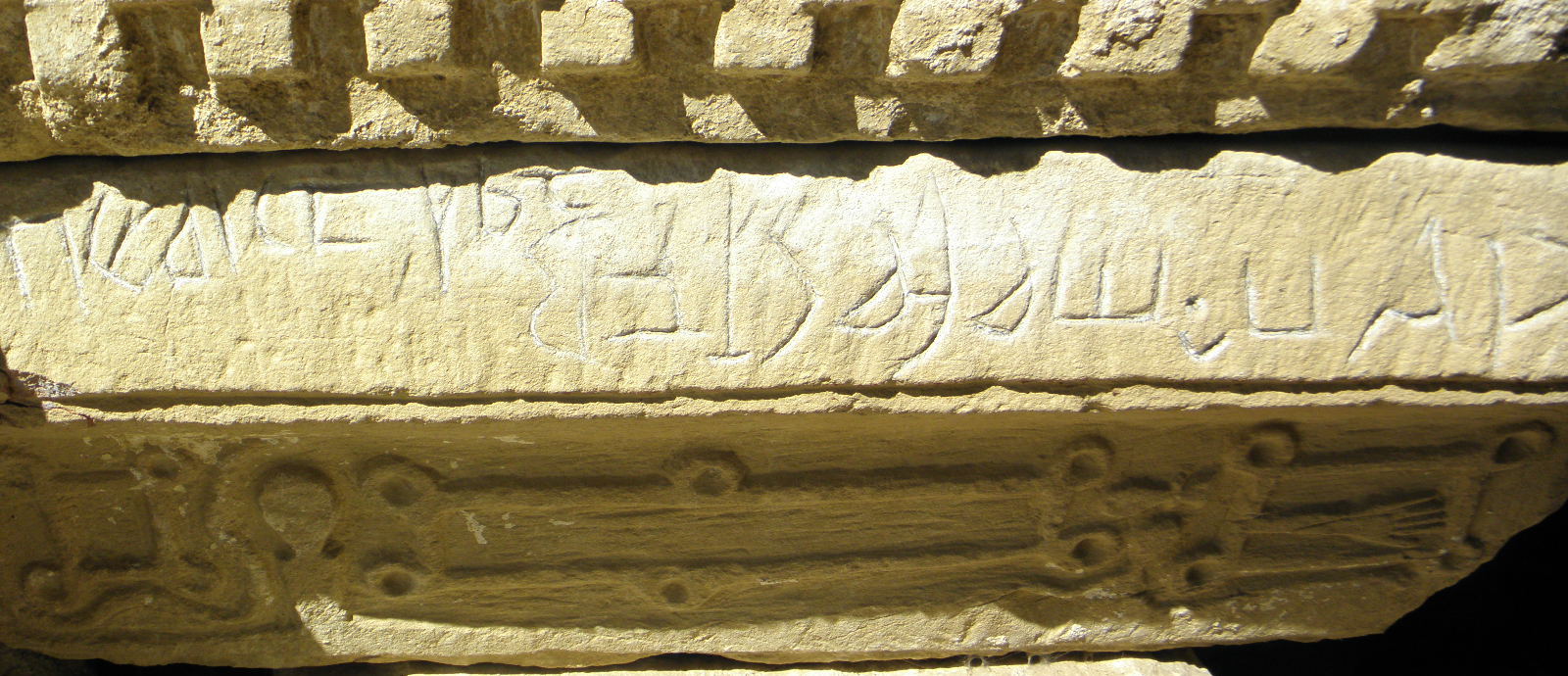
Intelligent Design proponents claim to be able to distinguish design from non-design. Here’s an easier task. Look at the inscription in the photograph. Is there any way to tell how old it is? I can tell you the stone turned up in an excavation in 1996 in the Pyrenees. Is there any way to tell if the marks are meaningful or gibberish?
A friend sent me a couple of links about the American mycologist, Paul Stamets. I’d not heard of this man or his ideas and, on the face of it, they seem either revolutionary or too good to be true. However, considering the recent suggestion that the herbicide, Roundup™, may be after all not so safe to use perhaps his ideas are worth exploring.
In what seems like a proof of Nietzsche’s Eternal Recurrence, the “is morality objective or subjective” debates are playing out yet again at UD.
Here, in 60 seconds or less, is why theistic objective morality doesn’t get off the ground:
[Results not guaranteed. May vary with individual reading speed.]
1. For objective morality to have an impact, we need to a) know that it exists, b) know what it requires, and c) know that we have reliable access to it. We don’t know any of those things.
2. Lacking access to objective morality, all we have left is subjective morality — what each person thinks is right or wrong. This is just as true for the objectivist as it is for the subjectivist.
3. Even if God existed and we knew exactly what he expected of us, there would be no reason to regard his will as morally binding. His morality would be just as subjective as ours.
