ChatGPT narrates TSZ

By now, many of you will have heard of ChatGPT. If you haven’t, be prepared — you’re going to hear a lot about it over the coming weeks and months.

ChatGPT is an artificial intelligence language model with an impressive ability to understand and generate humanlike text, drawing on a vast reservoir of knowledge gleaned from the internet. (It also makes stuff up, which can be a real problem.) It answers queries and can write stories, articles, computer code, and even (bad) poems. I don’t yet understand much about how it works, but when I learn more, I’ll describe it in the comments. Continue reading

Cockatoo intelligence and social learning

We’ve been underestimating birds for far too long. Here’s a great story about how Australian cockatoos have figured out how to open lidded trash bins and how the knowledge has been spreading through local populations via social learning. There are even regional cockatoo cultures which differ in which bin-opening technique the local birds use.

Crafty cockatoos master dumpster diving and teach each other

“Teach each other” is a bit of an exaggeration, but they do learn from each other. Continue reading

More arguments for the soul, examined

In the previous thread I examined (starting here) a couple of Richard Swinburne’s arguments for the soul, pointing out why I think they are flawed.

Because I find this stuff so interesting, I thought I would look for some more pro-soul arguments and open another thread to discuss them. This topic is important to a lot of people, particular those whose religious or spiritual beliefs invoke some concept of a soul or a soul-like entity. Continue reading

Did I lose my mind to science?

That’s the title of a new article at the Patheos website, which describes itself as “the world’s homepage for all religion”. The article is the first in a series by Ted Peters, emeritus professor of theology at Pacific Lutheran Theological Seminary, who understands the threat that materialism (aka physicalism) poses to traditional religious views regarding the self. Continue reading

USA: Eroding the separation of church and state is an ongoing bipartisan effort

First up, let’s agree that Christian Nationalism is a problem. Separation of church and state is a worthwhile principle. Also, laws instituted to guard this principle, such as that churches are considered tax-free non-profit organisations, as long as they do not participate in election campaigning, are good.
Continue reading

A Milestone (Millstone?) for Christianity in England and Wales

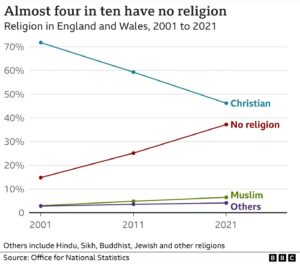
Results from the decennial census show that for the first time ever, fewer than half of English and Welsh citizens identify as Christian. The decline has been precipitous, as shown by the graph.

It appears that most of the Christians jumping ship end up in the ‘no religion’ category rather than converting to another religion. No data on how many of them still believe in a god or gods, or in a ‘higher power’. Also interesting that if established trends continue, the ‘no religion’ folks will become a majority in the not very distant future.

The graph comes from this BBC article.

Body, Soul, and Spirit

Some people consider the human to consist of a body with all other aspects to be derivative from this fundamental reality. Some people are more inclined to view the human as having a body and soul, with the soul being in some way primal.

I believe the human can be regarded as being composed of body, soul and spirit. But there are other ways of analysis other than seeing the threefold division.

Continue reading

What is a Woman?

Matt Walsh is asking this question in his new book and movie and getting a variety of answers it seems. Being a data driven science type guy, I like to start answering questions like this with observations. What observations can we make about women (and men) besides the obvious physical differences? Well if I had to characterize women vs. men over the whole scope of what we call history — the past 6000 years or so — I’d probably characterize women (contrasted with men) as generally … more nurturing, more empathetic, more emotional, more discerning, less creative / more maintaining … and men (contrasted with women) as generally … less nurturing more conquering / destroying, less empathetic, less emotional, less discerning, more creative / less maintaining. To summarize … I would say that Woman = Discerner / Revealer / Nurturer … Man = Maker / Conqueror / Destroyer. Of course these are generalities and there are definitely areas of overlap. Also, there will be debate as to WHY these differences exist. Some say it’s social conditioning and some say it’s more biological. What say you?

Anyway….

How are you all? How’s it been going?

I got diagnosed with an ocular melanoma in the middle of COVID which was a bit of a shock. It was discovered incidentally during an assessment for treatment of a complication of cataract surgery in the other eye.  Which was lucky, and I was treated very promptly, despite COVID restrictions, and all seems well, although it’s left me with somewhat impaired sight.

A momentous few years for us all, in small ways and large. It’s good to be back. The Evolution debates seem all a bit small scale in the face of climate breakdown and rising fascism, and yet again a serious threat of global nuclear war.

But good to see some familiar names still here. Thanks for keeping the penguins warm!

Extermination

Hi there

I’m Lizzie. I have no idea who is still posting here, but I’m the owner of the site. Alan Fox drew my attention to a recent post by Erik about LGBTQ+ people. I read it with growing horror, culminating when I arrived at these words:

 [LGBTQ+ people] exist sure enough and extermination is not the way to deal with them, but

“but”.

I set up this site as a venue in which people who wanted to discuss issues such as evolution, theism, and morality in good faith with people with who vehemently disagreed with them, could do so with minimal censorship.  I have been absent from the site for many years now, though I continue to pay the hosting fees.

I could simply delete Erik’s post. He would consider it “cancel culture”.  Yes, indeed I do wish to “cancel” those views from this blog. Committed as I am to uncensored discussion between people with radically opposing views (as exemplified in the original posting rules for the site) I will not provide a platform for articles that are Nazi-adjacent. I am deeply worried by the rise of right-wing fascism in the world, and I will not facilitate the propagation of such views.

No poster capable of considering, albeit rejecting, “extermination” as a “way to deal with” people like my own beloved daughter is welcome to post those views here. Every day I worry for her safety from people who want to exterminate her.

Alternatively, I could simply pull the plug on this site.

I will sleep on this. I would also welcome comments from any posters still active here. If there are hardly any left, I will probably do that last thing.

The Foundations Are Being Destroyed?

I was wondering what had happened to Uncommon Descent’s owner, lawyer Barry Arrington. Having bought the blog from “Intelligent Design” theorist* William Dembski, he established a reputation as a bit of a martinet, quick to delete comments and ban commenters he didn’t like. But recently, things have been much quieter and moderation has been light to non-existent, with no contributions from Arrington.

But he must have been saving himself up for a relaunch, as now a long (in comparison to Arrington’s other opening posts) post by him, What Must We Do When The Foundations Are Being Destroyed?, has appeared. I wonder initially who Barry means by “we” but the article soon makes it clear the call to arms is for the religious authoritarian right. It’s an annoying read as there is an inaccurate, misleading, selective point in almost every sentence so that, for me, it almost achieves the status of being so polarized in its essence as to be not worth responding to. But then that fulfils Barry’s prophesy and puts me on his level, on the other side of the barricade he is keen to erect.

Continue reading

Water Explains God?

I’ve been commenting at Uncommon Descent recently, initially because Upright Biped had reappeared there promoting his semiotic theory and I felt he wasn’t getting the response he needed. Upright Biped then withdrew but I haven’t been able to resist the urge to continue to chip in.

The discussions there often are dominated by right-wing religious commenters and I think it is only right, and good for them, to rattle their cages to challenge their assumptions, misconceptions, and misrepresentations. So when someone posted that life had to be more than chemicals as chemicals were random, I felt obliged to point out that chemical reactions are decidedly not random. I gave the example that hydrogen and oxygen, when mixed and a spark supplied, will react in exactly the proportion of two hydrogen atoms linking to one oxygen atom to form one molecule of water.

Imagine my surprise when a regular, BA77, misunderstood my point, thinking I was saying water is simple, and went off on a long diatribe to claim water’s admittedly strange and fascinating emergent properties are evidence for “Intelligent Design” (i. e. God). I find the claim unconvincing.

Here is the link to BA77’s comment.

Suffering

Many atheists argue that if God existed, He would not allow all the suffering that goes on in the world. And many theists believe in an omnipotent God without thinking more deeply about what this entails.


In Steiner’s lecture “The Origin of Suffering” he refers to Aeschylus who is quoted as saying, ““wisdom comes through suffering”. (A reading of the lecture can be heard here.)

And from a commentary on Aeschylus by Duane W. Krohnke, a Christian and an active member of Minneapolis’ Westminster Presbyterian Church:


The chorus in Agamemnon, a famous play by the Greek playwright Aeschylus (circa 525/524 BC—circa 456-455 BC) makes the following statement (in English translation):
“He who learns must suffer. And even in our sleep pain, which cannot forget, falls drop by drop upon the heart, until, in our own despair, against our will, comes wisdom through the awful grace of God.”

Continue reading

Why Virus Denial Is Wrong

Does this even need saying? That I should even feel moved to write this post, in this day and age, seems extraordinary. But an increasing number of people are latching onto the hoary old idea that there is no such thing as a virus – that viroloigists have been studying an artefact all this time; a product of the organism rather than an entity hijackiing host biology in order to spread between hosts.

Continue reading

Personal Gods and the Problem of Empty Toilet Paper Tubes

Another essay from my collection. Of note, this one was inspired by another poster on one of the sites I used to visit, however I don’t recall the poster’s name or what site this originally came up on. I’d like to give that poster credit for the original concept, so if the subject here rings a bell and you know who posted the idea previously, let me know. The essay is a more fleshed out and greatly elaborated take on the concept. _________________________________

I was brought up as an Episcopalian and went to church nearly every Sunday between the ages of about five through about fifteen. I recall many sermon topics and biblical teachings, but the topic that seemed to come up more frequently than others is the concept of a personal God. Certain priests and laypeople really gravitated to the idea that God was available on a personal level and claimed outright (and reiterated many times) that God wanted to have a personal relationship with everyone. This, of course, was coupled with the idea that God was also an all loving God. So, not only did this God want to hang out as buds, but in theory wanted the best for those folk it hung out with. Kind of like an invisible friend, but with the added bonus of being…well…Almighty. I confess, I really loved the idea of having God as a personal friend who was…well, in theory…really much cooler than any of my human friends. As you might imagine, I started to become a little annoyed and rather disillusioned when said supposed cool friend never actually did anything…well…cool. In fact, after a number of years it became quite clear (and rather disappointing) that this God didn’t do anything personal, at least not with me.

Continue reading

I’m Special

Now that more folk seem to have come out of the woodwork, I thought I’d put this essay up.

______________________________________

I used to hold the idea…the belief if you will…that I was following the “right” religion. I was Episcopalian, a devout Christian, and I believed Jesus was my savior. And of course, pretty much everyone around me at the time confirmed that yes, this was not only an accurate, acceptable way of thinking, but more importantly it was TRUE and the only CORRECT way of thinking! To contrast it, I (well…really…“we”, that is, the congregation in the church I went to) were reminded from time to time that “others” who did not accept such were not only wrong, but (and admittedly this was someone softened in many cases, which I now find rather odd) DAMNED! So, in other words, for years I bought into the idea that “I’m Special” because, of course, I was one of God’s chosen, loved, and forgiven people and…well…there were other folk who…well…weren’t.

There are a number of the things I find particularly head-slapping about this thinking when I look back on it now: the arrogance of it, for one, and the conceit, for two, but mostly the ridiculous anthropocentrism.

Continue reading

Choices, choices, choices…

Another essay from my collection to chew on. Enjoy!


The Bible, the Quran, the Vedas, the Torah, and a good many other holy works all describe situations in which God/gods chooses things. When I’ve asked, most religious people have no problem with deities in general, and their specific God in particular, having choices and making decisions. In not a few cases, people have looked at me like I had lost my mind or that I was definitely impaired in some manner even asking such a ridiculous question.

To me, however, the idea that a god, particularly an omni-god, could even understand the concept of choice, let alone actually make a decision, is nonsensical. Continue reading