Pesky EleP(T|H)ant

Over at Uncommon Descent KirosFocus repeats the same old bignum arguments as always. He seems to enjoy the ‘needle in a haystack’ metaphor, but I’d like to counter by asking how does he know he’s not searching for a needle in a needle stack?

There is then of course much smugness and back-pating, along with “Notice some chirping crickets?”

Well, let’s see what happens in an environment where crickets aren’t moderated or banned…

Genes in Conflict

On the Counterintuitive evolutionary truths thread, I expressed amazement at the sheer number of distinct kinds of intragenomic conflict that have been discovered by science.  In response, Allan Miller recommended the 2006 book Genes in Conflict, by Austin Burt and Robert Trivers. Burt’s name is unfamiliar to me, but Trivers is famous for proposing the theory of reciprocal altruism.

I ordered the book (23 on the Kindle and28 for the paperback), and so did Gralgrathor, so I thought it would be nice to have a discussion thread for the book as we read it. Anyone is welcome to join in, of course, whether or not you are reading the book.

ID’s grand quest

Scordova has posted something that caught my attention at UD.

William Dembski:

It’s up to ID proponents to demonstrate a few incontrovertible instances where design is uniquely fruitful for biology. Scientists without an inordinate attachment to Darwinian evolution (and there are many, though this fact is not widely advertised) will be only too happy to shift their allegiance if they think that intelligent design is where the interesting problems in biology lie.

Continue reading

Hypoxia – 4 of spades

At UD this claim was made:

Neither rocks nor human brains dream. Only the mind/soul dreams. The human body is a diving suit, specifically designed to be operational by conscious/subconscious intent – meaning, an individualized consciousness (mind/soul) can use it to functionally operate in the physical world. A rock has no such capacity for service.

I have to wonder how what this video depicts can be squared with that.

Hypoxia – 4 of spades

During hypobaric chamber, or altitude chamber training, #14 displayed symptoms of hypoxia, after exceeding his time of useful consciousness (TUC).

Continue reading

Stuck between a rock and an immaterial place

Kairosfocus has a new OP at UD entitled Putting the mind back on the table for discussion. His argument begins thus:

Starting with the principle that rocks have no dreams:

Reciprocating Bill points out that since KF denies physicalism, he has no principled basis for denying the consciousness of rocks:

If the physical states exhibited by brains, but absent in rocks, don’t account for human dreams (contemplation, etc.) then you’ve no basis for claiming rocks are devoid of dreams – at least not on the basis of the physical states present in brains and absent in rocks. Given that, on what basis do you claim that rocks don’t dream?

Needless to say, KF is squirming to avoid the question.

I’ve got popcorn in the microwave.  Pull up a chair.

Pinker: The Sense of Style

http://whyevolutionistrue.wordpress.com/2014/06/09/pinker-discusses-his-new-book-on-edge/

Steven Pinker is about to release a new book on writing. I’m holding my breath.

When you write you should pretend that you, the writer, see something in the world that’s interesting, that you are directing the attention of your reader to that thing in the world, and that you are doing so by means of conversation.

That may sound obvious. But it’s amazing how many of the bad habits of academese and legalese and so on come from flouting that model. Bad writers don’t point to something in the world but are self-conscious about not seeming naïve about the pitfalls of their own enterprise. Their goal is not to show something to the reader but to prove that they are not a bad lawyer or a bad scientist or a bad academic. And so bad writing is cluttered with apologies and hedges and somewhats and reviews of the past activity of people in the same line of work as the writer, as opposed to concentrating on something in the world that the writer is trying to get someone else to see with their own eyes.

If I were running a forum, I would ask posters to follow Pinker’s rules for writing.

A thread for William J Murray to unpack the alternatives to “materialism/physicalism/naturalism”

William has taken exception to the current state of science and its ‘overreach’.

He claims, “IMO, all that is left of materialism/physicalism/naturalism is really nothing more than a hidden (even subconscious) anti-theistic agenda.”

This is a thread for William to guide us in a detailed exploration of the alternatives, their mechanisms, how we might test them and how we might benefit from them.

on how to reconcile evolution, creation and intelligent design

<video snipped on request>


From the video description:

<redacted> TEDx presentation speaks to the debate over innovation of ideas specifically regarding evolution, creation and intelligent design. He asks whether or not science can have the courage to work together with philosophy and religion or worldview to discover where humanity is headed and presents the idea of human extension as a way to promote human dignity, cooperation, altruism and flourishing instead of Darwinian dehumanisation, conflict and struggle.

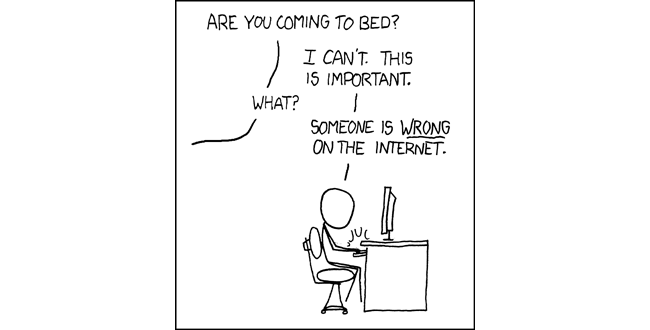
I Don’t care If You Are Wrong

Just some random, unorganized thoughts regarding the recent hostilities.

1. I don’t care if you are wrong.
2. Your disagreeing with me does not diminish my life.
3. I have no need to beat you into submission.
4. If I disagree with you, I would like to know why you believe what you believe.
5. I would like for you to understand my position, and I appreciate any effort you make to understand me.
6. To these ends I will ask questions designed to probe our differences.
7. If you don’t or can’t respond to my satisfaction, I will try to accept the impasse and move on.
8. These are more what you’d call “guidelines” than actual rules.

Roger Scruton on altruism

I’ve just started reading philosopher Roger Scruton’s new book The Soul of the World, in which he defends the transcendent against the scientific conception of reality. Chapter 3 contains an interesting but wrong-headed argument to the effect that evolutionary explanations of human altruism are superfluous, because altruism can be explained perfectly well in moral terms. It’s particularly interesting in light of our discussions on the Critique of Naturalism thread, so I thought I’d share it:

An organism acts altruistically, they tell us, if it benefits another organism at a cost to itself. The concept applies equally to the soldier ant that marches into the flames that threaten the anthill, and to the officer who throws himself onto the live grenade that threatens his platoon. The concept of altruism, so understood, cannot explain, or even recognize, the distinction between those two cases. Yet surely there is all the difference in the world between the ant that marches instinctively toward the flames, unable either to understand what it is doing or to fear the results of it, and the officer who consciously lays down his life for his troops.

Continue reading

“The Ascent of Man”, Forty Years On

In the late 1960’s, the British Broadcasting Corporation commissioned Jacob Bronowski to prepare a television series entitled “The Ascent of Man”. Apparently, the series was meant to be a scientific bookend to Kenneth, Baron Clark of Saltwood in the County of Kent OM CH KCB FBA’s “Civilisation” series, which was an historian’s view of how we ended up where we are.

Bronowski’s series aired across the world (and even this benighted high-school student watched it gobsmacked in Brisbane, Australia). Bronowski died in 1974, not long after the series was published. He also wrote a “book of the series”, which came out in 1973 (it is one of my treasured possessions, moth-eaten as it is).

A brief biography:

Jacob Bronowski was born in 1908 into a Jewish family in the Polish city of Lodz. His parents moved to Britain in 1920 and Bronowski pursued his senior studies in mathematics at Cambridge University. He later studied and conducted research in physics. He taught at the University College of Hull during the 1930s. During the Second World War, he conducted research on the effectiveness of Allied bombing campaigns, culminating in being part of a British Government survey of the results of the attack by the United States on Hiroshima and Nagasaki. As a result of his experiences in Japan, he turned from physics to biology to try to understand the nature of violence in humans.

His subsequent career includes many writings on what knowledge means: he concerned himself with the epistemological question of “what can we reliably know?”. The Ascent of Man series seems to have been his attempt to answer this question.

(I may have his history wrong, in which case, I apologise).

If you wish to see what he said in the series, fragments of the Ascent of Man series are available on Youtube via a search for “Bronowski Ascent of Man”.

My question is this:

Now, after forty years, how much did Bronowski get right?

My personal view is that Bronowski is mostly right. My version of his argument is that we construct useful knowledge out of a combination of imagination and observation. Science is philosophy (what can be) constrained by evidence (what is).

I am interested to know what this community thinks about Bronowski’s work, with the benefit of forty years of hindsight.

(my thanks to Gregory for alerting me to my misattribution of the “Civilisation” series to Sir Arthur C Clarke CBE FRAS).


Language: evolution or design?

Humans are both very like and very different from other species we find on Earth. At the sub-cellular and biochemical level, the similarities, the almost universality of the DNA code and its property of self-duplication and storage of genetic information is breathtaking. On the other hand, no other species has succeeded in the scope and breadth of it’s colonization of this planet.  Much of the “success” in growing a population that now exceeds seven billion individuals can be attributed to our being a social species.  Sociability and its evolutionary roots have been well studied. However there does seem to be something missing. The rapid runaway expansion of human culture and the extraordinary flowering of human art, which might be attributed in turn to the literal expansion of the human brain seem to require further explanation. Continue reading

The argument from Upright Biped

I note Barry Arrington, Uncommon Descent’s president, owner and legal defender is promoting a commenter,  the pseudonymous Upright Biped, not unknown to regular participants here. Not one OP but two (so far) glowing posts. Upright Biped has convinced himself, and (let’s be fair) some others, that he has come up with a knock-down argument against origin-of-life theories that take a purely reality-based approach.

The latest OP entitled UB Strikes Again! ends with the rejoinder “AVS, where are you? You’re letting down your side. Come on back and tell UB why he’s wrong!”

This seems somewhat disingenuous. Why should it be left to an anonymous self-described “biochemistry student” to fight against the might of Barry’s moderation and Bipeds weighty argument (that can be summarized as “a miracle happens, therefore design”)?

It’s already been done. Why should AVS need to renvent the wheel? I’d like to remind Barry that there is plenty of material blowing Upright Biped’s argument out of the water but I am unable to comment at Uncommon Descent. Maybe someone who still can would like to draw Barry’s and Biped’s attention to the fact that there are quite a few folks who’d like to tell UB why he’s wrong.

A Critique of Naturalism

The ‘traditional’ objections to a wholly naturalistic metaphysics, within the modern Western philosophical tradition, involve the vexed notions of freedom and consciousness.   But there is, I think, a much deeper and more interesting line of criticism to naturalism, and that involves the notion of intentionality and its closely correlated notion of normativity.

What is involved in my belief that I’m drinking a beer as I type this?  Well, my belief is about something — namely, the beer that I’m drinking.  But what does this “aboutness” consist of?   It requires, among other things, a commitment that I have undertaken — that I am prepared to respond to the appropriate sorts of challenges and criticisms of my belief.  I’m willing to play the game of giving and asking for reasons, and my willingness to be so treated is central to how others regard me as their epistemic peer.  But there doesn’t seem to be any way that the reason-giving game can be explained entirely in terms of the neurophysiological story of what’s going on inside my cranium.  That neurophysiological story is a story of is the case, and the reason-giving story is essentially a normative story — of what ought to be the case.

And if Hume is right — as he certainly seems to be! — in saying that one cannot derive an ought-statement from an is-statement,and if naturalism is an entirely descriptive/explanatory story that has no room for norms, then in light of the central role that norms play in human life (including their role in belief, desire, perception, and action), it is reasonable to conclude that naturalism cannot be right.

(Of course, it does not follow from this that any version of theism or ‘supernaturalism’ must be right, either.)


Why Would Anyone Care?

http://www.foxnews.com/us/2014/05/02/maine-teenagers-deny-animal-cruelty-charges-alleging-put-kitten-in-running/

A few months ago we had a discussion of whether non-human animals can be the subject of morality.

Over on UD, Mung opined that animals are meat robots, incapable of suffering.

EDIT: Wrong UD poster. Mapou, not Mung. Apologies.

The Myth of the Continuum of Creatures: A Reply to John Jeremiah Sullivan (Part Two)

Apparently the Bible neglects to mention the possibility that animals can be the subject of morality, or that torturing animals can be a sin. But some IDists have declared that torturing babies is self-evidently wrong.

So is microwaving kittens self-evidently wrong? Or self-evidently okay, because it isn’t forbidden by scripture? What Would William Do? Or Mung? Apparently we have secular laws against this. Why?

I’d like to ask this at UD, but I can’t.