Remember when I said that you can’t have genes switching on and off without a code, and how the sequence of DNA wasn’t the only code Keiths?
Read and learn:
http://www.businessinsider.com/scientists-improve-understanding-of-dna-folds-2016-6
Remember when I said that you can’t have genes switching on and off without a code, and how the sequence of DNA wasn’t the only code Keiths?
Read and learn:
http://www.businessinsider.com/scientists-improve-understanding-of-dna-folds-2016-6
Seems like this new thing in the Atlantic’d be up y’all’s alley:
http://www.theatlantic.com/science/archive/2016/06/how-consciousness-evolved/485558/
A New Theory Explains How Consciousness Evolved
Michael Graziano
Ever since Charles Darwin published On the Origin of Species in 1859, evolution has been the grand unifying theory of biology. Yet one of our most important biological traits, consciousness, is rarely studied in the context of evolution. Theories of consciousness come from religion, from philosophy, from cognitive science, but not so much from evolutionary biology. Maybe that’s why so few theories have been able to tackle basic questions such as: What is the adaptive value of consciousness? When did it evolve and what animals have it?

The talkrational.org logo
On May 23, the Talkrational database experienced a crash that left the post table broken. Our Web Host, Arvixe, farted around for several days and let the last good backup of the database be overwritten with the borked version.
They’ve been singularly useless at recovering the database, but I have some slender hopes that we may be able to fully or partially recover the post table without their “assistance”. osmanthus, one of our members who knows a lot of peeps in the forum tech world has reached out to some database experts who would like to try to resuscitate the database.
Every student of philosophy knows how to draw up the lists of primary and secondary qualities: on the left go extension, size, shape or figure, solidity, motion or rest, and number; on the right go color, sound, scent, taste, heat and cold. But what is the principle of the distinction? Does it have to do with objective versus subjective? Categorical versus dispositional? Intrinsic versus extrinsic? Or several or none of these?
I hope this starts a lively discussion. Be thankful I didn’t do the Social Justice post I was going to!
A very interesting blog post by William Dembski:
The old Dembski returns — the one was an old earth creationist before his run-in with Southwestern Baptist Theological Seminary.
I don’t find this surprising. I never really believed his capitulation to the fundamentalists. It always looked like saving his job rather than changing his beliefs.
Still, I found the post quite interesting. And maybe it will give some folk something better to do than flinging poo at Dawkins’ software.
Richard Dawkins has made his programs from The Blind Watchmaker and Climbing Mount Improbable available via a web browser interface.
Sadly for our friends at Uncommon Descent, the Weasel is not included.
I hope I will be forgiven for abusing the term “skepticism” here — for what I have in mind is not a perfectly innocuous “claims require evidence” epistemic prudence, but rather Cartesian skepticism.
According to the Cartesian skeptic, one can be perfectly certain about one’s own mental contents and yet also be in total doubt about what really corresponds to those mental contents. Hence she needs an argument that will justify her belief that there is any external reality at all, and that at least some of her mental contents can correspond to it.
There are many responses to Cartesian skepticism, and here I want to pick up on one strand in the pragmatist tradition that, on my view, cuts deepest into what is wrong with Cartesian skepticism.
I think that one cannot talk, in any intelligible sense, about justification in the first place without also committing oneself to a belief in other minds with whom one shares a world. (Not that I like that way of putting it — “a belief in other minds” is a much too intellectualistic interpretation of the myriad ways in which we experience the sentience of nonhuman animals and the sentience-and-sapience of other human animals.)
If the DNA codes primarily for proteins and helps regulate protein quantities, then where is the developmental or structural information? I’ve never gotten a straight answer from most evolutionists I’ve encountered, for that matter anyone on planet Earth. Maybe no one really knows. I think Creationist biologist Arthur Jones is right about Non-DNA inheritance.
Continue reading
This Strawson piece just appeared in the NY Times.
It’s a position that I found attractive long ago. FWIW, I preferred Strawson’s father as a philosopher but I give the son some credit for consistently pushing this position for years. (IIRC, correctly, he also has no sympathy for compatibalism, and is an old-fashioned hard determinist.
What do y’all think?
There has been much discussion, here and elsewhere, on ‘epigenetics’, broadly understood as the control of gene expression. People who cling to ‘classical’ models are portrayed, by revolutionaries and their cheerleaders, as dinosaurs standing in the way of progress.
I could perhaps explain, to any interested bystander, my own rationale for my position, since I’ve requested that of others. Continue reading
Any sufficiently convoluted explanation for biological phenomena is indistinguishable from epigenetics.
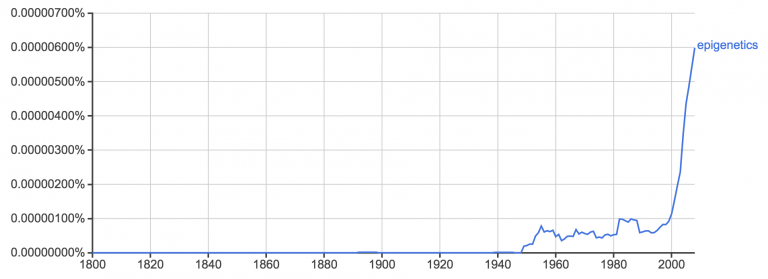
Use of the word “epigenetics” over time
A few times I’ve referred to my view about “the God question” as “radical agnosticism.” I thought it might be fun to work through what this means.
For the purposes of this discussion, by “God” I shall mean follow Hart’s definition of God as “the one infinite source of all that is: eternal, omniscient, omnipotent, omnipresent, uncreated, uncaused, perfectly transcendent of all things and for that very reason absolutely immanent to all things” (The Experience of God, p. 30).
Next, I shall stipulate that our assertions about the world fall into two classes: those that take a truth-value in all possible worlds and those that take a truth-value only in the actual world. This is a contemporary version of “Hume’s Fork”: there are “relations of ideas”, “truths of reason”, analytic a priori claims and then there are “matters of fact”, “truths of fact,” synthetic a posteriori claims. (There are some reasons to be skeptical of this neat distinction but I’ll leave that aside for now.)
Whether or not God exists would therefore seem to be either a “truth of fact” or a “truth of reason”. I shall therefore now argue that it cannot be either.
The intelligent-design movement is, by design, a big tent accommodating almost everyone who has something to say against “Darwinism.” How kooky is too kooky for admission? Well, the Raelian movement’s Message from the Designers may be out, but the Unification Church’s message from Moon is definitely in.
Evolution News and Views (ENV), ID’s blog of record, is consequently a wellspring of incoherence. It recently posted a lame argument by geneticist Wolf-Ekkehard Lönnig that survival is “too random” for natural selection to “work.” Geneticist (of high renown) Joe Felsenstein has just responded at The Panda’s Thumb. He mentions that the Discovery Institute also released a podcast interview of Lönnig. Checking it out, I find this teaser by David Klinghoffer, the editor of ENV: Continue reading
A Facebook friend of mine is a conspiracy nut. She was tagged in a post by a friend of hers, so up in my ‘news’ feed comes a post offering incontrovertible evidence that persistent contrails are in fact chemical spraying of the populace or the planet for nefarious purposes. I was dimly aware of this notion but was taken aback when encountering such people in the (virtual) flesh. Continue reading
I thought this article in the current New Yorker might generate some interesting discussion here.
http://www.newyorker.com/magazine/2016/05/02/breakthroughs-in-epigenetics
Would naturalism insist 500 fair coins 100% heads on a table could not possibly emerge from a random process (like random coin flipping)? How about a buzzillion fair coins being 100% heads after an explosion from a terrorist event at a bank? If naturalism won’t exclude such improbable events (events statistically indistinguishable from miracles), then naturalism doesn’t exclude miracles.
Continue reading
From the Center for Skeptical Inquiry:
The Foundation for Thought and Ethics, the non-profit which once published the internationally controversial textbook Of Pandas and People, has quietly closed its doors. The financially-struggling organization was completely dissolved some time in early 2016, and its titles have been absorbed by the notorious Intelligent Design group, The Discovery Institute.
More details and commentary on Pandas at the above link.
http://www.nature.com/news/evolution-of-darwin-s-finches-tracked-at-genetic-level-1.19795
“But their still Finches! Checkmate Evolutionists!”
Or some similar comment. But whatever. Still a very cool study.