Merry Kitzmas!

December 20th, 2015 is the tenth anniversary of the decision in Tammy Kitzmiller, et al. v. Dover Area School District, et al. 

Judge Jones (a Bush-appointed Republican) wrote a 139-page legal opinion which can be summarized thus: 

Teaching intelligent design in public school biology classes violates the Establishment Clause of the First Amendment to the Constitution of the United States (and Article I, Section 3, of the Pennsylvania State Constitution) because intelligent design is not science and “cannot uncouple itself from its creationist, and thus religious, antecedents.”

wikipedia article, side bar 

Despite the precedent set by Kitzmiller/Dover, creationist and Intelligent Design advocates continue to battle to remove teaching of evolution from public schools and to protect teachers who insert biblical creationist or ID speculations into science classes.

I found this interesting essay in response to our current “friend” John West from 2007, when JW applauded passage of Louisiana creationism law.

All sorts of laws advance secular purposes—that’s what laws are supposed to do, and the Constitution assumes as much—but no law may advance a merely religious purpose under the Constitution. Thus those who lobby for law to advance a religious purpose are indeed under a disadvantage, one traceable to the Constitution itself,which purposely erects a roadblock in the path of those who would want to use the government to propagate a religion. It does not erect a similar roadblock to those who would use the government for secular purposes[see essay for footnote], whether it be to set up a fire department, or run the U.S. Army, or the Post Office, or whether it be to teach students about biological science. It is therefore perfectly valid for a secularist to attack the religious motivations of her political opponents, while simultaneously rallying her own political supporters to secularism.

Timothy Sandefur

I think it’s particularly interesting that Sandefur identifies the non-symmetry between trying to advance religious purposes and trying to advance secular ones, which I know many religious people mistake.

Happy anniversary, y’all

Being

Three powerful commentaries on the nature of our existence:

The first is a BBC programme called The Secret Life of Waves.  My father, who died earlier this year, was very keen that we should all watch it, and it helped us hugely after his death, to know that this was what he thought, and wanted to share with his children and grandchildren.

https://www.youtube.com/watch?v=Kmllm1dAug4

The second is a lecture someone introduced me to recently by Alan Watts, It Starts Now.

Continue reading

Are we in a war?

Barry Arrington, owner of the pro-ID blog, Uncommon Descent is alleged to have written the following in an email to a contributor:

We are in a war. That is not a metaphor. We are fighting a war for the soul of Western Civilization, and we are losing, badly. In the summer of 2015 we find ourselves in a positon very similar to Great Britain’s position 75 years ago in the summer of 1940 – alone, demoralized, and besieged on all sides by a great darkness that constitutes an existential threat to freedom, justice and even rationality itself.


In this thread I don’t want to discuss the rights and wrongs of the email itself, nor of whether or not TSZ constitutes a “great darkness”.  Barry is entitled to decide who posts at UD and who does not; it’s his blog.

What interests me is the perception itself, which I suspect is quite widely shared.

Continue reading

Pastor Hates Jesus after Reading Coyne’s Book

Bruce Gerencser was a pastor for 27 years until he started reading books with non-Christian viewpoints. One of the 5 most influential books in his conversion to atheism was Jerry Coyne’s book, Why Evolution is True. Bruce’s kids are no longer evangelicals and left the faith that he once taught them. He openly says he hates Jesus now.

Continue reading

Unyielding Despair

Gregory has made the connection more than once between atheism and despair. But he wasn’t the first.

That Man is the product of causes which had no prevision of the end they were achieving; are but the outcome of accidental collocations of atoms; that no fire, no heroism, no intensity of thought and feeling, can preserve an individual life beyond the grave; that all the labours of the ages, all the devotion, all the inspiration, all the noonday brightness of human genius, are destined to extinction in the vast death of the solar system, and that the whole temple of Man’s achievement must inevitably be buried beneath the debris of a universe in ruins — all these things, if not quite beyond dispute, are yet so nearly certain, that no philosophy which rejects them can hope to stand. Only within the scaffolding of these truths, only on the firm foundation of unyielding despair, can the soul’s habitation henceforth be safely built.

– Bertrand Russell. A Free Man’s Worship

I’m thankful that my foundation is not one of unyielding despair.

The philosopher who finds no meaning in the world is not concerned exclusively with with a problem of pure metaphysics; he is also concerned to prove that there is no valid reason why he personally should not do as he wants to do, or why his friends should not seize political power and govern in the way that they find most advantageous to themselves.

– Aldous Huxley. Ends and Means

I am also thankful that I do not believe that there is no valid reason why I personally should not do as I want to do, and that my friends have no desire to seize political power and govern in the way that they find most advantageous to themselves.

Innate dualism and intimations of eternal life

Excerpts from a new article at Aeon by Natalie Emmons:

We see faces in the clouds and we might just see Jesus in our toast: the fact that we see anyone at all tells us that the human mind is actively searching for agents, even in the most ambiguous of situations.

…Bering and his colleagues set their sights on what psychologists call ‘intuitive mind-body dualism’ as an alternative…The study deliberately included a cluster of children too young to have been exposed to much religious testimony at all, to see whether even they had an inkling that a part of an individual survives death.

Continue reading

A Minimal Materialism

From Victor Reppert:

I am convinced that a broadly materialist view of the world must possess three essential features.

First, for a worldview to be materialistic, there must be a mechanistic base level.
Second, the level of basic physics must be causally closed.
Third, whatever is not physical, at least if it is in space and time, must supervene on the physical.

This understanding of a broadly materialistic worldview is not a tendentiously defined form of reductionism; it is what most people who would regard themselves as being in the broadly materialist camp would agree with, a sort of “minimal materialism.”

To the atheists:

Some of you know you’re materialists, some of you suspect it, others try to deny it or don’t like to be identified as such. But if you’re an atheist what else do you have?

The Cosmological Argument

I am currently working my way through the book A Natural History of Natural Theology: The Cognitive Science of Theology and Philosophy of Religion.

There is already a thread here dedicated to the book, but I decided to separate the thesis of the book from the actual natural theological arguments themselves. The evidence that the premises upon which these natural theological arguments rest are natural and intuitive are the subject of that thread.

In this thread I’d like to explore how the cosmological argument for the existence of God is presented in the book and provide a place where these cosmological arguments can be examined and criticized.

Continue reading

Is Religious Belief Natural?

Questions about the existence and attributes of God form the subject matter of natural theology, which seeks to gain knowledge of the divine by relying on reason and experience of the world. Arguments in natural theology rely largely on intuitions and inferences that seem natural to us, occurring spontaneously — at the sight of a beautiful landscape, perhaps, or in wonderment at the complexity of the cosmos — even to a non-philosopher.

Continue reading

The apparently absent,…

…non-interactive, invisible, silent, hidden, indifferent, concealed Designer

I cringed when I heard an IDist say something to the effect, “we use forensic science all the time to infer design, and this same science demonstrates an Intelligence made life”. The problem is forensic science identifies designs made by humans (or something human like). People generally believe some designer made Stonehenge because they see humans making comparable designs all the time. Many IDists don’t seem to appreciate invoking a never-seen designer poses a challenge for accepting design in biology.
Continue reading

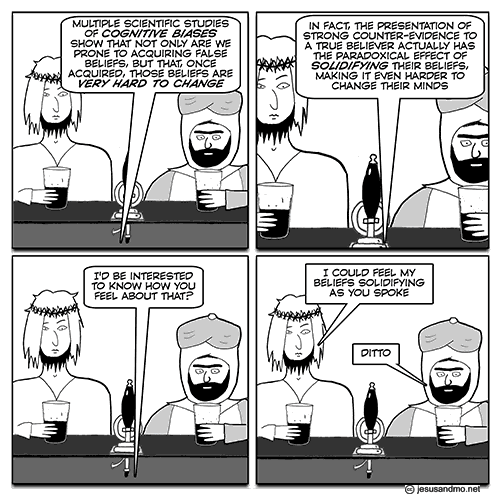
A rather topical Jesus and Mo today

Although I have to say, the adage that “you can’t reason a man out of beliefs he hasn’t reasoned himself into” always struck me as a load of cobblers.  Growing up is, to me, a process of discovering that what you always believed was true ain’t necessarily so.  But I’m sure it gets harder as you get older.