
Paul Nelson, Evolution, or Design ?

Source link

Paul Nelson, Evolution, or design ? I transcribed it for who is too lazy to see the video, but its worth to watch, a great speech:

Thanks to another reader, I have gotten a copy of McDonald’s actual paper. Reading it, I wonder how many of the Discovery Institute authors have actually read it. How many have just taken what one of their fellows said previously and done what most 10th grade students do for research papers (i.e. change a few words in an attempt to avoid plagiarism).

By adding their own interpretation of the prior authors work (using secondary sources instead of primary sources), quite a bit of error has crept in. I’m sure it’s just a bit of error, we all know that no creationist would say something that wasn’t true, especially if he is quoting an actual scientist’s paper.
No, I can’t do it, that level of sarcasm is too much for me. These people are liars. Either they are directly lying in order to make someone appear to say something that they actually didn’t or they are the worst researchers ever and shouldn’t be allowed to write non-fiction. Which is it creationists?

Spontaneous Generation

A century later we know that the overwhelming obstacle facing spontaneous generation is probability, or rather improbability, resulting from life’s enormously complex phenotypes. If even a single protein, a single specific sequence of amino acids, could not have emerged spontaneously, how much less so could a bacterium like E. coli with millions of proteins and other complex molecules? Modern biochemistry allows us to estimate the odds, and they demolish the spontaneous creation of complex organisms.

Looks like IDists aren’t the only ones to appeal to probability arguments. How does Wagner know what the probabilities are, or that spontaneous generation is even within the realm of what is possible?

Continue reading

Creationism’s best friend has died

It was not merely Judge John E. Jones who ruled against teaching “intelligent design” (ID), a thinly veiled surrogate for “creation science,” in public schools. The citizens of Dover, Pennsylvania, exercised the power of the ballot to ensure that their city did not appeal Kitzmiller. If the case had reached the Supreme Court of the United States, the justices possibly would have split 5-4 in favor of allowing public schools to teach ID.

Today ID lost its prospect of winning in the Supreme Court: Justice Antonin Scalia, Known For Biting Dissents, Dies At 79. As noted in the Wikipedia article on Edwards v. Aguillard (1987), in which the court nailed shut the coffin of creation science,

Justice Antonin Scalia, joined by Chief Justice William Rehnquist, dissented, accepting the Act’s stated purpose of “protecting academic freedom” as a sincere and legitimate secular purpose. They construed the term “academic freedom” to refer to “students’ freedom from indoctrination”, in this case their freedom “to decide for themselves how life began, based upon a fair and balanced presentation of the scientific evidence”.

Has quite a familiar ring, doesn’t it? The rhetoric of the ID movement was designed by a law professor, Phillip Johnson, to suit a creationism-friendly judge of the Law of the Land. This is indeed a sad day for ID, which already had acquired a moribund pallor.

Darwin Day

Even on his birthday, don’t say Darwin unless you mean it

How Darwin’s name is taken in vain, with mini-reviews of some of the worst offenders

Don’t say Darwin unless you mean it. Above all, don’t say “Darwin” when you mean “evolution”. It’s like saying “Dalton” when you mean atoms. Our understanding of atoms has moved on enormously since Dalton’s time, and our understanding of evolution has moved on similarly since Darwin’s. Neither of them knew, or could have known, the first thing regarding what they were talking about, and both would be delighted at how thoroughly their own work has been superseded. (Dalton of course deserves further discussion in his own right, which I will be providing in a few weeks time.)

DaltonsAtoms

From John Dalton’s A New System of Chemical Philosophy (1808)

Imagine if a lot of people decided that atomic theory was against their religion. We would see a parallel world of sacred science, in which molecules were “intelligently constructed”, and real chemistry would be referred to as Daltonism, or possibly, these days, neo-Daltonism. The scientific dissidents from Daltonism would invoke Dalton’s name on every possible occasion, and draw attention to the many inadequacies of atomic theory as he presented it in 1808.

The Big numbers game: Fine Tuning

The big numbers game: Fine Tuning

Creationist fine tuning claims are incomprehensible. I know certain physicists argue for cosmological fine tuning (I’m not sold, for reasons I may discuss later). I believe the claims we’ve seen lately are far removed from any serious claim of fine tuning, and reflect a lack of comprehension of physics or basic math by those that use them.

Here’s a typical claim: “The force of gravity is determined by the gravitational constant. If this constant varied by just one in 10^60 parts, none of us would exist.” (1). You will find this claim repeated in the UD comments section, and even their own glossary of definitions (2-5). Creationists love it, because the big numbers, to them, mean impossible, therefore God. Right?

But wait. Humans have only measured the gravitational constant “big G” to parts per million accuracy (with variations between measurement methods at hundreds of parts per million (6)). So, using Chem 101 terminology, the statement above says that we know a constant to about 6 significant figures, but if the value was different at the digit 54 decimal past the frontier of human understanding, we’d be hosed. Where did this precise value come from? What math-a-magics creates precision from fine air?

Continue reading

Chargaff Parity Rule 2, Biased/Non-Random Mutations

There is an approximate 8% excess of Adenine and Thymine above random in the DNA of humans. This suggests mutational bias and/or non-random mutation. If 3 billion coins were found to be 58% heads vs. 42% tails, then the chance hypothesis of a random unbiased coin flip would be easily rejected. The odds of such an event happening are astronomical according to the binomial distribution.

But such an imbalance is reflected in the human genome where:
Continue reading

Genetic Algorithms: When Drift Overcomes Selection

I often encounter posters here at TSZ who claim that Genetic Algorithms (GAs) either model or simulate evolution. They are never quite clear which it is, nor do they say what it means to model or simulate evolution (what would be required) and how GAs qualify as either one or the other. My position is that GAs neither model nor simulate evolution. In addition to other reasons I’ve given in the past I’d like to present the following argument.

GAs are often used to demonstrate “the power of cumulative selection.” Given small population sizes drift ought to dominate yet in GAs drift does not dominate. Why not?

Continue reading

The Discontinuity of Nature

Typology is perfectly consonant therefore with descent with modification. Each cladogram is witness to descent with modification and the existence of distinct Types. The modifications are novel taxa-defining homologs, acquired during the process of descent along a phylogenetic lineage, each of which defines a new Type.

– Denton, Michael. Evolution: Still a Theory in Crisis

I repeat, Michael Denton accepts common descent is is not a Creationist. My original thread has been inundated with scoffing and mocking and young earth creationism, all of which are far removed from the subject matter of Denton’s latest book. Trying again.

Continue reading

KF tackles the transfinite

Veteran TSZers may recall an entertaining thread in which a bunch of us tried to explain the cardinality of infinite sets to Joe G:

A lesson in cardinality for Joe G

At UD, commenters daveS and kairosfocus are now engaged in a long discussion of the transfinite, spanning three threads:

An infinite past can’t save Darwin?
An infinite past?
Durston and Craig on an infinite temporal past…

The sticking point, which keeps arising in different forms, is that KF cannot wrap his head around this simple fact: There are infinitely many integers, but each of them is finite.

Continue reading

Still a Theory in Crisis

Michael Denton’s new book is out, Evolution: Still A Theory In Crisis.

Denton’s stance is for structuralism and against functionalism, especially as functionalism appears in it’s current form as the modern synthesis or neo-Darwinism (the cumulative selection of small adaptive changes).

Denton argues for the reality of the types, that “there are unique taxon-defining novelties not led up to gradually from some antecedent form” and that the lack of intermediates undermines the Darwinian account of evolution. He also argues that a great deal of organic order appears to be non-adaptive, including “a great number of the taxa-defining Bauplans,” and that this also undermines the Darwinian account of evolution. Evo-devo is also showing us that “Darwinian selection is not the only or even the main factor that determined the shape and main branches of the great tree of life.”

Continue reading

George Ellis on top-down causation

In a recent OP at Uncommon Descent, Vincent Torley (vjtorley) defends a version of libertarian free will based on the notion of top-down causation. The dominant view among physicists (which I share) is that top-down causation does not exist, so Torley cites an essay by cosmologist George Ellis in defense of the concept.

Vincent is commenting here at TSZ, so I thought this would be a good opportunity to engage him in a discussion of top-down causation, with Ellis’s essay as a starting point. Here’s a key quote from Ellis’s essay to stimulate discussion:

However hardware is only causally effective because of the software which animates it: by itself hardware can do nothing. Both hardware and software are hierarchically structured, with the higher level logic driving the lower level events.

I think that’s wrong, but I’ll save my argument for the comment thread.

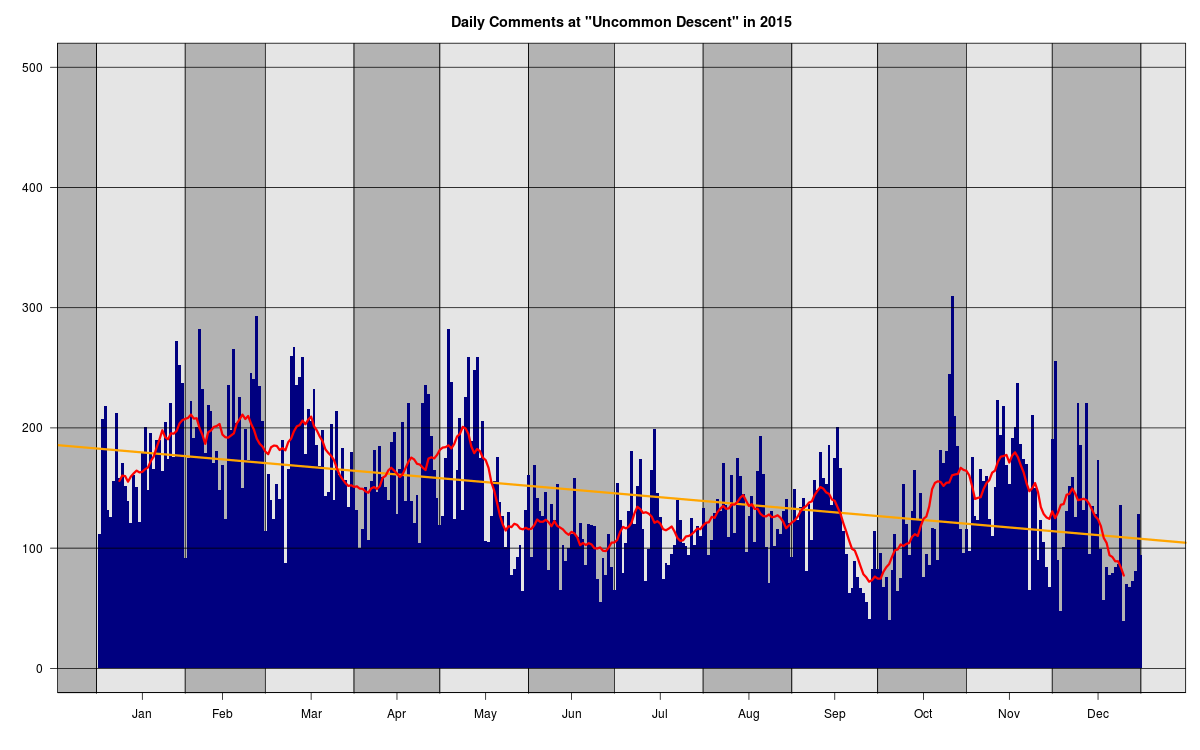
“Uncommon Descent” and “The Skeptical Zone” in 2015

(crossposted from here and here)

(Edited Feb 2, 2016 to add eight figures)

Since 2005, Uncommon Descent (UD) – founded by William Dembski – has been the place to discuss intelligent design. Unfortunately, the moderation policy has always been one-sided (and quite arbitrary at the same time!) Since 2011, the statement “You don’t have to participate in UD” is not longer answered with gritted teeth only, but with a real alternative: Elizabeth Liddle’s The Skeptical Zone (TSZ). So, how were these two sites doing in 2015?

Number of Comments 2005 – 2015

year 2005 2006 2007 2008 2009 2010 2011 2012 2013 2014 2015
UD  8,400 23,000 22,400 23,100 41,100 24,800 41,400 28,400 42,500 53,700 53,100
TSZ  2,200 15,100 16,900 20,400 45,200

In 2015, there were still 17% more comments at UD than at TSZ – 53,100 to 45,200.

UD-2015-02

Though UD is still going strong, there is a slight downwards trend (yellow line) in the daily number of comments.
Continue reading

How and Why: questions for scientists and philosophers?

The late John Davison often remarked that science could only answer “how” questions, not “why”. It seems to me philosophers, perhaps I’m really thinking of philosophers of religion rather than in general, attempt to find answers to “why” questions without always having a firm grasp on how reality works. Perhaps this is why there is so much talking past each other when the explanatory power of science vs other ways of knowing enters a discussion. Continue reading

Conservation and function of long noncoding RNAs

How about some cool science as we head toward the weekend?

Let’s talk about long noncoding RNAs (lncRNA) – they are (somewhat arbitrarily) defined as stretches of DNA that are at least 200 base pairs in length that are transcribed into mRNA but have little potential to code for proteins. Determining the function (if one exists) of a particular lncRNA can often be difficult.  In part, this may be due to the fact that lncRNA evolve much more quickly than protein-coding genes do and therefore exhibit a much smaller degree of sequence conservation, which can make identifying orthologs in other related organisms more difficult.  Nevertheless, if a particular lncRNA is functionally important, we would usually expect to see copies of it in related organisms, so finding these homologs can be an important indicator of function.

A new paper in Genes and Development by Quinn et al. is a useful demonstration of this.  The authors find evidence of 47 homologs of roX, an lncRNA involved in X chromosome dosage compensation,  across 35 fruit fly species.  The researchers identity roX homologs based on a combination of short regions of sequence conservation (“microhomology”), RNA secondary structure and synteny (i.e., similarity in location along a chromosome)  Here is the abstract (I believe the paper itself is open access): Continue reading

Christiantoday.com sides with UMC against the DI / ID.

Here’s the article in full:

Christian Today Article

The best bit?:

….However, the UMC has taken the view – expressed though it is in dusty legalese – that in allowing the promotion of intelligent design at its conference would to connive at something which is, not to put too fine a point upon it, not true.

In this respect, it is surely right. It’s always possible to find things about life and its development that evolutionary theory has not yet succeeded in explaining. To argue from this that the answer must be “God did it” is ultimately self-defeating. Science advances, the number of unknowns diminishes, and God is driven into a smaller and smaller space accordingly. This “God of the gaps” approach has long been discredited.

The UMC appears to have taken the view that giving a platform – no matter how small – to a view as mistaken as this undermines the credibility of the gospel because it encourages people to believe things that aren’t true. Building a faith around falsehood is putting people’s souls in peril. The Discovery Institute may not like it, but the UMC is surely right to stand its ground.

(format not the same as the original). Thoughts?

The Reasonableness of Atheism and Black Swans

As an ID proponent and creationist, the irony is that at the time in my life where I have the greatest level of faith in ID and creation, it is also the time in my life at some level I wish it were not true. I have concluded if the Christian God is the Intelligent Designer then he also makes the world a miserable place by design, that He has cursed this world because of Adam’s sin. See Malicious Intelligent Design.
Continue reading

Excilience and Contextomy

consilience. : the linking together of principles from different disciplines especially when forming a comprehensive theory.

contextomy. : an informal fallacy and a type of false attribution in which a passage is removed from its surrounding matter in such a way as to distort its intended meaning. Quote mining.

excilience. : the linking together of Contextomies from different disciplines especially when forming a comprehensive theory. Thought mining.

The Quote Mine Project provides excellent examples of contextomy. Uncommondescent provides excellent examples of excilience.

The practices lend themselves to all kinds of humorous incongruities. Among them are:

1. free will vs predestination
2. deism vs interventionism (Michael Denton vs Michael Behe)
3. front loading vs twiddling (Mike Gene vs gpuccio, etc.)
4. ascentism vs degenerationism (Chardin vs Sanford)
5. old earth vs young earth
6. realism vs last thursdayism
7. biblical literalism vs inspirationism

There are probably a lot more, but these come up frequently. The humor comes from observing that the armies of ID clash by night, without ever mentioning or discussing their differences and their contradictory assumptions and conclusions.

Food for discussion.