Question for discussion:
Is mathematics more fundamental than logic, or vice-versa? Neither? Or is it more complicated?

Question for discussion:
Is mathematics more fundamental than logic, or vice-versa? Neither? Or is it more complicated?
In a new post at UD, Denyse O’Leary quotes an article from The Scientist (which she misattributes to Science):
Populations of Escherichia coli grown in the lab quickly evolve tolerance when exposed to repeated treatments with the antibiotic ampicillin, according to a study published today (June 25) in Nature. Specifically, the bacteria evolved to stay in a dormant “lag” phase for just longer than three-, five-, or eight-hour-long treatment courses, before waking up and growing overnight until the next round of treatment began.
On the Counterintuitive evolutionary truths thread, I expressed amazement at the sheer number of distinct kinds of intragenomic conflict that have been discovered by science. In response, Allan Miller recommended the 2006 book Genes in Conflict, by Austin Burt and Robert Trivers. Burt’s name is unfamiliar to me, but Trivers is famous for proposing the theory of reciprocal altruism.
I ordered the book ( 28 for the paperback), and so did Gralgrathor, so I thought it would be nice to have a discussion thread for the book as we read it. Anyone is welcome to join in, of course, whether or not you are reading the book.
In the Roger Scruton on altruism thread, some commenters have expressed confusion over the evolutionary explanation of altruism in ants. If workers and soldiers leave no offspring, then how does their altruistic behavior get selected for?
Kairosfocus has a new OP at UD entitled Putting the mind back on the table for discussion. His argument begins thus:
Starting with the principle that rocks have no dreams:
Reciprocating Bill points out that since KF denies physicalism, he has no principled basis for denying the consciousness of rocks:
If the physical states exhibited by brains, but absent in rocks, don’t account for human dreams (contemplation, etc.) then you’ve no basis for claiming rocks are devoid of dreams – at least not on the basis of the physical states present in brains and absent in rocks. Given that, on what basis do you claim that rocks don’t dream?
Needless to say, KF is squirming to avoid the question.
I’ve got popcorn in the microwave. Pull up a chair.
Religion is notorious for requiring and valorizing faith. Consider the story of Doubting Thomas, or this bit of “infallible” dogma that every Roman Catholic is required to believe:
<video snipped on request>
From the video description:
<redacted> TEDx presentation speaks to the debate over innovation of ideas specifically regarding evolution, creation and intelligent design. He asks whether or not science can have the courage to work together with philosophy and religion or worldview to discover where humanity is headed and presents the idea of human extension as a way to promote human dignity, cooperation, altruism and flourishing instead of Darwinian dehumanisation, conflict and struggle.
I’ve just started reading philosopher Roger Scruton’s new book The Soul of the World, in which he defends the transcendent against the scientific conception of reality. Chapter 3 contains an interesting but wrong-headed argument to the effect that evolutionary explanations of human altruism are superfluous, because altruism can be explained perfectly well in moral terms. It’s particularly interesting in light of our discussions on the Critique of Naturalism thread, so I thought I’d share it:
An organism acts altruistically, they tell us, if it benefits another organism at a cost to itself. The concept applies equally to the soldier ant that marches into the flames that threaten the anthill, and to the officer who throws himself onto the live grenade that threatens his platoon. The concept of altruism, so understood, cannot explain, or even recognize, the distinction between those two cases. Yet surely there is all the difference in the world between the ant that marches instinctively toward the flames, unable either to understand what it is doing or to fear the results of it, and the officer who consciously lays down his life for his troops.
At UD, Eric Anderson has a new OP entitled
No-one Knows the Mind of God… Except the Committed Atheist
It’s the same argument we’ve heard so many times before. Here are a few excerpts:
When is the YEC God no longer the YEC God? That question came up in my recent thread on methodological naturalism and accommodationism. In that thread I argued that science falsifies the YEC God, because it shows definitively that the earth is about a million times older than the YECs believe. If the earth is old, then the YEC God doesn’t exist. There might still be a God, but not the YEC God, because the YEC God necessarily created the earth a short time ago. Otherwise, it wouldn’t be “the YEC God” at all!
Robin and Petrushka objected because they didn’t see “the YEC God” as being essentially YEC. In other words, they saw “the YEC God” as referring to a God who would still be the same God even if it turned out that he hadn’t created the universe several thousand years ago.
Some of you may be familiar with the infamous Jack Chick tract Big Daddy?, in which a sweaty, arrogant atheist professor with a hideous combover is defeated by a young, earnest Christian student with a side part.
If so, then this trailer for the new movie God’s Not Dead will seem eerily familiar:
https://www.youtube.com/watch?v=bMjo5f9eiX8
I saw the movie a few weekends ago, and I’ll post my thoughts in the comment section. Meanwhile, enjoy!
Many critics of Intelligent Design and creationism are methodological naturalists – that is, they believe that supernatural topics are off-limits to science, and that science is inherently unable to pass judgment on religious claims.
It’s time to start a continuation thread for Split-brain patients and the dire implications for the soul, because the original thread is being affected by a software bug. Only the final page of comments is affected. Continue reading
Barry’s latest post at UD has the title Biology Students Score Below Religion and Classics Students on Test of Critical Thinking. Unsurprisingly, it’s Barry who actually flunks the critical thinking test.
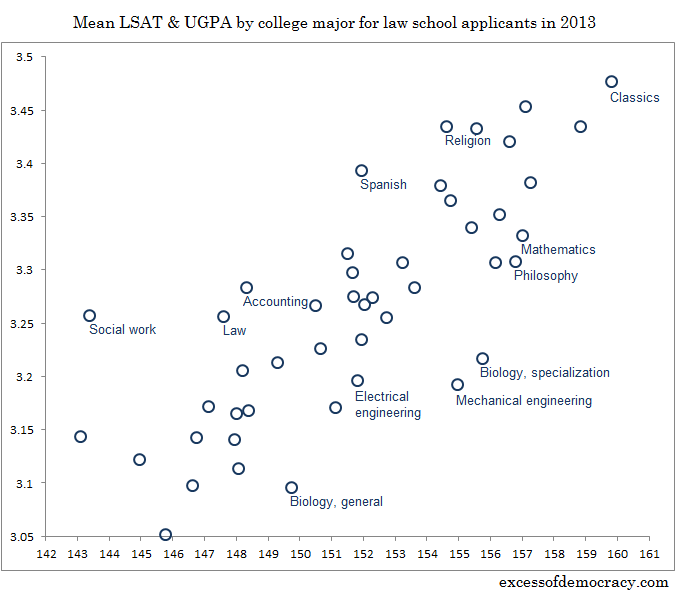
(Click graph for a bigger version)
Folks who believe in an immaterial soul (also known as ‘substance dualists’) face a daunting challenge. Why, if our mental and emotional functions are carried out by the immaterial soul, are they so completely affected by changes to the physical brain?
Alvin Plantinga is widely regarded as one of the world’s leading Christian philosophers. Watch the video below and ask yourself, WTF?
So as not to spoil your fun, I’ll refrain from offering my take on the argument until readers have had a chance to comment.
In his recent post, Alan Fox mentions Samuel Johnson in defense of the existence of external reality. He is referring, of course, to Johnson’s famous criticism of Berkeley’s idealism as described by Johnson’s biographer, James Boswell:
At UD, Sal asks:
When I watched the Ken Ham vs. Bill Nye debate, I lamented, “Why Lord do we not have an Isaac Newton of today defending your creation?” In years gone by, Christians were at the forefront of intellectual advancement in science, technology, medicine, literature, art, music, etc. I lamented, “dear Lord, why has this happened? Why do you defend your Word and the testimony of your creation this way? Wouldn’t the world be inclined to believe if you raised up someone like Newton to defend creation in the present day?”
A bizarre new post at UD had me checking the date to make sure it wasn’t April 1st.
In it, commenter ‘nullasalus’ explains that although he doesn’t think the multiverse is plausible, he nevertheless thinks “it’s a good idea, from an ID perspective, to accept and take part in multiverse speculations,” and offers these four reasons, which I have quoted verbatim:
1. If we live in an infinite multiverse, Intelligent Design is no longer a possibility – it is a certainty.
2. While Intelligent Design becomes a certainty (at least somewhere), Darwinism becomes obsolete and obscure.
3. Theism becomes true on the spot – specifically, polytheism.
4. If ID proponents embrace the multiverse, there’s a good chance the scientific community will drop it like a hot potato.
That last one is especially funny. Enjoy!